Ageism is a large part of the funeral industry and is something actually encouraged by the industry. Many regard it as a minor thing, not even an issue and completely write it off. However, it has a direct and indirect negative impact on companies and individuals.

Showing posts with label discrimination. Show all posts
Showing posts with label discrimination. Show all posts


2012-04-11
Sexism in the Funeral Industry: A case study of W.N.Bull
You can read my previous post on sexism in the industry by clicking here.
It should be noted that these devisions and many of these policies are not official or written anywhere, and there have (apparently) been exceptions. However they are strickt policies I personally saw actively put into practice regularly at WNBull. So while not official they do exist and do influence the company heavily in many ways.
The 'garage staff' go out on funerals, they do the transfers, prepare coffins, prepare bodies and do all the physical work or driving. This is not sexist itself as it is the role of garage staff, they are the ones who do the physical work and the funeral labour. However what makes it sexist is that garage staff are always male. Women are not allowed to be, or assist, garage staff at WNBull. the garage staff also have a very informal uniform (while mostly optional) while not on a funeral or transfer. The two groups are primarily defined and identified by sex such as "the boys in the garage". And as such all physical labour, even office related, is done by the garage staff. Even simple and easy tasks as taking the post up are almost always done by the garage staff.
The 'office staff' never go out on funerals (except two who I will get to later). They are the arrangers who go out to family homes and arrange the whole funeral with the family, then they are baned from attending the funeral itself. This causes a tension amongst the staff who get to know a family and assist them in arranging their loved ones funeral and then do not get to see it in action. They never see the fuit of their work. It also means they have no experience of how WNBull operates as they have never seen a funeral by WNBull and do not know about certain procedures or places. An example is a couple of times inappropriate chapels have been booked at crematoriums, either a chapel that is way too small or way too big, because the arranger simply does not know how big or even where that chapel is. One must wonder why the office staff cannot, must not, go on funerals if it would help them with the job emotionally and professionally. It is simply because they are women, all office staff are always women at WNBull and always older. There is a strickt and almost official policy that the office must be staffed by women, except for the superior who is a guy that has been with the company for too many years to count.
Garage and office staff do not mingle much, there is a physical separation between the two groups. For example there are two lunch rooms, one for office staff and one for garage staff and despite being quite close to each other they are very separate and prevent interaction between the two groups. When an office staff member did join the garage staff in their lunch room it made the boss obviously unhappy and uneasy. The boss actually poked her head into the lunch room and made note of the mixing of the staff. At WNBull one can go without seeing the other group of staff for a good week or more. This in itself is not really sexist, but because of the division of gender between garage and office staff it becomes very sexist.
Sexism is prevalent in many policies that are not in themselves sexist. These policies become sexist because of how they are excited and their very reason for existence. A great example of this is the policy expressly banning women from wearing pants. The women at WNBull must always wear a long skirt of dress and are not allowed to go out on funerals, which is also related to being office staff. These policies do not apply to the boss who is female, she is usually seen wearing pants and not just going out on funerals but also conducting them. It is obvious that the boss does this to deliberately appear separate, more important, than the other staff. The rules do not apply to her as she makes them and is above them. She literally wears the pants among the women. There is a lot of evidence to support this from her need to control everything and inability to delegate to her constant desire for power shown through changing things for the sake of it and stating her beliefe in "the power of the pencil" when referring to her her ability to make decisions about WNBull and the staff.
This only serves to highlight the divide between staff and create a negative rift. The women see how it is quite possible for a woman to go on (and conduct) funerals and how wearing pants can be acceptable. Yet they are not allowed to do either and actively punished if they even discuss doing so. Here a 'power display' policy becomes sexist in how it forces women to do something unnecessary because they are women.
Naturally there are staff who do have a foot in both the garage and office. To be a conductor at WNBull you must also be an arranger (but not necessarily the other way around). And the arrangers are office staff, thus all the conductors in the garage are also office staff. However they are not seen as proper office staff or even 'real office staff' or real arrangers. As such I came to divide the conductors into 'garage conductors' and 'office conductors' which, was based primarily on sex. I witnessed several important arranger meetings that the conductors were not able to attend and as such they missed key information. The office has a 'round up' meeting every morning for its arrangers, which the conductors are extremely rarely part of. Only once did I see a garage conductor attend a round up meeting in the whole year I was there. Instead it was only the 'office conductors' who attended regularly out of all the conductors. These office conductors are the office superiors (who as I discussed earlier he is the only male who works primarily in the office) and the boss (who as I discussed before is the only female allowed on funerals or to wear pants).
There are also certain preferences and special treatments towards staff based on their placement as 'garage' (or male) and 'office' (or female). Not only are the office staff freed from physical work, due to being both women and office staff, but they are also given things first. A few times baskets were sent by pleased mourners, company contacts or others and always they were opened in the office and very rarely shared with the garage staff. One particular example is of when a mourner sent a fruit basket to thank the funeral staff (who are the garage staff) for what a great job they did on the funeral. This basket was opened and distributed in the office to those who had no part in the funeral. The garage staff only found out because someone found the card. Yet the office staff do not get all the perks, the garage staff get to go out, get to have free food on funerals and get to see a funeral from start to finish. The office staff who often work on the funeral never see it pan out, never see the result of their work and as such have surprisingly low satisfaction for their work at WNBull.
The physical separation of the two groups of staff and the different ways the groups are treated creates a rift between staff. People who would quite like each other do not know one-another. All they see is two groups based primarily on sex and how the other group is treated better because of it. The women do not have to do anything physical and the men get to go on funerals.
As a result the staff themselves become sexist even though they are not actually sexist. It was interesting, and worrying, how people became part of such a sexist and prejudice system. The women in the office start assigning all physical tasks and roles to the men without realising, such as physical ones. The men started to foster attitudes of women, such as that women were not as good at driving as men or that the women were more likely to fight amongst themselves. What should be noted is that the staff were actually not sexist (at least for the most part). The garage staff believed the women to be capable to go funerals and the office staff believed the men to be capable of working in the office. Yet they all fell into sex rolls and assigned sex rolls without realisation or hesitation. The staff at WNBull became part of the sexist machine.
~~
2012-04-06
Sexism in the Funeral Industry
Firstly 'sex' is a specific term different from but related to gender. Sex is the physical characteristics of a person, whether they are physically male or female. There are exceptions to this, such as those who are born with both sets of gentiles or those who possess DNA for one gender and yet gentiles of the other. For example a woman was found to have XY chromosomes and not XX even thought she was physically female. Gender on the other hand is the psychological characteristics and definition, whether that person think of themselves as male, female or another option. For example someone may be physically male but see themselves as a woman. But for the purposes of this post I am looking strictly at physical male and female or peoples sex and how this is played out in the funeral industry.
There is a difference between noticing differences between sexes and sexism itself. Sometimes we should take note of the differences and to not do so is instil poor form and inappropriate if not discrimination. The funeral industry, while rarely strenuous, is often very physical. Undertakers have to slide whole bodies about, moved and manipulate these bodies to dress them, move empty coffins and then carry 'filled' coffins. An average lighter wood coffin is about 20kg, an average body is 50-70kg. The combination of these is a fair bit of weight that needs to be carried, sometimes a great distance over bad terrain. Quite honestly women are not as strong as men, as just about anyone should realise. It is not just about size, as men are generally larger, but also to do with proportions and distributions. For example women have more of their weight in their hips while men have more of their weight in their upper body. There are stories of coffins being dropped by all female undertakers (although this is very rare). And companies such as White Ladies are always all female (although this is not always the case behind the scenes), they are not allowed to have a guy or two just help to carry the coffin. This would make it much easier and safer on difficult jobs. We should acknowledge and take into account physical differences (and other related) between the sexes. To do so would not be sexist but practical. To not do so is in itself sexist as they are dividing the staff based on sex and yet not taking into account actual differences between the sexes.
As for the funeral industry it is full of sexism and specific roles based on sex. Take InvoCare for example. InvoCare is a perfect model of modernity and democracy. Everyone is equal and accountable at InvoCare, even state and national managers. The system is extremely efficient and operates much like any other modern corporation. As such anyone is eligible for promotion or a job based on performance. InvoCare could not care less about religion, race, sex, gender or any classification that is not related to the task. So they are quite willing and able to promote women as equally as men based on their individual performance. This is good in that they do not resort to prejudice against women or affirmative action for women. One might think that affirmative action allows discriminated groups to get a leg up and become equal, yet it does the opposite. It is the equivalent of saying that group is incapable and needs to be assisted by the other, better, group. In terms of this argument that women are not capable of getting a promotion themselves and thus need special help from men to do so. The other issue with affirmative action is that just like prejudice it judges a person based on a general classification. That the candidate is not an individual with their own pros and cons but as (in this case) a woman or a man and should be evaluated as such. Thankfully InvoCare does not do this and has no affirmative action policies or practices (as far as I know). Instead they look to the individual and evaluate them as a person rather than as a general group. Having said this most people at the top of InvoCare are men, women have resided at the top but only one or two. This is the same with most of the academic world where women do become a smaller minority the higher one looks. But this is not necessarily due to a glass ceiling in that field or company. As with InvoCare it is due to the current social system. We participate in sex roles which impact our career. For example women are more likely to take time off if a child is sick to care for the child. Men are more likely to focus on work than family. Thus the minority of senior women at InvoCare is not because of InvoCare but because of society. As such InvoCare is not sexist towards in evaluating and assessing employees, it is too efficient to care for thing such as sex.
However InvoCare is sexist in its use, role assignment and branding of employees. They segregate and discriminate against certain genders and advertise these sexes as being better at certain tasks because of their sex. Despite the fact that these tasks or attributes are not influenced by gender or sex. An example of this is the whole idea behind White Ladys (an all female company), the company slogan is "a woman's understanding" and display images of a woman smelling a flower with a soft white background such as figure 1. below. Lets look at some images of the staff from the White Ladys website.
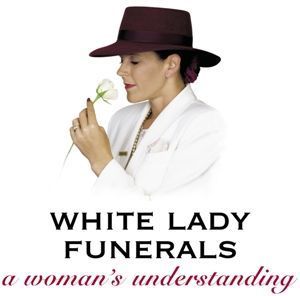 |
| Fig 1. The main photo for White Lady advertisements and promotions. This photo can be found on almost everything related to the company. |
 |
| Fig 2. The staff at White Ladys. |
 |
| Fig 3. Assisting a child. |
 |
| Fig 4. Assisting mourners. |
It is clear that they are actively portraying women as gentle, emotional and understanding, able to empathise strongly with the mourners and the deceased. In most images the women are interacting directly with mourners assisting and empathising with them such as in figure 3 and figure 4. In other images they are depicted as friendly and welcoming such as with figure 2. Another thing to note is how the emphasis is on what they are doing or are like rather than who they are. It is difficult to see their faces and identify them as the focus is elsewhere. There is an unspecified emphasis in old fashioned sex roles here. The women are all shown to be 'mothering' or 'nurturing', the way they are looking after the people, the way the tagline refers to understanding. We should also note that they are all wearing skirts and white clothing. The skirts are not really practical for the industry as there is a lot of awkward movement and bending needed and yet it is the company uniform. The white is another strange thing as it would get dirty easily and obviously. An undertaker can often and easily find themselves kneeling in the dirt to get a better grip on the coffin at a cemetery. So a white uniform with a skirt is a strange choice for this type of job. This only highlights the importance on identifying and emphasising the sex of the worker over the role of the worker. White lady employees are female before they are undertakers.
Now lets look at pictures of Guardian funerals, another big name for InvoCare which is mostly staffed by men. There are no pictures of the staff, well, one but it is irrelevant as it does not show the staff at work and too small to be worth looking at. There are no pictures on any other InvoCare company websites of the staff at work. In other words InvoCare has based a whole company of White Ladys on the staff, on the sex of the staff. So they must show how it is operated by women and why this is beneficial. I have however found images of Guardian staff in physical advertisements so they do show the staff. In these images the staff are always shown as formal and professional. They might be smiling and friendly but they are never shown to be doing or interacting like the women at White Ladys. This creates an unsaid and implicit message that men are not as gentle, emotional and do not empathise with others as much. The men in InvoCare owned companies are depicted as professional (posing formally in dark suits) while the women are depicted as emotional (posing casually in white suits and often smiling). There are obvious and strict roles between the genders in InvoCare advertising and policy.
Certain companies (which I will not name but are not InvoCare related) have very overt sexist policies. For example they have a strickt policy of women must always be at the foot end on a transfer or when moving/manipulating a body. This is because the foot end of a body has very little weight. Most of our wight (about 60-80%) is above the hips. So having the guy at the head end means he will bear most of the weight making it easier for the woman. While this is taking into account sex differences which is not sexist their policy itself is sexist in the way it deals with these differences. It assumes that all (or at least most) women are not capable or should not be involved in moving much weight. There are many situations where this is un-necessary, pointless or stupid. Such as with a child where there is little weight at any end, or if the guy has an injury and while able to work should not strain himself. Plus it puts all the strain on the men and none on the women, swapping ends every now and then makes things easier in the long run. Instead due to this general policy women always end up with the easier job while men always end up with the more difficult work. Certain thing,s such as moving a body, depend on the situation and circumstance making blanket policies general, inappropriate and discriminatory. One may think this policy is in itself not as sexist as I make out to be. However consider it alongside the following point.
These same companies do not let women drive. If there is a man and woman on the transfer then the man must drive. And these companies arrange it so a man and woman or two men are paired together rather than two women. By combining the two policies about women (that they must be at the foot end and that they cannot drive) we start to see several possible discriminatory reasons and beliefs come to light. Such as that women are not as competent drivers, that women do not 'take charge' or falter under pressure, that women cannot handel physical work and so on. Women never end up driving or carrying much weight with these companies (physically and metaphorically). This gives women an easier job and puts more work on the men, but it also restricts the role and responsibilities of women. Limiting and judging women as lesser than their male coworkers. So it is both discriminating against and for people based on their sex.
This is only a brief and shallow look at sexism inside the funeral industry. Sexism runs rampant and unchecked either actively through preventing women and men from doing certain jobs or subtly in the form of attributing certain characteristics with certain sexes. The issue is bound in the fact that the funeral industry is very old and unchecked. There is almost no regulation and no power over those who work in the industry. A funeral home has the option to join the Australian Funeral Directors Association but there is no requirement to do so. And if they do not meet certain standards there is almost nothing in the way of repercussions. Such as with the funeral director who filled a coffin with bricks after cremating the wrong body. He is still in business and just as bad, going so far as to stalk a woman with a hearse. Most undertakers are decent people, but regulation is needed and could help reduce things like sexism. Or at least bring these issues to light.
~~
An interesting side not on White Ladys is that the lady featured in the main pictures smelling the rose was fired and escorted out by police. I do not know what she did or even if the story is true, but either way InvoCare does not care and continues to use her photo to promote the company. I have also been told that InvoCare actually owns her image, they have the rights to use her face as they like. This sounds very likely as I know they have ownership of certain other peoples images which they use.
Subscribe to:
Comments (Atom)