Not too long ago I wrote an article 'The InvoCare Share' about how much of the industry InvoCare really owns. After much research, questionable numbers and a bit of guessing and discussing it with others I came to the conclusion that InvoCare does about 25% of all national funerals. Not the giants people think them to be. However InvoCare does about 50,000 SpY (services/funerals per year) while the next biggest company does about 6,000 SpY. Thus while InvoCare does not own as much of the industry as people think they are by far the biggest single company.
This then lead to a few questions from people about InvoCare, how good they are, how they treat bodies and funerals as commercial objects and so on. So I decided to write a little post on what I think of InvoCare.

Showing posts with label OHS. Show all posts
Showing posts with label OHS. Show all posts
2012-07-16


2012-04-14
OH&S - The mortuary
OH&S is an important part of the funeral industry as there are many hazards to contend with regularly. From back injuries to infections or even burns, while not a dangerous industry it is hazardous. Here is a briefe guide to keep you safe in the mortuary.
- Look at the board as you enter: Any decent funeral home will have a white board in its mortuary. This board contains all relevant information about the deceased within the fridge, from name and date of death to size and whether they have a pacemaker or are infectious. So have a quick look to see if anyone has an old date of death, lots of fluids or is infectious before jumping in.
- PPE or Personal Protective Equipment: Protective equipment and clothing is key with any OH&S. It can range from basic gloves to special masks.
Hygiene:
- PPE; Gloves: This is rather simple but easy to miss. Put on gloves before entering the mortuary and continue to wear them at all times once inside. Naturally there will be times where you have to take them off while in the mortuary. This is not an issue so long as you touch as little as possible without gloves and wash your hands afterwards.
<> Warning: Wearing latex based gloves or other equipment regularly and often can result in latex allergies, especially with products containing latex powder. Symptoms include; skin irritations/dryness, vomiting, nausea, difficulty breathing, headaches, etc. Latex free gloves and equipment will prevent this. <>
- Double glove: This is where you wear two gloves on each hand, so a total of four gloves. Some think that this is a little silly or over the top. But it reduces the chance of something getting through a broken glove and if you need to take the outer gloves off for some reason then you are still wearing a pair which are clean. I really liked to double glove in many situations and not just where the work was dirty, even transfer. So while I really recommend it it is not always praticale or viable. For one it waists gloves (which add up) and can take time if they gloves do not fit well.
- PPE; Shoe caps: These are basically shower caps to wear over your shoes. It prevents you walking things in or our of the mortuary on your shoes. Not all mortuaries will have these, nor are they actually that important. If they are available then use them, if not do not worry.
- PPE; Masks: Not always essential or useful but necessary in certain situations. For example with a bad decomp body or when embalming.
- PPE; Goggles: Just like the maks it is not always useful but when it is it becomes essential. For example when embalming fluids can squirt, these are not fluids you want in your eye.
- Wash and disinfect hands: Again this is simple and easy to miss yet so important to basic safety and hygiene.
- Alcohol based cleaning: Alcohol based cleaning products and hand sanitises greatly reduce the chance of infection. Just after exiting the mortuary or as soon as you are back in the transfer vehicle use a small bit of this type of hand sanitiser. It i simple and effective.
- Wipe up fluids as you go: This falls into two categories as it presents two different types of danger. Fluids (such as blood, stomach contents, etc) can contain infectious diseases and so they should be dealt with asap.
Safety:
- Careful when lifting: The biggest hazard in the mortuary (and industry) is back injuries. Keep your back straight and bend your knees. Always ask for help if you are not confident and do not be a hero.
- Get a grip on the body: When moving the body about, especially if rolling it on its side, make sure you have a good grip on the body and good footing on the ground. Bodies are often surprisingly heavy and do not help, they're just dead weight. To roll a body safely put one hand on the furthest side of its hip and using your other hand take the furthest arm of the body. Next pull towards you with both hands together and the body should roll to the side. Do not pull too far or you will end up on the ground with a body on top of you.
- Wipe up fluids and liquids as you go: This falls into two categories as it presents two different types of danger. Fluids (such as blood, stomach contents, etc) can be slippery and give you trouble when try to move the body. So wipe them up and prevent an accident.
~~
- Look at the board as you enter: Any decent funeral home will have a white board in its mortuary. This board contains all relevant information about the deceased within the fridge, from name and date of death to size and whether they have a pacemaker or are infectious. So have a quick look to see if anyone has an old date of death, lots of fluids or is infectious before jumping in.
- PPE or Personal Protective Equipment: Protective equipment and clothing is key with any OH&S. It can range from basic gloves to special masks.
Hygiene:
- PPE; Gloves: This is rather simple but easy to miss. Put on gloves before entering the mortuary and continue to wear them at all times once inside. Naturally there will be times where you have to take them off while in the mortuary. This is not an issue so long as you touch as little as possible without gloves and wash your hands afterwards.
<> Warning: Wearing latex based gloves or other equipment regularly and often can result in latex allergies, especially with products containing latex powder. Symptoms include; skin irritations/dryness, vomiting, nausea, difficulty breathing, headaches, etc. Latex free gloves and equipment will prevent this. <>
- Double glove: This is where you wear two gloves on each hand, so a total of four gloves. Some think that this is a little silly or over the top. But it reduces the chance of something getting through a broken glove and if you need to take the outer gloves off for some reason then you are still wearing a pair which are clean. I really liked to double glove in many situations and not just where the work was dirty, even transfer. So while I really recommend it it is not always praticale or viable. For one it waists gloves (which add up) and can take time if they gloves do not fit well.
- PPE; Shoe caps: These are basically shower caps to wear over your shoes. It prevents you walking things in or our of the mortuary on your shoes. Not all mortuaries will have these, nor are they actually that important. If they are available then use them, if not do not worry.
- PPE; Masks: Not always essential or useful but necessary in certain situations. For example with a bad decomp body or when embalming.
- PPE; Goggles: Just like the maks it is not always useful but when it is it becomes essential. For example when embalming fluids can squirt, these are not fluids you want in your eye.
- Wash and disinfect hands: Again this is simple and easy to miss yet so important to basic safety and hygiene.
- Alcohol based cleaning: Alcohol based cleaning products and hand sanitises greatly reduce the chance of infection. Just after exiting the mortuary or as soon as you are back in the transfer vehicle use a small bit of this type of hand sanitiser. It i simple and effective.
- Wipe up fluids as you go: This falls into two categories as it presents two different types of danger. Fluids (such as blood, stomach contents, etc) can contain infectious diseases and so they should be dealt with asap.
Safety:
- Careful when lifting: The biggest hazard in the mortuary (and industry) is back injuries. Keep your back straight and bend your knees. Always ask for help if you are not confident and do not be a hero.
- Get a grip on the body: When moving the body about, especially if rolling it on its side, make sure you have a good grip on the body and good footing on the ground. Bodies are often surprisingly heavy and do not help, they're just dead weight. To roll a body safely put one hand on the furthest side of its hip and using your other hand take the furthest arm of the body. Next pull towards you with both hands together and the body should roll to the side. Do not pull too far or you will end up on the ground with a body on top of you.
- Wipe up fluids and liquids as you go: This falls into two categories as it presents two different types of danger. Fluids (such as blood, stomach contents, etc) can be slippery and give you trouble when try to move the body. So wipe them up and prevent an accident.
~~
2012-04-02
The Dangers of Gravedigging
Cemeteries are not chosen for their good soil. Most are just clay or sand or a mix of the two. In any case this makes them terrible to work with.
Gravedigging is actually a rather dangerous job. In dry weather at Eastern Suburbs Memorial Park (ESMP), also known as Botany Cemetery, the sand is very fine and lose. As a result they often cannot use machinery and have to dig the grave by hand. This means they have to get into the grave and dig with shovels. They also have to board up the sides to prevent the grave collapsing (which is quite common due to the lose sand). However the sand still pours through even the tiniest of gaps. Worse is that if they bump the board or if it is simply not secured properly then the whole side can come crashing down on the diggers. There have been a few close calls over the years but luckily no serious injuries or issues. The diggers at ESMP pray for rain as it binds the sand and prevents it moving about so easily, however too much rain and the sound is liable to move about.
Digging is just as dangerous in the wet, if not more so at certain cemeteries. At Rookwood for example the soil is made up of a sticky and slippery clay. The digger trucks at this cemetery are just covered with the clay both inside and outside. From the steering wheel to the door handles the once white trucks are perfect brown. Also at these places if they cannot dig with a machine (such as with memorial or difficult to reach graves) then they have to do it by hand. This is incredibly difficult and can take days to dig a single grave.
Another issue is in the weather itself, diggers work outside in any and all conditions. They will work outside even on the hottest days in summer where the temperature is over 40c and there is no shade or wind to cool them. Something they have to watch for is being burnt. Anything metal left in the sun on these days becomes so hot it will burn on contact. So all their shovels and other tools with metal part, the grave covers which have metal handles and so on can burn them if not careful. A fairly common health issue for diggers is skin cancer, after talking with several over my time I found many who either had a skin cancer removed or knew a co-worker who had one removed. Even though they used sun-screen and wore hats the amount of time in the Australian sun took its tole. A less common issue with
Grave collapses are an unavoidable occurrence. If you are at a funeral and the grave has fake grass down both or one side it means that the grave collapsed. In these cases you can often see the coffin, or very very rarely the body, in the next grave. When this happens the diggers will spray a dis-infectant which smells like odd bubblegum. They will also put out the seats down-wind of the grave (for obvious reasons as the smell is rather unpleasant). So again, if you see fake grass, smell strange bubblegum and the seating is in an unexpected spot it means that the grave has collapsed the coffin next to it is exposed.
There is very little the diggers can do to prevent or lessen this. I remember one digger telling me how as they dug the graves on one side kept collapsing and falling into the original grave. The more they dug out the more that fell in and in the end over four graves along had collapsed into the original grave. He said it was because of the rain, it had rained heavily over the last few days and the ground had moved about.
Water in the grave is another issue for diggers. It makes digging the grave difficult and then the family are often unhappy with the sight of water in the grave. Sometimes it is so bad that the coffin will float when lowered which can really upset certain families. Unfortunately the funeral directors get the blame, even though they had nothing do do with the grave, or the diggers get the blame, even though there is nothing they can do. At some cemeteries (such as Forest Lawn) once you dig to a certain depth you hit the water table. So if the family order a deep grave then no matter what there will be water in the bottom. Again this is an issue with it rains as due to the slope of many graveyards the water will pour into the grave.
One digger told me about how this happened on one of his jobs. It was raining so hard that there was (as he put it) a waterfall flowing down the side of the grave. They had two pumps working constantly but it was slowly filling up. This is not normally a problem as most families will undertand, but in this case the deceased had died by accidental drowning. So they were extremely upset with the idea of his coffin being lowered into water. In the end the funeral had to be postponed and the poor digger coped a lot of blame.
In the end the diggers are usually really nice people who work very hard. Often they go above and beyond their duties to help families and funeral staff. I remember one digger who helped us change a tire on a hearse in his own time. Unfortunately they also earn too little being paid only minimum wage, as do most in the industry. So perhaps throw them a small tip, offer them a cold water, or at least thank them for their work.
~~
2012-03-21
The Transfer Van: How the dead are transported
 |
| The Toyota Hiace |
One of the things that surprises people about the transfer van is that it is literally a van and nothing special. People often believe the body is transported in a special vehicle designed for the job, much like a hearse if not a hearse. When I tell them that it is a van, often a Toyota Hiace, they are surprised but not shocked. Nobody has ever expressed displeasure with the thought of their loved one, or themselves, being transfered in a van. It is just something they never thought about rather than something they disliked.
I should not that there are actual state and national laws on what vehicles can transport a body. Because I do now fully know these laws or regulations I will not go into them in detail. But basically the vehicle has to have an airtight seal between the driver and the body. The compartment the body is held in must also have decent ventilation to the outside. Thus one cannot just transport a body in the back of any car.
Now for the transfer vehicle itself. The most common is the Toyota Hiace (pictured right and below) as it is cheap, practical and so reliable. The Hiace is used by 'Statewide' and 'Mortuary Services Support' (dedicated transfer companies) and many funeral homes. It is just such a reliable van, I remember how we would run our Hiace up and down freeways for days on end and it never missed a beat. Plus it is actually quite cheap (to run and buy) which makes it quite a good option from a financial point of view for the company. All of this is exactly what one wants in the transfer car, last thing anyone wants is to be broken down with a body on board. The next most common would be a basic Mercedes Van, this is used primarily be InvoCare transfer crews. It is more expensive to buy than the Hiace, but InvoCare is not just rich, they are also happy and willing to spend money if it is justified. The Mercedes is a much nicer van inside and outside with better airconditioning and more legroom for the drivers. However there are other much less common transfer vehicles, I remember an interstate transfer company arrived with a really odd custom built car. It was like a ute which's tray was a large single and sealed box. This thing was apparently from the 1980s and on its second engine, which had done over 5 million kilometres.
Because the Toyota Hiace is the most common transfer vehicle I will primarily look at this as the example of the transfer van. In the back of the Hiace is an automatic 'lift' (pictured below) which can be raised or lowered. This makes it possible for the van to hold four bodies at once and because the lift can be lowered it makes 'loading up' the body much easier. One can simply lower the lift to waist hight rather than have to lift the body to head hight. Inside the Hiace there is the divider, this divider is not only the airtight seal but also practical because it has so many shelves. Here is where we keep the body bags, slide sheets, gloves, hand sanitisers, street map and so on.
One massive drawback to the Hiace is that it is rather top heavy once the lift is installed. A transfer van, exactly the same as the one featured in this post, actually flipped on its side in Melbourne only a couple of years ago. When driving it you could really feel this top heaviness. It was obviously impossible to take any corner too fast or the van would fall over.
 |
| Inside the cabin of the Hiace. |
 |
| Inside the back of the Hiace with the lift raised. |
 |
| Inside the back of the Hiace with the lift lowered. |
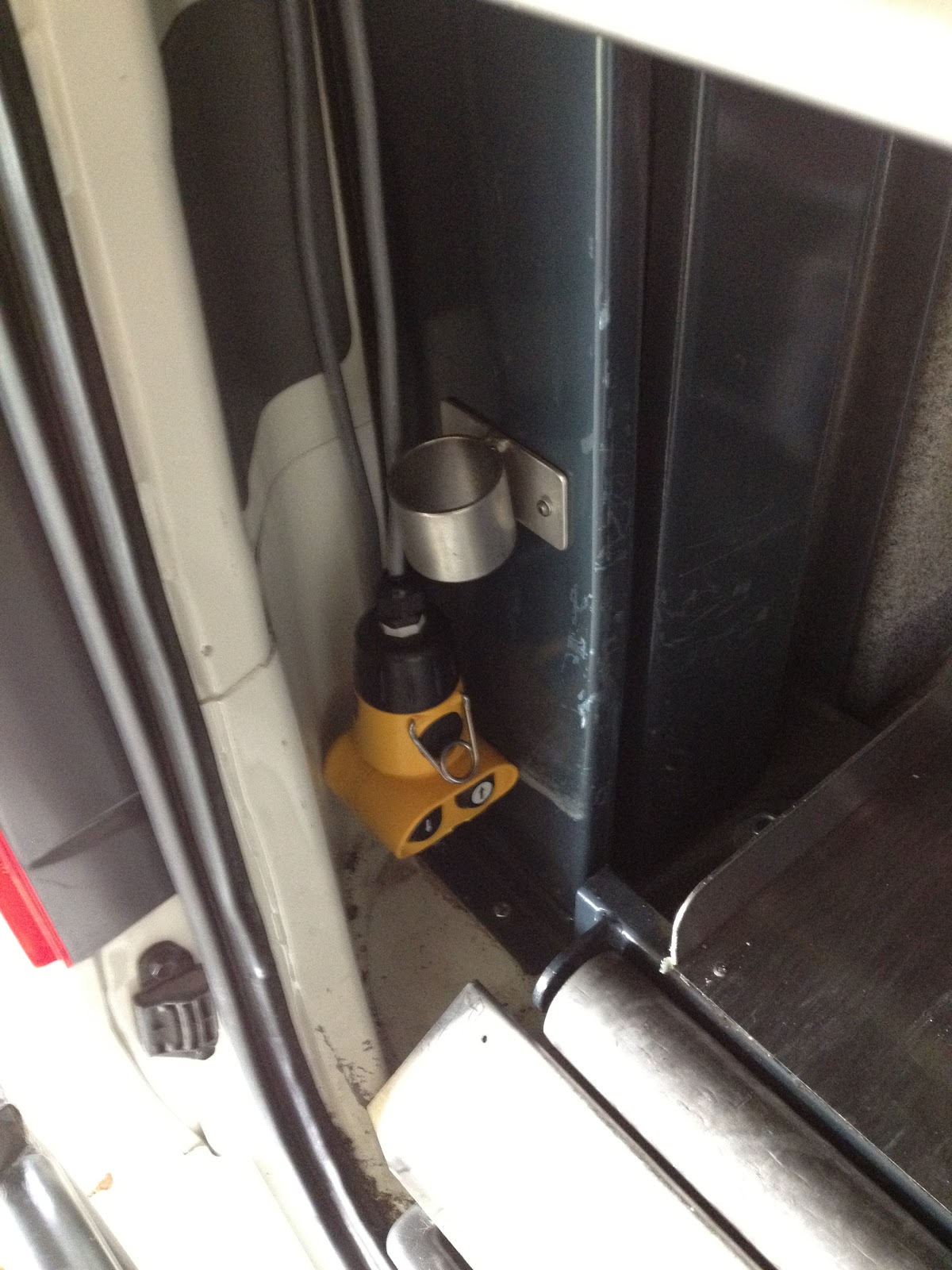 |
| The switch to raise and lower the lift. |
 |
| Stretchers sitting inside the van. |
 |
| The clamp used to keep the stretchers in place. |
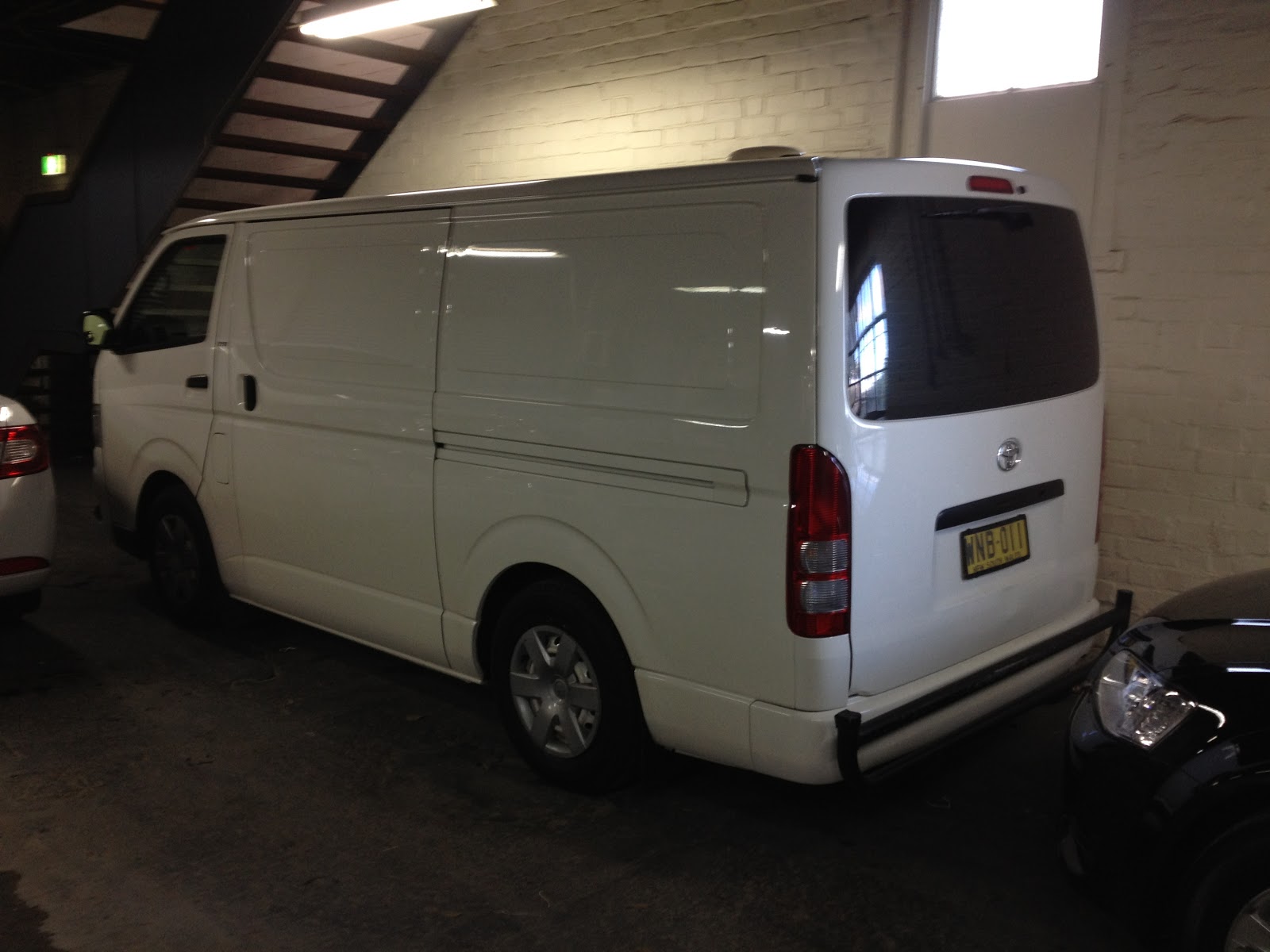 |
| Our transfer van, back in the garage after a long day. |
 |
| The transfer stretchers. The leg-less one is lying upside down and on top of the one with legs |
 |
| Inside the transfer van with no stretchers. |

This is what we will all ride in one day, a white van. It is literally the second last thing most people will be driven in after they die (the last being the hearse).
~~
2012-03-01
Funeral Terminology
There is a bit of specific terminology in the funeral industry. But actually not that much, especially when compared with other areas such as psychology, medicine, etc.
General Terminology:
General Terminology:
- DC - Death Certificate, the original is essential with all burials and cremations. Also used as authority to transfer a body.
- CC - Cremation Certificate, the original is essential with all cremations.
- Intrim - A temporary DC used to transfer a body. It is not suitable for burial or cremation.
- NDY or Not Dead Yet - Someone who is soon to die and is arranging their funeral.
Transfer Terminology:
- Transfer - The process of moving a dead body prior to any service, such as collecting a body from the hospital to bring to the funeral home. Or taking the body to the airport to be sent overseas.
- Transfer Vehicle, Ambulance Hearse - Although 'ambulance hearse' is a much older term often considered inappropriate by many, it can still be used. Either way this is the vehicle used to transfer the body. It is usually a white Toyota Hiace van.
- Ambulance Stretcher, Collapsible Stretcher - A stretcher used to transfer bodies. It has collapsable legs, like an ambulance stretcher, which fold down and in with the use of a handel.
- One-Man Stretcher, Carry Stretcher - A stretcher used to transfer bodies. It has no legs, instead only two wheels on the foot end of the stretcher. It is much lighter and cheaper than the ambulance stretcher but the lack of legs makes it difficult to carry heavy bodies.
- Slide Sheets - Large slippery sheets made from parachute material. They are used to slide or carry bodies about, often in small or awkward spaces. Although these sheets are not cheap they are durable and reusable.
- Pat Slides - A flat, thin board, smaller than the average person. It is used in hospitals and nursing homes as well to slide a body from the bed to stretcher. Or to slide a body up or down small heights.
- Evacuation Pod - This is basically like a hammock that is sealed with buckles. Used to move a body up or down stairs. One person will hold the long handles at both the foot and head end which makes the weight even and controllable, even down steep stairs or slopes.
- Seat Slide - A cloth basket like carrier with four handles. It is used to move a body from a seated position (such as on the toilet or in a chair) and onto the stretcher.
- Body Bag - A blue large plastic bag made out of tarpaulin like material used for containing and moving a body. It has a long zipper from head to toe and can be unzipped so it is completely open. Although most body bags are simple and have no handels lately there have been more with handels, and more cloth style body bags.
- Valuables - Anything on the body other than clothes. Such as jewellery, pictures, watches, money, etc. It does not have to be worth anything. All valuables should be noted on the transfer sheet and in the mortuary book.
- ID Tag, Wrist Tag - An armband placed around at least one, but sometimes both wrists of the deceased. There should always be at least one on the body at all times. The wirst tag is similar to a hospital or club wrist band, plastic and secured with one press button that cannot be undone once fastened. Some places use different colours to represent different things, such as yellow for valuables to be returned to the family and blue for valuables to stay with the body or red for no valuables.
Funeral & Hearse Terminology:
- Goose Neck - The stopper used in a hearse to keep the coffin in place. It is slotted into special holes along the middle of the hearse and tightened with a horizontal screw with a rubber stopped on the end.
- Pegs - The small metal 'sticks' used to keep the coffin straight as it is loaded or unloaded from the hearse. They have rubber on the top to prevent damage to the coffin.
- Ropes - The long flat ropes used to manually lower the coffin at the grave.
- Automatic Lower - A device used at the graveside to lower coffins automatically. It can only be used on certain lawn graves. Basically it uses clockwork style gears inside to keep the speed steady and slow.
- Wing Droos, Side Doors - When referring to the hearse this is describing the small doors on either side that open to the space under where the coffin sits. The space underneath the coffin is completely hollow and designed to store things, these doors give access to that area.
- Coffin Bars - Long bars used to carry a coffin. At least two are placed under the coffin, one at each end, and one person will carry the bar on either side. This means at least four people will carry the coffin with both hands, which makes it much easier.
- Catafalgue - A special and specific object at crematoriums. This is what the coffin is placed on at the crematorium, be it fixed to the front or movable and on wheels.
- Crypt, Vault - A special above ground 'burial' for the deceased. Usually refers to a small stone building where four to ten coffins can sit on each level. It sometimes has two levels, one on the surface and one underground.
- Cortege - The process of cars following the hearse. They should (by law) have their lights on, but not hazard lights or high beams. The cortege should also have right of way (by law) at roundabouts and other intersections without lights. It is also highly illegal to cut-off a cortege, but this is difficult to prove or police.
- Police Cortege, Police Honour Guard - A special cortege which has police guiding it or blocking traffic at least part of the way. Very rare now with few funerals having police escorts unless the deceased had direct ties to the police or was extremely important. This type of cortege will often speed slightly and run read lights. They will also follow each other a lot closer in this type of cortege.
- Family Car, Mourning Car - The car provided by the funeral company to transport the family, friends of the deceased or the priest or celebrant. For example Greek Orthodox funerals must provide a free car for the priest, although they will often charge the family secretly.
- Zink Liner - A special inside lining made of zink. It is used for international transfers or for coffins going into a vault. The zink liner prevents fluids and gases getting in or out of the coffin.
- Grave Marker - A simple marker used to indicate where someone was recently buried. It can be used temporarily or in lieu of a gravestone. Most often it is a simple white wooden cross.
Mortuary Terminology:
- TP - A temporary, simple embalming of the body. It is much quicker and easier than a complete embalm.
- Aneurysm Hook - Perhaps one of the most useful and versatile tools in the mortuary. And it looks and feels great! With a flat hook on one end and a rounded scraper on the other it can be used in endless ways. Plus the gap in the middle makes it great for tying suture corde to, this means the needle wont go falling off the table.
- Forceps - Scissor like tool that seals, grabs and clamps rather than cuts.
- Trocar - An ancient device used to inject and/or remove fluids from a body.
This is a picture of just about every tool used in embalming or the mortuary in general. Starting from left to right at the top you can see the trocar, other similar fluid removing/adding tools, forceps and clamps and finally the different gauges of needles used for suturing and other such tasks. On the second, bottom row we see scalpels, scissors, a few different aneurysm hooks, tweezers and finally different attachments for the trocar.
~~
The Slow Rise of Obesity
Obesity and heavy bodies are becoming an increasing problem for the funeral industry. Yes, on one hand it means a shorter life spane which is good for the industry. But more importantly it is causing big issues and costing the whole industry a lot of time and money. So here is a look at some changes being introduced to handle heavy bodies and why.
Australia now has a higher number of obese people than America. And there is countless evidence to show how Australians are getting heavier. Indeed there is no doubt that the average weight is changing. So the funeral industry, just like many other industries, will have to keep up with this change.
Any body over 70kg is tricky to work with. At 90kg they become difficult and require special attention. The first issue we have with a heavy body is with the transfer. The transfer crew consists of two people. Only two people and little special equipment. This makes moving 90kg+ of dead weight very difficult. And as I outline in the house transfers post most homes were not designed to move a body through. Hence the saying "I hope they die on the ground floor". So some of the first changes seen in the funeral industry are procedural changes dealing with transferring heavy bodies. They are designing special courses solely dedicated to teaching staff how to safely move a heavy body. These courses are targeted at western Sydney, such as Liverpool, Penrith, Eastern Creek, Paramatta, etc. Obviously this is because there is a higher rate of obese people people in Western Sydney. And truth be told all except for one of the heavy or obese bodies I have transfered were either from the coroners or from Westmead Hospital.
I remember assisting the embalmer with a big guy from the Pacific Islands. The skin on his skull was over an inch thick, and it should only be a few millimetres at most. Usually the embalmer can work alone and have a body fully embalmed in about three hours. However it took three of us about two days just to embalm him. Then five of us another day to dress and coffin him.
Special body bags and coffins for heavy or large bodies have always existed. But their rate of use is increasing. Now body bags with handles are becoming more common and are almost a regular site for many transfer crews. One coffin manufacturer told me how he is making proportionately more oversize (OS) coffins than he did a few years ago. He is also looking at different, more secure ways to attach the handles to coffins.
Most normal OS coffins will fit in a hearse and most other spaces without too much trouble. It might be a bit tight, but it can get about. However the custom larger OS coffins are another story, some will not even fit in the hearse. A transfer van is the only option for transporting a large OS coffin. And nobody could carry it by handles, so no handles are attached (which also saves space). They carry it on three to four long bars they place underneath the coffin. This means there is always three to four people on each side, making it easier to carry. However this coffin is too large for most cemeteries and crematoriums. We struggle to fit something like that through a large door, having to go through the service garage door.
Most of these large coffins do not fit in many regular crematoriums, either through the doors or in the 'burner' itself. Just last year crematorium set about installing a spacial new 'burner' to cremate larger bodies. It will have a bigger door and more space inside because they had a couple of bodies that would not fit in the crematorium. They had to get the funeral director to re-coffin the body into a smaller custom made coffin with thin walls. Squishing up the body to do so. A regular 'burner' costs over $250,000 just to buy, let alone install. So a special larger one will cost a lot more. Yet it is obviously worth it and they will be one of the only crematoriums to have the larger accommodation. The average burning time is about 3 hours for most bodies. However they have had a couple in recent time who took 24-36 hours. This is a big difference from most people.
Recently the coroners at Glebe installed a special lifting machine over the lift we use to load bodies in and out of the coroners. This lifting device is designed to move a body between the coroners trolleys and the transfer stretcher. It is not just bolted onto the roof but has its own special frame built into the roof and has a weight rating of up to 400kg. This would have easily cost tens of thousands to buy and install. And the coroners had their last budget heavily slashed so much they had to reduce staff in some areas. But again, just like the special cremator it is worth it.
There were rumours that the cemeteries were considering increasing the size of grave plots. You can buy larger plots, or double sized plots. But the rumour was that they were looking at increasing the average size of plots. And cemeteries are very space conscious. They covert space and hold on to it with devotion, always desiring and devouring more. After all, once a space is taken it will be decades before it may become open again. Waverly for example is mostly closed, to buy a plot there would cost at least $70,000 for just one, if it is even available. And selling space is worth a lot, they even take out or shrink roads to make space for more grave plots. Others constantly try to expand into neighbouring national parks or empty land. For the cemeteries to increase plot size would be to lose land, which is a massive issue for the cemetery.
Overall many new procedures, technologies and attitudes are being developed to deal with the increasing number of obese people in Australia. All at great cost, time and effort. But in the end many organisations see it as worth it.
~~
Australia now has a higher number of obese people than America. And there is countless evidence to show how Australians are getting heavier. Indeed there is no doubt that the average weight is changing. So the funeral industry, just like many other industries, will have to keep up with this change.
Any body over 70kg is tricky to work with. At 90kg they become difficult and require special attention. The first issue we have with a heavy body is with the transfer. The transfer crew consists of two people. Only two people and little special equipment. This makes moving 90kg+ of dead weight very difficult. And as I outline in the house transfers post most homes were not designed to move a body through. Hence the saying "I hope they die on the ground floor". So some of the first changes seen in the funeral industry are procedural changes dealing with transferring heavy bodies. They are designing special courses solely dedicated to teaching staff how to safely move a heavy body. These courses are targeted at western Sydney, such as Liverpool, Penrith, Eastern Creek, Paramatta, etc. Obviously this is because there is a higher rate of obese people people in Western Sydney. And truth be told all except for one of the heavy or obese bodies I have transfered were either from the coroners or from Westmead Hospital.
I remember assisting the embalmer with a big guy from the Pacific Islands. The skin on his skull was over an inch thick, and it should only be a few millimetres at most. Usually the embalmer can work alone and have a body fully embalmed in about three hours. However it took three of us about two days just to embalm him. Then five of us another day to dress and coffin him.
Special body bags and coffins for heavy or large bodies have always existed. But their rate of use is increasing. Now body bags with handles are becoming more common and are almost a regular site for many transfer crews. One coffin manufacturer told me how he is making proportionately more oversize (OS) coffins than he did a few years ago. He is also looking at different, more secure ways to attach the handles to coffins.
Most normal OS coffins will fit in a hearse and most other spaces without too much trouble. It might be a bit tight, but it can get about. However the custom larger OS coffins are another story, some will not even fit in the hearse. A transfer van is the only option for transporting a large OS coffin. And nobody could carry it by handles, so no handles are attached (which also saves space). They carry it on three to four long bars they place underneath the coffin. This means there is always three to four people on each side, making it easier to carry. However this coffin is too large for most cemeteries and crematoriums. We struggle to fit something like that through a large door, having to go through the service garage door.
Most of these large coffins do not fit in many regular crematoriums, either through the doors or in the 'burner' itself. Just last year crematorium set about installing a spacial new 'burner' to cremate larger bodies. It will have a bigger door and more space inside because they had a couple of bodies that would not fit in the crematorium. They had to get the funeral director to re-coffin the body into a smaller custom made coffin with thin walls. Squishing up the body to do so. A regular 'burner' costs over $250,000 just to buy, let alone install. So a special larger one will cost a lot more. Yet it is obviously worth it and they will be one of the only crematoriums to have the larger accommodation. The average burning time is about 3 hours for most bodies. However they have had a couple in recent time who took 24-36 hours. This is a big difference from most people.
Recently the coroners at Glebe installed a special lifting machine over the lift we use to load bodies in and out of the coroners. This lifting device is designed to move a body between the coroners trolleys and the transfer stretcher. It is not just bolted onto the roof but has its own special frame built into the roof and has a weight rating of up to 400kg. This would have easily cost tens of thousands to buy and install. And the coroners had their last budget heavily slashed so much they had to reduce staff in some areas. But again, just like the special cremator it is worth it.
There were rumours that the cemeteries were considering increasing the size of grave plots. You can buy larger plots, or double sized plots. But the rumour was that they were looking at increasing the average size of plots. And cemeteries are very space conscious. They covert space and hold on to it with devotion, always desiring and devouring more. After all, once a space is taken it will be decades before it may become open again. Waverly for example is mostly closed, to buy a plot there would cost at least $70,000 for just one, if it is even available. And selling space is worth a lot, they even take out or shrink roads to make space for more grave plots. Others constantly try to expand into neighbouring national parks or empty land. For the cemeteries to increase plot size would be to lose land, which is a massive issue for the cemetery.
Overall many new procedures, technologies and attitudes are being developed to deal with the increasing number of obese people in Australia. All at great cost, time and effort. But in the end many organisations see it as worth it.
~~
Subscribe to:
Posts (Atom)