Showing posts with label coffin. Show all posts

2013-09-27

LifeArt - Making Coffins

    This is an interesting video about how LifeArt make their cardboard coffins. Unfortunately it's only 240p and a low quality video. But it is definitely worth a watch, especially for those not familiar with LifeArt.

LifeArt Clean Coffin Technology

     You can read more about LifeArt coffins via their website. Essentially they're cardboard coffins, which are environmentally friendly. Personally I like them for their customisation abilities and how light and practical they are. You can get any image or design printed on them, or simply get a plain one and decorate it in person as I have seen some people do.

    LifeArt recently released an online design tool, allowing people to design coffins themselves. It's a fun tool to play with, LifeArt Online Design.

    However, a huge drawback is that they are not available directly to the public. To me this is a bit of a shame as LifeArt would make a wonderful art medium. I've seen families paint, write poems, and stick collages on the coffins. Opening this up to a wider community could be good.

    My personal belief is that LifeArt could be a great product and used in a great way, but often gets dismissed or ignored too soon. The environmental benefits, the costs, and the quality are not as important as the customisation. The very option and notion of being able to completely customise a coffin like this is great and should be given more credit. So I think it's wonderful to see LifeArt running with this through things like the online design tool. The ability to interact so directly with the coffin, and to change it so dramatically, is a very powerful thing. I've had the pleasure of seeing some amazing things mourners have done with LifeArt coffins.

~~

2012-11-11

Working Funerals - Turning the coffin mistakes

    A while ago I wrote a post on how to turn the coffin after a service.  Just a basic guide for those who have limited experience with this.

    Since then I have been asked about mistakes that are made when turning the coffin.  What mistakes are made and how to avoid them.  Here are the four most common mistakes I have seen and how to prevent them.

2012-08-03

Working Funerals - Lowering the coffin

    This post is a how to guid on lowering the coffin at the cemetery.  It looks simple and easy but so many people do it wrong and risk injuring their back or damaging the coffin.  While written from the point of view of an undertaker this guide can also be handy for mourners.

2012-07-01

Slow Rise of Obesity - Part two: the preparation

  It is no debate, we are getting larger and fatter.  Yet what does this actually mean?  As in how are our attitudes and views changing and how is it affecting our lives?  To answer this I look to funeral and the funeral industry.  The funeral industry is a wonderful way to look at society.  To look at us, our attitudes, beliefs, how we go about our daily lives and so on.  This is because quite simply the way we live is the way we die, the two are directly connected.

This is why I decided to do a few detailed posts on obesity in the funeral industry as I experienced it and understand it.  Through looking at how obesity affects the funeral industry we can understand how it affects our lives.  My first post was on the transfer of obese bodies.  This post is on how we deal with and process the obese body.  What happens in the mortuary to the body and the coffin of obese bodies.

2012-05-23

How to - Carrying & moving the coffin

    After seing my previous post about how to attend a funeral someone recently asked me about how to move a move a coffin.  So here is a little guide on how to move and handel the coffin.

    Foot first.  This is something which a lot of people do not notice and do not do.  But it is a key thing which should always be done.  When moving the coffin take the foot end first.  In a car the coffin should have the foot end towards the driver so again, it travels foot first even when being driven.  This has a symbolic meaning in that it represents the person walking.  As though they are still moving of their own to the next place.  However it also has a practical reason in that it prevents the body from 'purging'.  Purging is where the body basically throws up fluids.  So keep the head raised will keep the fluids down.

    Turn clockwise.  This is symbolic of the moving of life.  It directly represents the turning of the clock and the passage of time.  However always turning clockwise also means you will know what everyone is doing.  There will be no surprises if you follow a pattern.

    Wheel by the thumbscrews.  When wheeling the coffin always hold the thumbscrews and not the handels.  Holding the thumbscrews will be daunting to the inexperienced yet it gives much better grip and control.  The handels are too low for most people so it will mean bending awkwardly and possibly bad for people.  This also does not look good.  To see the paul bearers bending awkwardly as they wheel the coffin.  More importantly holding the handels give little grip which could lift the coffin off the trolley.  For better control and comfort hold the thumbscrews.  It does not just look better but is better.

    Keep in step.  Many people struggle with this, and while not essential it does help.  Keeping in step prevents treating on anyones toes and looks nice.  To keep in step just copy the person in front of you.  Move as and when they move and everything will be fine.  If you are at the front of the coffin (the foot end) copy the person leading the coffin, be they the conductor, a priest or whoever else might be in front.  If nobody is leading the coffin just walk evenly and do not worry too much.

    Keep it level.  When going up or down stairs keep the coffin level as much as possible.  By keeping the coffin level it makes sure nothing on top (such as flowers) will fall off.  It also makes it much easier and safer for everyone involved.  To keep the coffin level those at the low end will have to lift it up as much as practical. 

    Carry by one handel.  Unless you are picking up, raising, or placing down the coffin only use one handel.  Sometimes people try to use both hands to carry the coffin, but this never works and just makes it awkward.  You should only ever need to use one hand on one handel to carry a coffin safely.  Simply use your hand that is closest to the coffin.  If carrying coffins regularly swap sides to prevent strains or developing a 'preferred side'.

    Face the foot end.  The coffin should always travel foot first.  I cannot stress this enough.  Thus you should always face the foot end when carrying the coffin.  So if you are getting the coffin out of a hearse or off something face the foot end.  It is amusing to see people getting a coffin out of a hearse and they instinctively face away from the hearse.  Away from the foot end.  Instead they should face towards the hearse when pulling the coffin out.  As shown in the picture above.

    Do not stress or worry.  Carrying the coffin can be a worrying thing for a lot of people.  Yet it is not that difficult.  Nobody has dropped a coffin as far as I know.  There are stories of close calls, where a handel came off as they were carrying, yet in every case the coffin was caught.  So the chances of you dropping a coffin, or tripping, while carrying it is very, very, low.

    Keep out of the way.  Do as the funeral conductor instructs when they instruct.  It is better to do nothing than to do something wrong.  So sit tight and wait for a signal, either from the conductor or a pre-determined point in the service.  I have seen families jump up too early to carry a coffin.  They're too eager and nervous.  Then they got in the way when the funeral staff moved up to turn the coffin, which made the family feel bad.  So sit tight, stay still and be where you are suppose to be.  That way everything will be fine.

    Following this stay out of the way and move away when you are done.  Especially at the graveside when the funeral staff tell you to move away then move away.  Often the conductor will be holding the coffin, on his own, so it is heavy and awkward.  The last thing he needs is someone standing in the way asking if he has the coffin.

    This of course is not everything to do with moving a coffin.  But it is a start and should help the nervous or inexperienced.  Look to the conductor, or the hearse driver, if you are unsure about what to do.  In he end it is an easier and less stressful task than one would think.

~~

2012-05-01

Working Funerals - Turning the coffin

    At my grandfathers funeral I couldn't help but notice the mistakes the undertakers made when turning the coffin.  The mistakes wren't serious or disrespectful and they went un-noticed to the other mourners.  But after working funerals I saw these little mistakes.  And this made me realise how many mistakes can be made when turning the coffin, so I thought a little guide might help.

    Turning the coffin is a rather important part of the service, and it is a part many overlook or dismiss.  It is also a rather simple procedure that has plenty of room for errors.

    'Turning the' coffin refers to the act of rotating the coffin at the end of a funeral service to take it to the next or final stage.  This is done while family, friends or other mourners are watching and is a part of the service itself.  Mourners or staff can turn the coffin, but it is usually the undertakers who do it.

    Any movement of the coffin is important and potentially emotional for most mourners.  So turning the coffin is very significant for most people.  It is also done infront of many people and its always watched intently.  As such it should always be done right.  Thus an article explaining how to turn the coffin could be helpful to mourners or funeral directors alike.

Here is my step by step guid on how to properly turn a coffin:

Fig1. Getting into position.
1. The hearse driver and other staff member will wait near the coffin before moving over and preparing it. This involves removing any symbols (items placed on top or near the coffin) or obstructions (such as the pascal candle or tables).  As they approach they should bow to the stage or coffin depending on tradition or practice.
Fig2. Getting ready to turn.
2. The staff move into position, the hearse driver goes to the head end and the other staff member goes to the foot end.

3. They pause for a moment and when the hearse driver signals they place their hands on the coffin.

4. The staff want to have a firm but dignified hold of the coffin.  It should not be grabbed and moved like a box or furniture but it does need a firm grasp to keep control.

5. After placing their hands on the coffin the staff pause and again wait for the hearse drivers signal.
Fig 3. Turning the coffin.
6. When the hearse driver signals the staff turn the coffin clockwise.  It must always be turned clockwise! Turning the coffin in this direction represents the passage of time, it is an old and symbolic tradition.

7. It might be necessary to perform a three-point-turn in tight spaces.  There is nothing wrong with this if movements are kept to a minimum where possible.  Be sure to discuss this with the conductor or hearse driver before going up to turn.
Fig 4. Finishing the turn.
8. The assisting staff at the foot end should make sure the coffin is straight.  To do this they pull the coffin down the isle towards them a very short distance.  Never pull the coffin too far in this direction and do not worry about getting the coffin perfectly straight.

9. The staff will move off as previously instructed by the conductor.


Some simple key things to remember are:

-  Pause after approaching the coffin, pause again after placing your hands on it and make a final pause after turning the coffin.  This makes the whole thing appear much more respectful and professional.
-  Look for the hearse drivers signals, move when they move and move as they move.  Again, it will look professional and like you are a team.
-  Do not move too far.  Restrict all movements as much as is practical otherwise mistakes can be made.
-  Flow steadily, do not move suddenly or jerkily.  Think of the process as like a dance, move with a rhythm and do not make sudden or unexpected movements.
If a mistake is made ignore it if you can.  Most mourners will not notice mistakes unless the undertakers make them noticeable.  So if you can get away with a mistake then do so.
Know the crew and other staff.  This is difficult with large companies who change crews and staff often.  But if you can get to know them do so.  It really helped me, to know how and when each hearse driver liked to turn the coffin.  Then I could match their styles and appear more professional and I would notice quicker if something went wrong.  We all have our personal tastes and touches, getting to know these will go a long way.
-  Communicate!  This is perhaps the best and most important thing.  Listen to the conductor and hearse driver.  Do no over discuss what is to happen but make sure everyone is on the same page and you know not only your role but what others are meant to do.  This means if something goes wrong or someone goes missing you can easily step in.

    Just remember not to worry too much about it and if you are unsure of what to do don't do anything.  A great rule for funerals is do nothing if you are unsure.  It is much better to do nothing than do something wrong.  When turning the coffin generally wait to see what the hearse driver or conductor are doing before you act.  And if you are the hearse driver or conductor you should know what you are doing and not really need this guide.

~~

2012-03-31

How to Trim a Coffin WNBull Style - The Handels

    You can read the previous parts on how to do the inside lining here and how to do the lid and thumbscrews here.  But now for the handles, an important part of the coffin.

    One thing to remember is that you must make sure all screws and nails are in properly, otherwise the handle may come off at a bad time.


1. Flip the coffin onto its side.


2. Get the following tools and place them close by:
- 1x Hammer.
- 1x Guide (the wood block used to keep the handel straight and in the right spot, labelled "tudor" in the picture).
- 1x Drill.
- 6x Handles.
- 12x Nails (long).
- 24x Screws.


3. Line up the handle so the middle will be centred with the thumbscrew on the lid.  Feel free to use the hammer to help make it straight.


4. Use the guide to keep the handle straight and at just the right hight on the coffin.


5. Hammer the nails into the tops of the handle, you need two nails per handle.


6. Once all three handles have been secured drill them down.


7. Check all there handles making sure they are straight and secured.

8. Flip the coffin to the other side and now do the same with those three handles.


    If you followed all three posts then that's it, you trimmed a coffin!

    You can read the previous parts on how to do the inside lining here and how to do the lid and thumbscrews here.

~~

2012-03-26

Cultural Differences in the Hearse: American and Australian hearse

    I wrote this post about inside the hearse a while ago.  What surprised me was how few people knew about the hearse.   As a follow up I have been keeping an eye out for articles about the hearse and recently I came across this post about unusual hearses at the Chive.  It's about 'unusual' hearses, but what is interesting to me is picture 25, which although a little odd is quite a standard hearse to me.  This lead to me thinking about the cultural differences in hearse's between America and Australia and how this might indicate cultural differences in funerals as well.

2012-03-21

Coffin Costs

    The coffin is an important item to any funeral, after all, when one thinks or googles funeral the first things that come up are usually of people carrying or crying over a coffin in a cemetery.  Yet it is so expensive, disproportionately so.  A mid-range coffin will have well over 100% profit on it.  What is interesting is that people pay this cost and that once they find out about the high profit margine they are offended.  We do not like the idea of a funeral home making profits, all despite it being a business like any other.  Coles sells food, Big W sells products and funeral homes sell the process of dealing with the dead.  But they all use the same models and methods to do so.  So here I intend to examine the prices of coffins, what people get for their money and why they cost so much.

    The coffin is one of the most important items in many ways and to many people.  Coffins carry with them an emotional significance for most people, especially when they think it holds the body of their loved one.  I noticed that people will treat the coffin with reverence and significance.  Naturally this varies from culture to culture and person to  person.  For example ethnic people (such as Greeks, Lebanese, Italians, etc) will often want to 'touch' the coffin in some way or see inside it.  They touch it by either by crowding around madly and emotionally or by quietly and calmly carrying it.  Traditional Catholics on the other hand will sometimes touch the coffin by carrying it, but unless they are part of a religious order they will rarely be physically involved with the coffin and not want to see inside.  However they do gaze on it more, for them it is more visually significant than for other cultures.

Ready and waiting to be sold.
    It is also often the most expensive item at a funeral.  This is because it is all but essential for a funeral.  You have to get the body there somehow and people rarely want to see the body itself being interacted with.  People like the body to be in a box or wrapped up heavily and it is this wrapping or box that is handled.  However, while essential this is not the reason the coffin will cost so much, nor is it the reason "high end" coffins exist.  It is because of the previously mentioned significance that they are so costly.  For a low end coffin one could expect to pay $1,000.  For a midrange model one pays $2,000 to $5,000 and for the top end it would cost $6,000 or more.  

    The value for money is quite interesting.  Firstly coffins are just boxes, usually wooden, and looking at them being made this is quite clear.  Although the end product is actively deceptive of this fact, and idea I will expand in another post at another time.  But for now I will explain that they are usually chipboard, just like furniture.  Yes, until you get to the high midrange prices or higher the inside is just chipboard and it will have shiny plastic handles.  One of InvoCares favourite coffins are what people in the industry refer to as "the ikea coffins" or "the snap-together coffins.  Because they literally snak together, they arrive at the funeral home, fresh from China, as flat separate pieces in a cardboard box.  Staff then take these pieces and "whack them together", not needing any glue, nails, stapes or anything else to fix the pieces together.  Due to being made in China on mass they are very cheap for InvoCare, even after shipping they cost well under the price charged.  However they are considered to be very cheap and low quality by those I talked with in the industry.  There were often gaps of almost an inch between whole sides, exposing the contents within.  There was also an incident or two where a coffin got caught as it was lowered at the grave, quite a common affair, but on a few rare occasions they broke open, quite uncommon.  Another interesting point on the low end models is that this is where LifeArt starts and aims most of its advertising.  LifeArt are basically cardboard coffins which are said to be very cheap compared to others and also very environmental.  Luckily neither of these points are particularly true, not that the truth matters to most.  But they cost more than the basic $1,000 chipboard coffins and are made from trees as are the wooden coffins. 

    Of course this is just the low end coffins, with the midrange the quality often changes quite a bit.  For example midrange models are almost always chipboard (which is actually quite decent for a coffin) and put together in a more complex method than the 'snap together' variety.  These coffins will also sometimes feature actual metal handles rather than plastic and have more details on the body of the coffin.  But they cost $5,000 or more, so one would expect these basic changes.  Yet seeing it from the undertakers angle one wonders if this price is worth it.  People outside the industry assumed that if the coffin cost $5,000 for them then it would cost the funeral home $4,000 or more.  It was always assumed that the profit margin was low or at least modest.  When I informed them that the coffin actually cost $1,000 to $2,000 (after shipping and tax) they were quite surprised and outraged.  But why, what is wrong with a business making money?  Well, quite simply I wont answer this here, it is too long and convoluted a concept to discuss in this post.  So for now I will look at why the funeral home has such a high profit on certain coffins.

    As one conductor said "the expensive coffins are the bread and butter of the industry".  He went on to say that this large profit allows the company to survive, to pay the employee wages and cover unforeseen costs.  One would think that the "service fee" families pay for funeral would cover the cost of the funeral.  But it only covers most of it and for that funeral.  There are others where the service fee did not cover everything.  For example I waited for over an hour at RPA for the body to be released (due to the shocking attitudes and management at RPA).  So who paid for the time we spent there, for two people to just sit around for an hour or so?  Well the coffin did.  It would be wrong and inappropriate to pass this cost directly onto the family, whether they can afford it or not.  But it would be just as wrong not to pay the transfer crew for their time.  Thus instead the cost is taken off the cost of the high profit coffins.  So now you might be thinking that undertakers are basically taking the costs of funerals from those who pay for a high profit coffin.  This is essentially correct; the funeral home is doing a funeral yet charing another family for the costs that the original family would refuse.  Nothing is wrong with this practice, the costs have to be covered and it would be wrong or impossible for the funeral home to pass on these costs.  So if they want to stay in business then they have to find the money somewhere.  This somewhere is high profit coffins, if people are willing to pay this price then the funeral home has every right to charge the price.  A suit salesman once told me that he would charge over 180% profit in some suburbs for his suits to cover the costs of selling suits at a slight loss in other places.  It is simply the same process at work with coffins.

    Actually the whole coffin sale process is quite refined.  Tom Jokinen explains the American coffin sale process in 'Curtains: Adventures if an undertaker in training' (an amusing and true book).  Here he illustrates how where coffins are placed in the "show room" is strictly dictated.  And not just their hight, but their lateral location (as in which is on the right and which is on the left).  They even specifically design the pathway people will walk, working out the direction and pace of travel.  All very American and related to McDonaldization, yet in Australia we do not do things quite the same way.  The sale of coffins is often more relaxed here, although showrooms exist and are thought about they are not thought of in the same detail as in America.  In fact WNBull (a top funeral home in Sydney and one of the most expensive) did not even have a show room of any sort.  One existed in the past but they found it was not used very much or well and as such turned it into a meeting room.  This is interesting in and of itself.  That in America the show room is considered important if not essential for most funeral homes according to Jokinen.  Yet in Australia even a top funeral home did not see a need for a show room and instead thought a staff meeting room would be more effective.  Actually, not many funeral homes in Australia have show rooms.

    Many undertakers who are involved with organising a funeral for a loved one, or themselves, will tend to buy the midrange coffins.  These people will also either inspect the coffin in the trim shop, not in the show room or simply pick it from a book (like most Australians).  However they will always have a pre-determined preference for the coffin.  They know what they want, what they will pay and what they will get and they got for that.  Talking with undertakers who had organised funerals for relatives it was clear they were never sold a coffin so much as bought the coffin.  Yet more interestingly, knowing the value and markup, people with industry experience will either got for the very cheapest of the cheap of upper midrange.  From talking with them I think it is because they know the value of the cheap coffin is decent and they do not see the reasoning for paying more.  After all, these are people who have been to several funerals every day for the past few years which has made it a mundane and common affair.  When they got for the upper midrange it appears to usually be because of the "value" or "quality" that they see in these coffins.  They know what they are getting, know the high profits and yet think of these coffins as quite worth it for themselves and their loved ones. 

    If one wanted to buy and provide a coffin themselves without going through a funeral home then this is quite possible.  Simply contact a coffin manufacturer and see which one will sell a single coffin.  Almost all Australian coffin manufactures would be quite happy and willing to sell one coffin to someone (and have done so in the past, even taking custom orders).  I would recommend 'Beta Caskets' for this as they have good service, are good quality and well priced.  You might pay a lot more than it cost to make, but it would still be cheaper than buying it from a funeral home.  Again, despite knowing this and having contacts with coffin manufacturers funeral directors are still most likely to buy the coffin through the funeral home.  I have never heard of someone with industry experience buying the coffin from the manufacturer.

    Value is an complicated idea when talking about coffins.  One dimension is that they have an emotional value, playing an important role in the funeral service.  On another side they have a financial value, people want quality for paying thousands.  Yet this value decreases as price increases with top range coffins having over 100% profit for the funeral home.  At first many people find this profit avaricious, to be taking advantage of the dead and the grieving to make money.  Upon closer inspection this becomes transparently false as the money does go to covering valid unspoken costs.  Without the top end coffins there would be far fewer funeral homes and far fewer options for families.

~~

2012-03-08

How to Trim a Coffin WNBull Style - The Lid & Thumbscrews

    If you followed the steps in this previous post about trimming a coffin or the coffin has come pre-trimmed then you are ready for the next part.  The lid.  Mist funerals at W.N.Bull are traditional Catholic, and as such this method will focus on a Catholic coffin.  The only real differences between Catholic and "non-Catholic" is the thumbscrews and use of a cross or crucifix.  Catholic (and some other religions) use cross shaped thumbscrew and scutcheons while the others will use a simple fan shaped thumbscrew.

    So here is how to put on a Catholic coffin lid, remember, the only difference between Catholic and anything else is the use of crucifixes or crosses or a non-religious design in certain areas.

1. Place the lid back on the coffin and grab the following tools:
- 1x Hammer.
- 2x Pokers.
- 6x Thumbscrews.
- 6x Scutcheons (the flat part that sits over the hole on the lid of the coffin).
- 12x Nails (small).


2. Poke the 'pokers' through each hole in the lid.  This makes it easier to get the thumbscrew through the lining later.  Next poke each 'poker' through an opposite hole on either end of the coffin.  This will keep the lid alined correctly with the body of the coffin.


3. Start at the two holes next to the pokers, again diagonally opposite each other at each end of the coffin.  Place the scutcheons over these holes, then screw the thumbscrew in.  Continue on to each hole until all six thumbscrews are screwed tightly in place.

<> Make sure to leave the thumbscrew sideways so the 'arms' do not sit over the holes in the scutcheon for the nails.

Scutcheon in place and thumbscrew about to be tightened
Thumbscrew tightened all the way.


All thumbscrews in place and ready for the next part.

4. Land the helicopters.  This is the process of nailing down each scutcheon with the little nails.  Un-nailed scutcheons are called 'helicopters' as they will spin like the blades of a helicopter when the thumbscrew is unscrewed later.  So land those helicopters!

5. Usually the next step would be to put on the handles.  But if the coffin is already sold and you have a nameplate then attach it now.  The nameplate should sit level with the shoulders of the coffin or where the shoulders of the deceased would be.  If a cross or crucifix is to be added do this now as well.  Simply attach some blue-tack to the back of the cross/crucifix to help hold it down.  Then place it in the middle of the coffin so the top is level with the top of the thumbscrews.  Nail it down through the rin on the top of the cross/crucifix with one little nail.

That is it!!  It is the easiest part of preparing the coffin.

Continue here for how to attach the handles.

Or go here for the previous part on trimming the inside of a coffin.

~~

2012-03-05

How to Trim a Coffin WNBull Style - The Inside Lining

    There is a lot of emphasis at WNBull about doing things "the Bulls' way".  Often for good reason as these methods are tried and true for the funeral industry.  Some are focused on differentiating WNBull from other funeral homes.  And the rest are just silly little things that have built up in a company that is 120 years old.  I have noticed that everything at WNBull is taught via word of mouth.  There is no written procedure for anything not directly related to OH&S that was introduced by InvoCare.  How to do a transfer, how to trim a coffin, how to work a funeral and so on.  None of that is written anywhere and as such is liable to die out as people leave.  Over 100 years of tradition and knowledge is slowly leaving the company.  As such I thought I should write some of it down for everyone to learn.

    One main thing every undertaker at WNBull must know is how to trim a coffin, by their standard. Once you know the basics of trimming a coffin there is little variation.  Small details differentiate companies or individuals, but really the main foundations are all the same.  So here is how to trim a coffin, WNBull style, with pictures:

You can go here for preparing the lid, including the thumbscrews.

Or go here for how to attach the handles.

1. Select the correct coffin and know the type.  There are many to pick from, most are the same but some have small variations.  I will discuss most of these variations at the end.  Coffins come as just a box, no handles, no thumbscrews, no trim/lining inside.  So you will need to put it together before it is sold or used.


2. Lay the coffin on the horses.


3. Using a drill unscrew the two to four screws holding the lid on.  Inside you should find three items:
- 1x Plastic Pillow.
- 1x Plastic lining.
- 1x Upper lining & Lower.


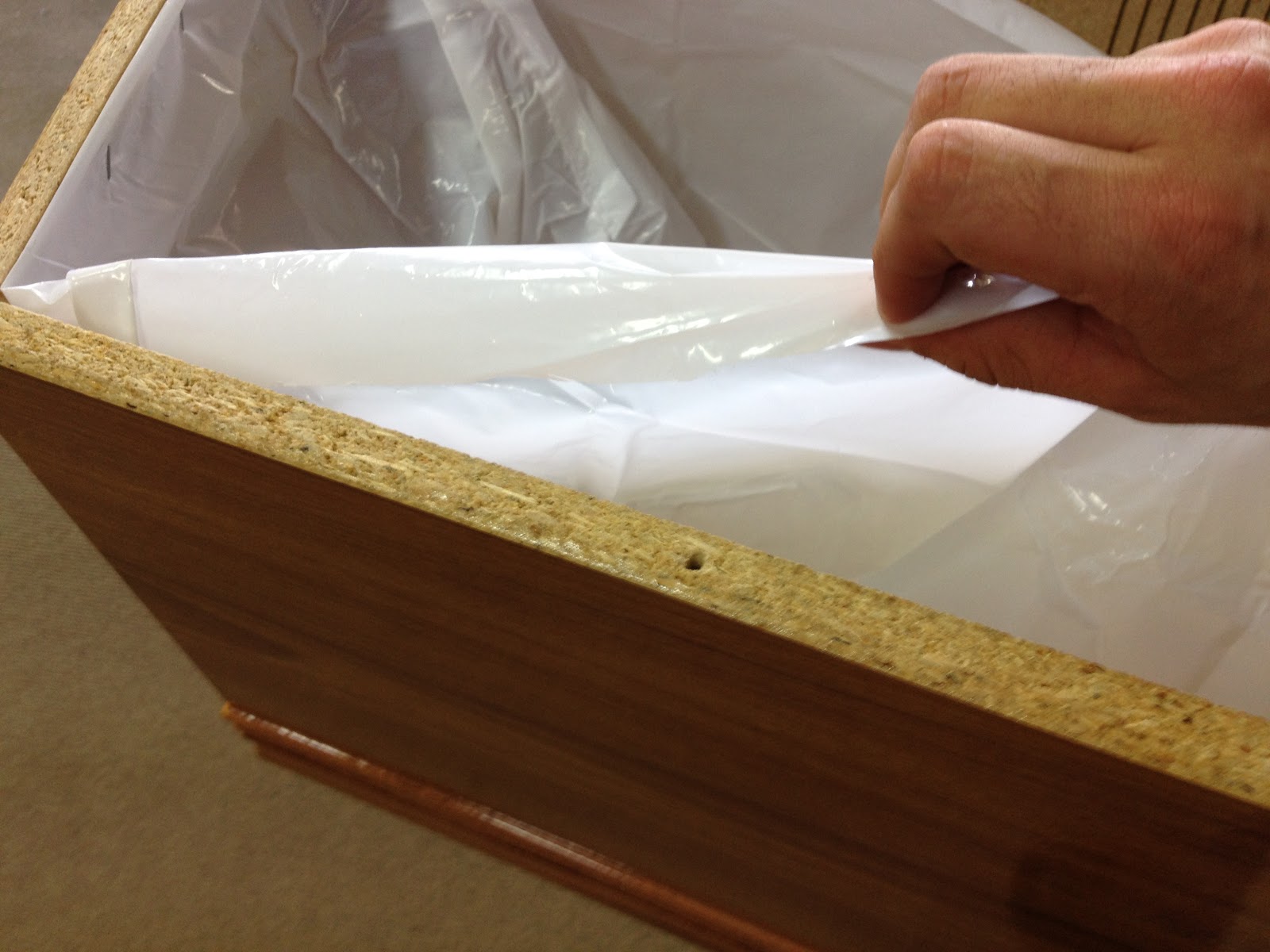
4. Start by taking everything out and placing it on the floor.  Next open the plastic lining and place it along the inside of the coffin.  It has a head end indicated by extra seams on the lining where it would sit in the 'shoulder' (the part that is bowed out) of the coffin.  If you get the lining the wrong way around it will rip later.

5. Find the middle of the lining at the head end and staple it to the inner side of the coffin.  Then staple outwards along the head of the coffin to the corners.

<> When stapling make sure the staples are diagonal, vertical or especially horizontal do not hold strongly.

<> A good idea is to turn over the liner by about an inch long the top, this will give it more stability and make sure it stays in place.


6. Place a staple into the corner of the coffin to keep the lining tightly in place.  Staple along the one side to the foot end.  Then staple along the other side to the foot end.


7. Fold the excess lining underneath itself at the foot end.  This is called a 'pleat'.


8. That should be it for the plastic lining.  Check it against these pictures, the lining should be flush with all the corners and fairly even on both sides.  It should also be able to move about a bit.  Do not worry too much, it does not have to be perfect at this stage.


9. Time to prep the pillow. Do this by taking out any excess shredded paper and condensing it.  The pillow must not be too dense or fluffy or it will not support the deceased's head properly.  Once this is done seal the end with tape.  Next poke a hole or two in the side of the pillow to allow air in and out.


10. Now for the lining people see.  Identify the lower lining, it is larger than the upper lining.  Find the middle and staple that to the center of the head end, similar to how you stapled the pastic lining to the coffin.


11. Pleat the corners at the head end.  Do this by folding the lining over and under itself as shown in the picture on the left below.


This is how it should look, nice and symmetrical.
12. Staple along each side to the foot end.  Remembering to keep the staples diagonal.

13. Now you are at the foot end you should have some extra lining dangling about.  Grab the shortest end pleat it before stapeling the rest to the foot of the coffin.  Next, with the longer end pleat it and then pleat again on the other side, covering the ends underneath it in the middle.  It should end up similar to the lining at the head end.


14. Finally we are at the last part of the linings, the upper lining.  This strip is smaller than the lower lining and has a ruffle to it.  Just like the other linings find the middle and staple this to the center of the top on the coffin.  Then staple along the top until you get to the corners.

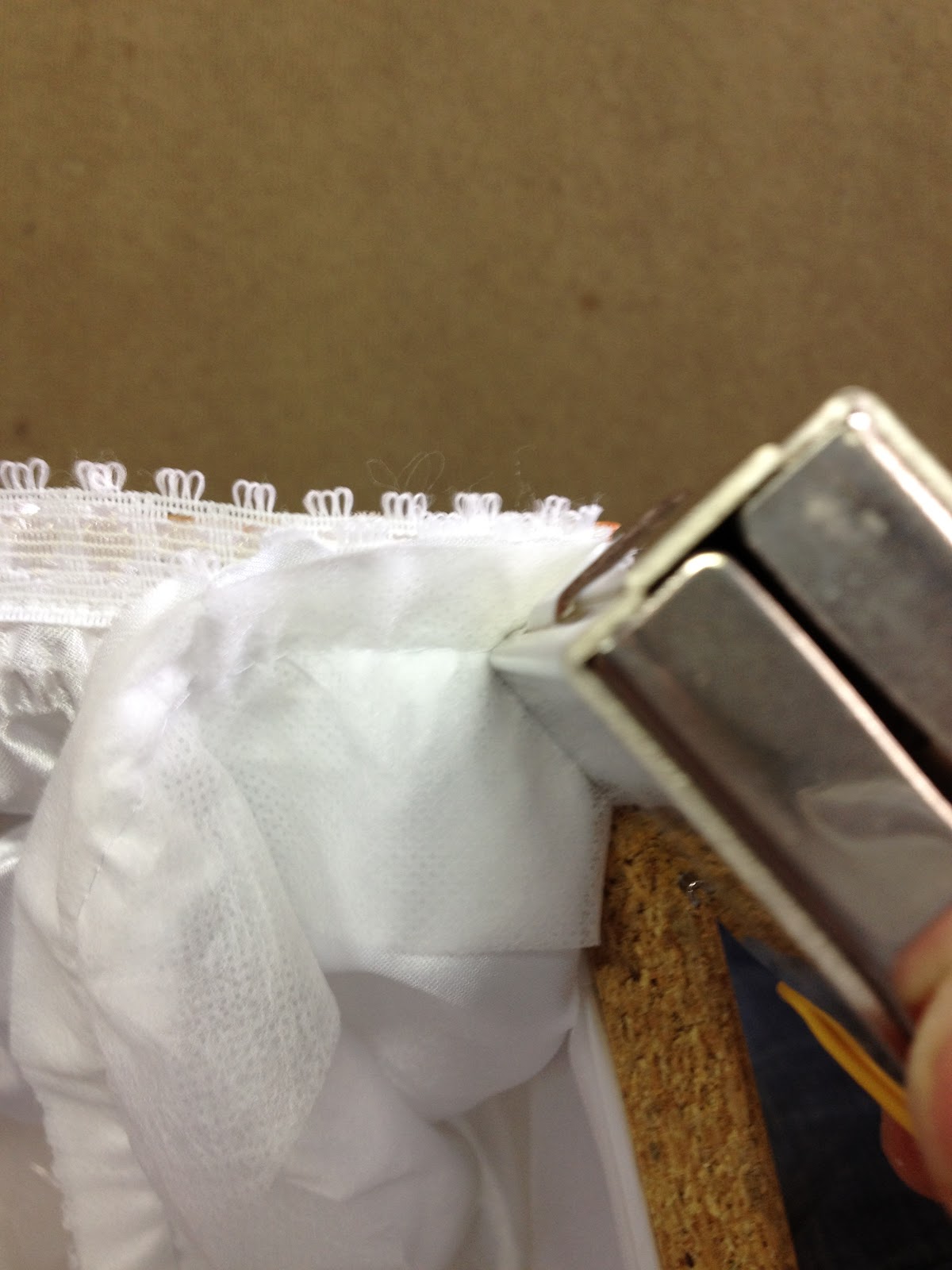
15. Now we will need to do a 'corner' on the lining, this is easy but finicky to get just right.  Take the trim and line it up over the corner, bending it back upon itself.  Then staple it on the corner, line up the staple diagonally with the corner of the coffin and staple the trim in place.

Folding the lining.
Lining up the staple.


Staple in place.
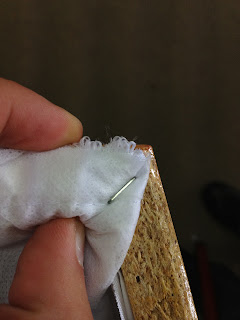
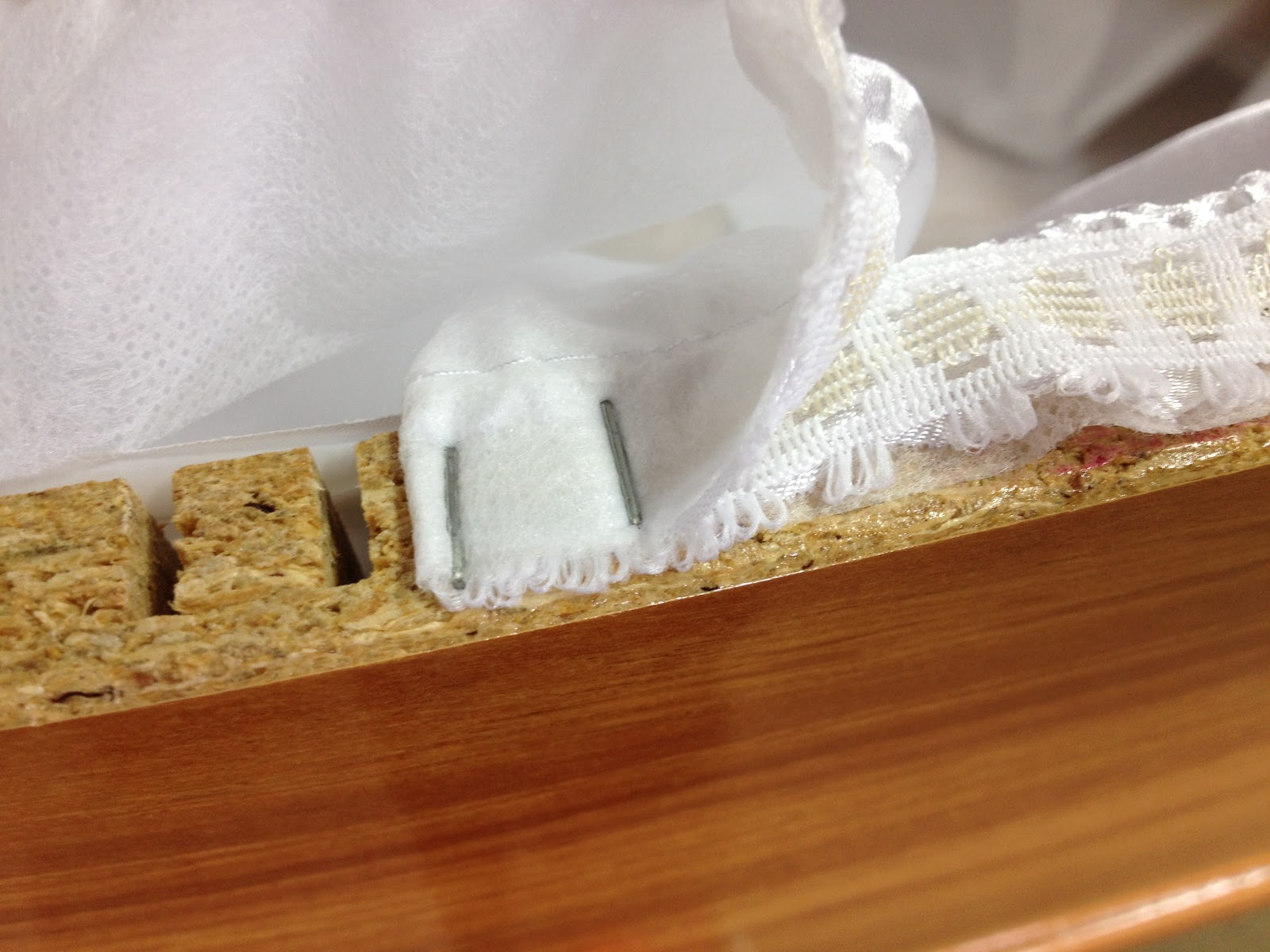
16. Staple the lining along the top of the coffin.  Put the staples under the lace, but into the cloth itself.  Some will put the staples under the cloth into a thinner material but this does not hold very well.  If you staple under the lace then the staples should not be visible.


Stapeling the lining down.

17. As you staple along you will notice the holes for the thumbscrews.  As obvious as this is do not staple across the top of these holes.  Instead place one staple diagonally on either side of the hole.  This will make the lining stay in place while you screw the thumbscrews in and make it easier to find the hole should you need to.  There are three oles on either side of the coffin.
The thumbscrew hole.
Staples on either side of the thumbscrew.
You only need one on each side.
18. When you come to the shoulders you will need to pleat again, making a total of three pleats on each side.  By now you should be accustomed to pleating, but this is a little different.  Fold the lining back in on itself, similar to 'cornering'.  Place one staple vertically on each slot, taking up two slots to do so.  This will make the pleat nice and wide but not too wide as to waste space.


19. Measure the distance between each of the three pleats and make sure it is the same on both sides.  You can use the staple gun, or count the notches.  A little trick is to start and stop at the first and last notches.

Measuring the distance.
Stopping on the last notch.


20. Continue to staple along the sides, remembering to take not of the holes for the thumbscrews and to staple under the lace but into the cloth.

21. Once at the foot end corner the lining again on both sides.  Find the shorter side and star to staple it down with one staple.


22. Fold the two sides of lining over each other, with the longer on top.  Tuck the two ends underneath the middle and staple it down.  Everyone has a different way of finishing the lining, but as long as it is symmetrical and presentable then it will be fine.

Continue here for preparing the lid, including the thumbscrews.

Or go here for how to attach the handles.

~~