Showing posts with label vault. Show all posts

2012-05-30

Funeral Fun - Emptying the crypt

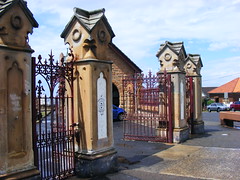
Gates into Waverley Cemetery.
    This was perhaps my favourite day at W.N.Bull.  It was also one of the hardest and dirtiest and even somewhat dangerous.

    Basically the job was to move five coffins in a crypt so it could be renovated.  I had never been in a crypt before but had heard stories.  People described them as dark, damp, dirty, small, boring and slippery.  So I  was actually rather excited and looking forward to it.

The day before we took the stretchers out of the transfer van and filled it with things we might need.  Such as boards, ropes, torches and so on.  Just a variety of things that might be handy if needed.  I was put in the van and sent on a funeral first.  This meant I had to bring a more 'practical' set of cloths as my three piece funeral suit would not be suitable for pulling coffins out of a crypt.

    After the funeral I made my way over to Waverley Cemetery where the crypt was.  As usual I was the first to arrive and so I had plenty of time to sit and eat my lunch.  After all I would soon need my energy.  I sat near the gate so that it was in sight but I was hidden.  It was starting to turn into a miserable day,  it was cold, overcast and looked like rain.  Hardly the sort of weather we wanted.

    Not too much later everyone else started to arrive and we made our way to the crypt.  As they set up I changed into the more suitable work clothes.  It had started to spit rain very lightly and then stopped, I remember one of the other undertakers commenting that he hopped the rain would keep away, even for a little bit.

    When they had opened the door and set up we went inside to assess the situation.  The job involved taking four adult coffins and one baby coffin off shelves and then taking them down one level into a room underneath the crypt.  Unfortunately the door to the basement room under the crypt was directly infront of the door to the crypt itself and actually very small.  It was not so much a 'door' as a small and steep hole with some stairs.  Even better this hole was right in front of the door to the upper level.  So we had to cover it up with boards to be able to get in and out of the upper level.  Then we would have to uncover it to get to the bottom level.
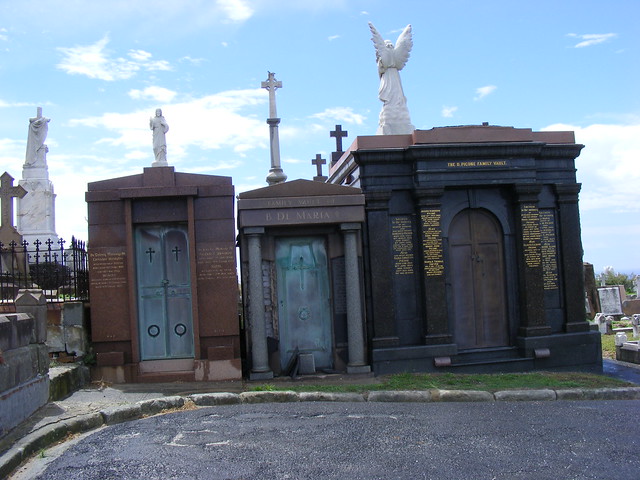
Three crypts at Waverley, the one of the right is very
similar to the one we worked out of.
    The room with the coffins was fairly small, there was not much standing room at all.  And two of the coffins were quite high, at about my head height.  The coffins themselves were also quite heavy, they were solid timber or oak and had an inch of lead lining inside.  Plus half of them had no handels and thus had nothing to tie ropes to.  All of this meant it would be a difficult and somewhat dangerous job.  We had to drag heavy coffins off high shelves in a dark and slippery stone room.  Then we had to slid them through a step hole not much bigger than the coffins themselves.  Finally we would have to lift these heavy coffin up above our heads and onto the shelves in another small and even darker room.

    And there were only four of us.  The grave diggers were not allowed to help due to OH&S issues.  They obviously felt sorry for us and helped how they could, in fact a couple got quite actively involved.  But they were council employees and council diggers cannot by law do certain things.  Such as move coffins (like lowering or carrying them) and so on.  All due to OH&S and insurance issues.

    But what could we do?  There were only four of us and the poor family had waited months for the job to be done.  But our boss had been putting it off.  And a family member was present through the job, he was obviously very upset at seeing his family being moved about but he was also extremely grateful.

    We set to work and moved the two easiest coffins out first.  I remember thinking how difficult it was, that these two coffins were so heavy and how little room there was.  Little did I know that this would be the easiest part of the job.  After taking the  two coffins out we loaded them into the back of the van.  Then we uncovered the hole to the bottom level and started to take the coffins down.

    Here was the trouble, the hole was just big enough to fit the coffins and very step.  We had to tie the coffin with rops, lower it foot first down the hole, then send the smaller person to squeeze between the coffin and the hole and direct it as the others continued to lower.  Guess who was the 'smaller' person, me!  I was to squeeze myself down the hole and direct the coffin until there was enough room for the others to come down and help me.

    This is how we got the first coffin into the room.  But then we had to get it on a shelf.  Because of the lack of room and steepness of the hole we could barely raise the foot end of the coffin to get it onto the shelf.  It kept getting caught on the walls, and with its heavy weight we had a lot of trouble.  But we did it, the first two coffins were on the shelves and done.

    Now it got hard.  The next two coffins were bigger, heavier, had no handels and were higher.  We lifted them up onto sticks while still on the shelves, then we tied ropes around them.  Next I climbed up to the top shelf of the crypt (which had nothing on it except debris and dirt).  I had to lie on this shelf as it was close to the roof and then take a rope to help swing the coffin out.  So there I lay, in the dirt on a cold shelf in a crypt.  All while swinging a heavy coffin down.

    With a lot of trouble and effort we got the last two coffins out.  But they were larger, so getting them down the hole was more difficult.  I remember at one point another undertaker getting his pants caught on the coffin as he tried to squeeze past it to get down the hole.  It was quite funny actually, seing him stuck there by his pants to a coffin!  Even he thought it was funny.  But then the supervisor reminded us that the family was watching and we had to stop giggling.

    In the end we got the job done, but it was very dirty and a lot of work.  When we finished the family member thanked us all personally, he was very grateful for the job and thought we had done well.  And I had so much fun doing it, we all did.  As difficult and dirty as it was it was also very rewarding and seing the job finished was so satisfying.  I really enjoyed the day and the job with good people.

~~

2012-03-01

Funeral Terminology

    There is a bit of specific terminology in the funeral industry.  But actually not that much, especially when compared with other areas such as psychology, medicine, etc.


General Terminology:

  • DC - Death Certificate, the original is essential with all burials and cremations.  Also used as authority to transfer a body.
  • CC - Cremation Certificate, the original is essential with all cremations.
  • Intrim - A temporary DC used to transfer a body.  It is not suitable for burial or cremation.
  • NDY or Not Dead Yet - Someone who is soon to die and is arranging their funeral.

Transfer Terminology:
  • Transfer - The process of moving a dead body prior to any service, such as collecting a body from the hospital to bring to the funeral home.  Or taking the body to the airport to be sent overseas.
  • Transfer Vehicle, Ambulance Hearse - Although 'ambulance hearse' is a much older term often considered inappropriate by many, it can still be used.  Either way this is the vehicle used to transfer the body.  It is usually a white Toyota Hiace van.
  • Ambulance Stretcher, Collapsible Stretcher - A stretcher used to transfer bodies.  It has collapsable legs, like an ambulance stretcher, which fold down and in with the use of a handel.
  • One-Man Stretcher, Carry Stretcher - A stretcher used to transfer bodies.  It has no legs, instead only two wheels on the foot end of the stretcher.  It is much lighter and cheaper than the ambulance stretcher but the lack of legs makes it difficult to carry heavy bodies.
  • Slide Sheets - Large slippery sheets made from parachute material.  They are used to slide or carry bodies about, often in small or awkward spaces.  Although these sheets are not cheap they are durable and reusable.
  • Pat Slides - A flat, thin board, smaller than the average person.  It is used in hospitals and nursing homes as well to slide a body from the bed to stretcher.  Or to slide a body up or down small heights.
  • Evacuation Pod - This is basically like a hammock that is sealed with buckles.  Used to move a body up or down stairs.  One person will hold the long handles at both the foot and head end which makes the weight even and controllable, even down steep stairs or slopes.
  • Seat Slide - A cloth basket like carrier with four handles.  It is used to move a body from a seated position (such as on the toilet or in a chair) and onto the stretcher.
  • Body Bag - A blue large plastic bag made out of tarpaulin like material used for containing and moving a body.  It has a long zipper from head to toe and can be unzipped so it is completely open.  Although most body bags are simple and have no handels lately there have been more with handels, and more cloth style body bags.
  • Valuables - Anything on the body other than clothes.  Such as jewellery, pictures, watches, money, etc.  It does not have to be worth anything.  All valuables should be noted on the transfer sheet and in the mortuary book.
  • ID Tag, Wrist Tag - An armband placed around at least one, but sometimes both wrists of the deceased.  There should always be at least one on the body at all times.  The wirst tag is similar to a hospital or club wrist band, plastic and secured with one press button that cannot be undone once fastened.  Some places use different colours to represent different things, such as yellow for valuables to be returned to the family and blue for valuables to stay with the body or red for no valuables.

Funeral & Hearse Terminology:
  • Goose Neck - The stopper used in a hearse to keep the coffin in place.  It is slotted into special holes along the middle of the hearse and tightened with a horizontal screw with a rubber stopped on the end.
  • Pegs - The small metal 'sticks' used to keep the coffin straight as it is loaded or unloaded from the hearse.  They have rubber on the top to prevent damage to the coffin.
  • Ropes - The long flat ropes used to manually lower the coffin at the grave.
  • Automatic Lower - A device used at the graveside to lower coffins automatically.  It can only be used on certain lawn graves.  Basically it uses clockwork style gears inside to keep the speed steady and slow.
  • Wing Droos, Side Doors - When referring to the hearse this is describing the small doors on either side that open to the space under where the coffin sits.  The space underneath the coffin is completely hollow and designed to store things, these doors give access to that area.
  • Coffin Bars - Long bars used to carry a coffin.  At least two are placed under the coffin, one at each end, and one person will carry the bar on either side.  This means at least four people will carry the coffin with both hands, which makes it much easier.
  • Catafalgue - A special and specific object at crematoriums.  This is what the coffin is placed on at the crematorium, be it fixed to the front or movable and on wheels.
  • Crypt, Vault - A special above ground 'burial' for the deceased.  Usually refers to a small stone building where four to ten coffins can sit on each level.  It sometimes has two levels, one on the surface and one underground.
  • Cortege - The process of cars following the hearse.  They should (by law) have their lights on, but not hazard lights or high beams.  The cortege should also have right of way (by law) at roundabouts and other intersections without lights.  It is also highly illegal to cut-off a cortege, but this is difficult to prove or police.
  • Police Cortege, Police Honour Guard - A special cortege which has police guiding it or blocking traffic at least part of the way.  Very rare now with few funerals having police escorts unless the deceased had direct ties to the police or was extremely important.  This type of cortege will often speed slightly and run read lights.  They will also follow each other a lot closer in this type of cortege.
  • Family Car, Mourning Car - The car provided by the funeral company to transport the family, friends of the deceased or the priest or celebrant.  For example Greek Orthodox funerals must provide a free car for the priest, although they will often charge the family secretly.
  • Zink Liner - A special inside lining made of zink.  It is used for international transfers or for coffins going into a vault.  The zink liner prevents fluids and gases getting in or out of the coffin.
  • Grave Marker - A simple marker used to indicate where someone was recently buried.  It can be used temporarily or in lieu of a gravestone.  Most often it is a simple white wooden cross.

Mortuary Terminology:
  • TP - A temporary, simple embalming of the body.  It is much quicker and easier than a complete embalm.
  • Aneurysm Hook - Perhaps one of the most useful and versatile tools in the mortuary.  And it looks and feels great! With a flat hook on one end and a rounded scraper on the other it can be used in endless ways.  Plus the gap in the middle makes it great for tying suture corde to, this means the needle wont go falling off the table.
  • Forceps - Scissor like tool that seals, grabs and clamps rather than cuts.
  • Trocar - An ancient device used to inject and/or remove fluids from a body.
This is a picture of just about every tool used in embalming or the mortuary in general.  Starting from left to right at the top you can see the trocar, other similar fluid removing/adding tools, forceps and clamps and finally the different gauges of needles used for suturing and other such tasks.  On the second, bottom row we see scalpels, scissors, a few different aneurysm hooks, tweezers and finally different attachments for the trocar.


~~