Showing posts with label toyota. Show all posts

2012-03-21

The Transfer Van: How the dead are transported

The Toyota Hiace
    The transfer van is something that is so important, an essential part of society, and yet almost nobody knows it even exists.  This is not because we do not actively avoid it.  Instead it is just something which nobody is told or thinks about.  Thus I thought it was about time i brought the transfer van out of the dark.

    One of the things that surprises people about the transfer van is that it is literally a van and nothing special.  People often believe the body is transported in a special vehicle designed for the job, much like a hearse if not a hearse.  When I tell them that it is a van, often a Toyota Hiace, they are surprised but not shocked.  Nobody has ever expressed displeasure with the thought of their loved one, or themselves, being transfered in a van.  It is just something they never thought about rather than something they disliked.

    I should not that there are actual state and national laws on what vehicles can transport a body.  Because I do now fully know these laws or regulations I will not go into them in detail.  But basically the vehicle has to have an airtight seal between the driver and the body.  The compartment the body is held in must also have decent ventilation to the outside.  Thus one cannot just transport a body in the back of any car.

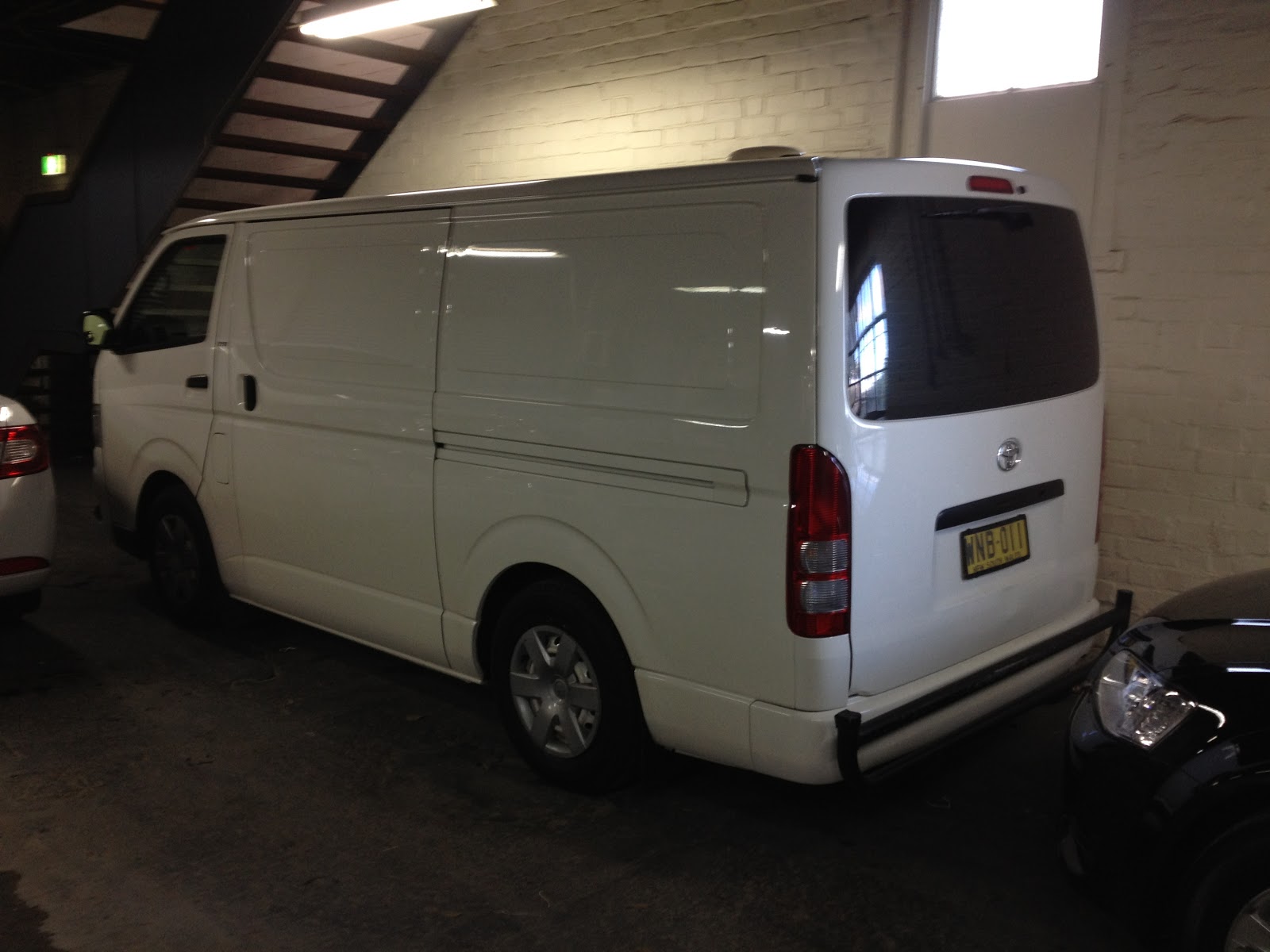
    Now for the transfer vehicle itself.  The most common is the Toyota Hiace (pictured right and below) as it is cheap, practical and so reliable.  The Hiace is used by 'Statewide' and 'Mortuary Services Support' (dedicated transfer companies) and many funeral homes.  It is just such a reliable van, I remember how we would run our Hiace up and down freeways for days on end and it never missed a beat.  Plus it is actually quite cheap (to run and buy) which makes it quite a good option from a financial point of view for the company.  All of this is exactly what one wants in the transfer car, last thing anyone wants is to be broken down with a body on board.  The next most common would be a basic Mercedes Van, this is used primarily be InvoCare transfer crews.  It is more expensive to buy than the Hiace, but InvoCare is not just rich, they are also happy and willing to spend money if it is justified.  The Mercedes is a much nicer van inside and outside with better airconditioning and more legroom for the drivers.  However there are other much less common transfer vehicles, I remember an interstate transfer company arrived with a really odd custom built car.  It was like a ute which's tray was a large single and sealed box.  This thing was apparently from the 1980s and on its second engine, which had done over 5 million kilometres.

    Because the Toyota Hiace is the most common transfer vehicle I will primarily look at this as the example of the transfer van.  In the back of the Hiace is an automatic 'lift' (pictured below) which can be raised or lowered.  This makes it possible for the van to hold four bodies at once and because the lift can be lowered it makes 'loading up' the body much easier.  One can simply lower the lift to waist hight rather than have to lift the body to head hight.  Inside the Hiace there is the divider, this divider is not only the airtight seal but also practical because it has so many shelves.  Here is where we keep the body bags, slide sheets, gloves, hand sanitisers, street map and so on.

    One massive drawback to the Hiace is that it is rather top heavy once the lift is installed.  A transfer van, exactly the same as the one featured in this post, actually flipped on its side in Melbourne only a couple of years ago.  When driving it you could really feel this top heaviness.  It was obviously impossible to take any corner too fast or the van would fall over.


Inside the cabin of the Hiace.

Inside the back of the Hiace with the lift raised.

Inside the back of the Hiace with the lift lowered.

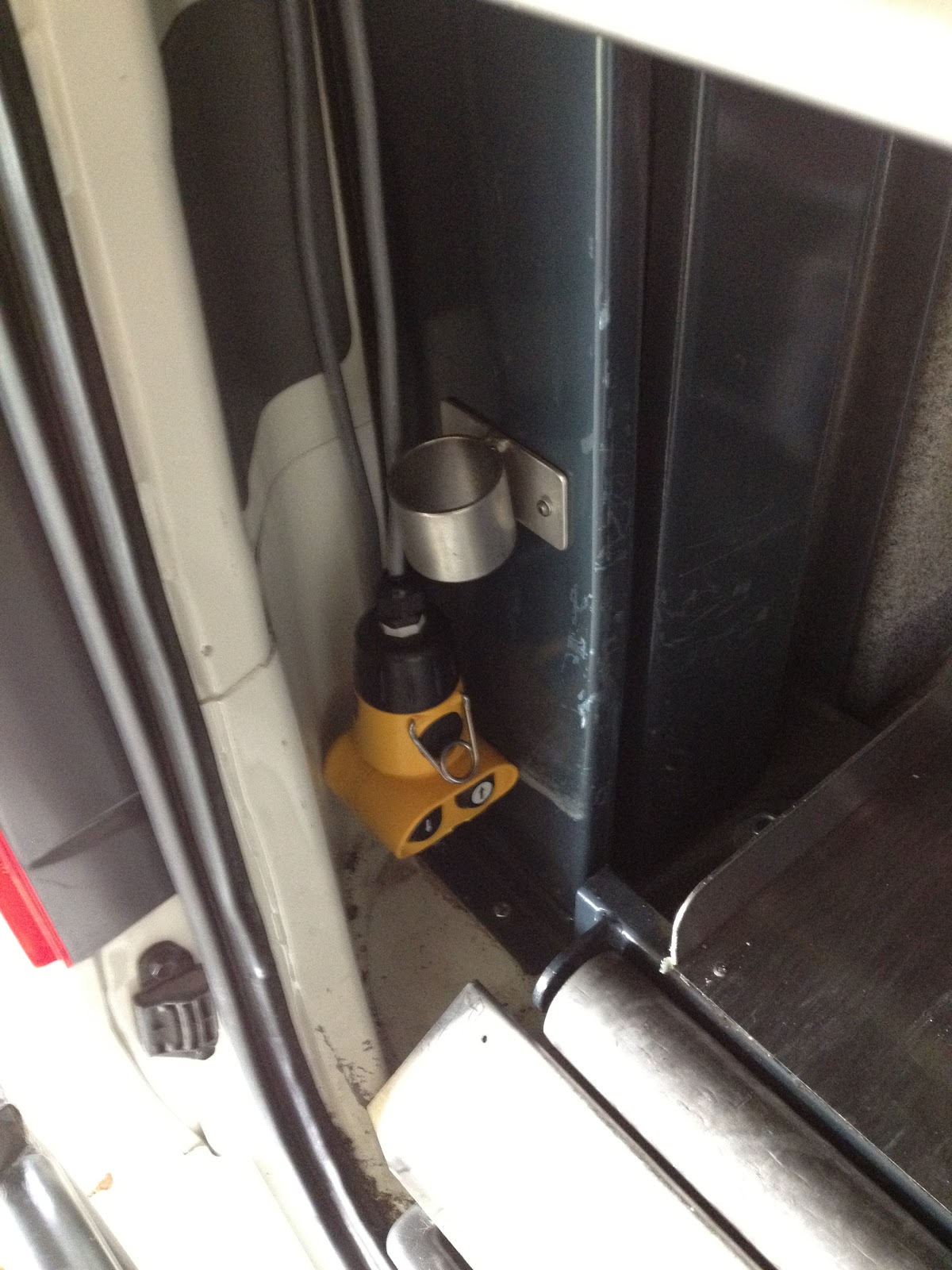
The switch to raise and lower the lift.

Stretchers sitting inside the van.

The clamp used to keep the stretchers in place.
Our transfer van, back in the garage after a long day.
The transfer stretchers.
The leg-less one is lying upside down and on top of the one with legs

Inside the transfer van with no stretchers.


    This is what we will all ride in one day, a white van.  It is literally the second last thing most people will be driven in after they die (the last being the hearse).

~~

2012-03-14

Ignoring the Dead & the Consequences

    One of the biggest issues with the funeral industry is a lack of thought or discussion about it.  Not because it is a taboo or inappropriate subject, but for other reasons such as a lack of information and an odd idea that others find it upsetting or taboo.  This lack of discussion leds to serious issues and deregulation.

    Many argue that it is a 'hidden industry' and that most people do not want to know about it.  Either that it is taboo, upsetting or just something to keep quiet.  However I disagree with this entirely.  People are almost always quite happy to talk about it, and actually really interested in the industry.  This is why it started 'The Other Side of Funerals', to feed people the information they crave.

    It was almost surprising the first time I saw the white Toyota van and was told that it was the transfer vehicle.  It was very unexpected to find out that the body is picked up and brought to the funeral home in the back of a Toyota Hiace van.  What was more surprising is how I had never actually thought about this. About how the body is moved about, I knew they would die in hospital then turn up in a coffin at the funeral.  Everything in the middle was an absence, an area I had never avoided because I had never even considered it.  And I think this is the case for most people.  It is not a topic we avoid thinking or talking about, but a topic we never think or talk about.

    When driving families whilst on funerals I never brought up the topic of how the industry worked.  But it was surprising how often and keenly the family asked me about it.  Especially once they realised that I would be open, honest and still quite diplomatic and not graphic about the industry.  One would consider this to be an inappropriate time to discuss these things.  Here they are, in a black car following a hearse containing the body of their loved one.  Yet they always appreciated it, now knowing for sure that their loved one had been treated respectfully and what the basics of the process was.  I never once had a bad reaction from those who asked about the industry.

    A certain mortician at Westmead Hospital once told me about how the hospital had an open day one a year.  And once the heads of the hospital had asked if the mortuary would be appropriate or possible to include in tours.  The mortuary staff agreed, saying they had no issue with showing and explaining to people about the mortuary.  Then the first open day rolled around which would include the mortuary, the staff did not thinking many of the public would be willing or interested.  Yet they had too many people, the day was scheduled to shut at 16:00 and he said they were still letting people inside well after 19:00.  It was a huge success and very popular.  So popular in fact that the hospital then started regular tours, first focusing on bringing people from the military, police, fire brigade and so on, the aim was to let them experience a body and understand the mortuary.  But after a while the mortuary staff put a stop to the tours as they were becoming a 'freak show'.  The hospital even went as far as to invite young boy scouts to see the bodies and mortuary.  So the public is so keen and willing to see a mortuary.

    This defies what I have experienced at most hospitals.  Mortuaries are never labelled on maps or the doors, the only two exceptions I know of being Concorde and Westmead.  Instead the mortuary is down a corridor at the end of a car park and behind doors that look as though they lead to a closet.  Hospitals do their best to hid the fact that they have a mortuary, almost as though admitting its existence would be telling the patients that they will die.  They hide the mortuary as though they are hiding the fact of death within their hospital.  Yet the one time that I know of where they publicised its existence and even held tours it was hugely popular.

    Because we never think of the industry there are a lot of areas and processes which exist, yet are unknown.  They are blankes in how we think.  perhaps the best example in the movement of the body; tehy die in a nursing home and arrive at the funeral already in a coffin.  But how did this happen, how did they make it to the funeral home or into the coffin?  You probably do not know and yet it happens every day.

    There is a lot of misunderstanding about the industry.  Because many do not know much about it they believe the strangest things.  A great one is that gravediggers steal belongings from coffins, a really odd idea.  They barely have time to eat lunch let alone open a whole coffin on the chance that they would get something of value.  Or that undertakers will break a persons legs to fit them in the coffin when breaking legs involves so much work compared to bending them (you bend your legs all the time when you walk or sit, it is not hard), or getting just a bigger coffin.

    But why is it such a hidden and misunderstood industry?  If we are not against talking about it then why do we never actually talk about it?  I have heard many argue that it is a taboo topic, something inappropriate to discuss.  These people then go on to argue how this is changing over time and the industry is now more 'appropriate' to talk about.  While this may have once been true it is no longer the case these days at all.  As I said before, people are really interested in the industry and very rarely take offence to anything said.  There are two reason I believe people do not know about funerals.  The first being that they think others will be offended or find in inappropriate or upsetting.  Discussing how a body is moved and handled could upset someone whose loved one recently died.  And yet this is rarely if ever the case.  People are often more interested as they now have been involved in the process.  Plus they like to know how their loved one was treated.  The second reason is that people have little information about the industry.  How many know someone who works as an undertaker, gravedigger or another similar role?  How many have read a book or seen a movie about the funeral industry and not just one set in the industry?  There is actually rather little information or acknowledgement of the industry.

    So now you might be asking what the result of this lack of knowledge leads to.  Well, it has a direct and serious impact on the industry as a whole.  The first, and most important to many, case is with hospitals.  They hid the morgue for various reasons and this lets the place be mis-managed.  Most hospitals have decent morgues, clean enough and organised well enough.  I have noticed that those with dedicated and full-time staff are by far the best, especially compared to just having casual support staff who take care of the morgue along with many other duties.  Westmead is a good example, with dedicated staff who are responsible for everything they are also proud of everything.  The place is so neat and clean that the blue floors would be more hygienic than your kitchen stove.  With not even a paint chip or scuff mark to be seen then place is actually really nice inside.  At Westmead they also signpost the location of the mortuary, not hiding it from anyone.  However RPA there is no sign to identify it, the mortuary is located in the middle of a service corridor, scuff marks along the walls, rubbish and food processing nearby.  The support staff are always late to arrive, often making funeral staff wait an hour or more, which is then tacked onto the cost of the funeral for the family.  RPA is hated by many in the industry (myself included) and we would never want to have a loved one die in that hospital.  And it use to be worse, much worse.  The old mortuary was even more run-down and mis-managed to the point where they found a dead baby behind a fridge when renovating.  Hiding the mortuary lets problems bread and does not help anyone.

    Another issue from a lack of thought is the deregulation of the industry.  If one wants to become a funeral director all they really need is a briefcase, phone, fax and computer.  Everything else from mortuary to hearse and even staff can be leased out for the day by these "briefcase funeral directors".  The result is that they have little control or influence in the process, allowing for all kinds of misconduct and mistakes.  It was actually rather amusing but when I started in the industry it was discovered that a small catering company who had never organised a funeral got given an important state funeral in Canberra.  Obviously they were the lowest bidder andas such who knows what the funeral was like.  There are no qualifications or credentials needed to join the funeral industry, if you want to join all you should have is a drivers license, and even that is optional.  This deregulation is also having an impact in transfers.  I have heard stories from funeral directors where they have done police transfers, pulling bodies out of cars or taking them from the crime scene to the coroners.  And all they get is a regular suit and a pair of latex gloves.  Appart from the gloves there is little to no protective equipment.  It is not like the movies, or like America, where the coroners has a special and dedicated transfer crew.  Instead in Australia it is just a local funeral home who will take the body from one place to the next.  Yes, just a couple of undertakers working for minimum wage, with no training and no protective equipment are the ones who transfer bodies about.

    Overall the funeral industry is a hidden and unknown one.  But not because it is taboo so much as people do not know about it and some think it will offend people.  This lack of public knowledge lends room for misconduct and deregulation.  No qualifications or training is needed to become a funeral director or transfer bodies from crime scenes or anywhere else.  If the public would look at the industry a little closer regulations which are desperately needed could be introduced.  The public would also find the work and processes to be a lot less upsetting, taboo or grose than thought.

~~

2012-03-01

Funeral Terminology

    There is a bit of specific terminology in the funeral industry.  But actually not that much, especially when compared with other areas such as psychology, medicine, etc.


General Terminology:

  • DC - Death Certificate, the original is essential with all burials and cremations.  Also used as authority to transfer a body.
  • CC - Cremation Certificate, the original is essential with all cremations.
  • Intrim - A temporary DC used to transfer a body.  It is not suitable for burial or cremation.
  • NDY or Not Dead Yet - Someone who is soon to die and is arranging their funeral.

Transfer Terminology:
  • Transfer - The process of moving a dead body prior to any service, such as collecting a body from the hospital to bring to the funeral home.  Or taking the body to the airport to be sent overseas.
  • Transfer Vehicle, Ambulance Hearse - Although 'ambulance hearse' is a much older term often considered inappropriate by many, it can still be used.  Either way this is the vehicle used to transfer the body.  It is usually a white Toyota Hiace van.
  • Ambulance Stretcher, Collapsible Stretcher - A stretcher used to transfer bodies.  It has collapsable legs, like an ambulance stretcher, which fold down and in with the use of a handel.
  • One-Man Stretcher, Carry Stretcher - A stretcher used to transfer bodies.  It has no legs, instead only two wheels on the foot end of the stretcher.  It is much lighter and cheaper than the ambulance stretcher but the lack of legs makes it difficult to carry heavy bodies.
  • Slide Sheets - Large slippery sheets made from parachute material.  They are used to slide or carry bodies about, often in small or awkward spaces.  Although these sheets are not cheap they are durable and reusable.
  • Pat Slides - A flat, thin board, smaller than the average person.  It is used in hospitals and nursing homes as well to slide a body from the bed to stretcher.  Or to slide a body up or down small heights.
  • Evacuation Pod - This is basically like a hammock that is sealed with buckles.  Used to move a body up or down stairs.  One person will hold the long handles at both the foot and head end which makes the weight even and controllable, even down steep stairs or slopes.
  • Seat Slide - A cloth basket like carrier with four handles.  It is used to move a body from a seated position (such as on the toilet or in a chair) and onto the stretcher.
  • Body Bag - A blue large plastic bag made out of tarpaulin like material used for containing and moving a body.  It has a long zipper from head to toe and can be unzipped so it is completely open.  Although most body bags are simple and have no handels lately there have been more with handels, and more cloth style body bags.
  • Valuables - Anything on the body other than clothes.  Such as jewellery, pictures, watches, money, etc.  It does not have to be worth anything.  All valuables should be noted on the transfer sheet and in the mortuary book.
  • ID Tag, Wrist Tag - An armband placed around at least one, but sometimes both wrists of the deceased.  There should always be at least one on the body at all times.  The wirst tag is similar to a hospital or club wrist band, plastic and secured with one press button that cannot be undone once fastened.  Some places use different colours to represent different things, such as yellow for valuables to be returned to the family and blue for valuables to stay with the body or red for no valuables.

Funeral & Hearse Terminology:
  • Goose Neck - The stopper used in a hearse to keep the coffin in place.  It is slotted into special holes along the middle of the hearse and tightened with a horizontal screw with a rubber stopped on the end.
  • Pegs - The small metal 'sticks' used to keep the coffin straight as it is loaded or unloaded from the hearse.  They have rubber on the top to prevent damage to the coffin.
  • Ropes - The long flat ropes used to manually lower the coffin at the grave.
  • Automatic Lower - A device used at the graveside to lower coffins automatically.  It can only be used on certain lawn graves.  Basically it uses clockwork style gears inside to keep the speed steady and slow.
  • Wing Droos, Side Doors - When referring to the hearse this is describing the small doors on either side that open to the space under where the coffin sits.  The space underneath the coffin is completely hollow and designed to store things, these doors give access to that area.
  • Coffin Bars - Long bars used to carry a coffin.  At least two are placed under the coffin, one at each end, and one person will carry the bar on either side.  This means at least four people will carry the coffin with both hands, which makes it much easier.
  • Catafalgue - A special and specific object at crematoriums.  This is what the coffin is placed on at the crematorium, be it fixed to the front or movable and on wheels.
  • Crypt, Vault - A special above ground 'burial' for the deceased.  Usually refers to a small stone building where four to ten coffins can sit on each level.  It sometimes has two levels, one on the surface and one underground.
  • Cortege - The process of cars following the hearse.  They should (by law) have their lights on, but not hazard lights or high beams.  The cortege should also have right of way (by law) at roundabouts and other intersections without lights.  It is also highly illegal to cut-off a cortege, but this is difficult to prove or police.
  • Police Cortege, Police Honour Guard - A special cortege which has police guiding it or blocking traffic at least part of the way.  Very rare now with few funerals having police escorts unless the deceased had direct ties to the police or was extremely important.  This type of cortege will often speed slightly and run read lights.  They will also follow each other a lot closer in this type of cortege.
  • Family Car, Mourning Car - The car provided by the funeral company to transport the family, friends of the deceased or the priest or celebrant.  For example Greek Orthodox funerals must provide a free car for the priest, although they will often charge the family secretly.
  • Zink Liner - A special inside lining made of zink.  It is used for international transfers or for coffins going into a vault.  The zink liner prevents fluids and gases getting in or out of the coffin.
  • Grave Marker - A simple marker used to indicate where someone was recently buried.  It can be used temporarily or in lieu of a gravestone.  Most often it is a simple white wooden cross.

Mortuary Terminology:
  • TP - A temporary, simple embalming of the body.  It is much quicker and easier than a complete embalm.
  • Aneurysm Hook - Perhaps one of the most useful and versatile tools in the mortuary.  And it looks and feels great! With a flat hook on one end and a rounded scraper on the other it can be used in endless ways.  Plus the gap in the middle makes it great for tying suture corde to, this means the needle wont go falling off the table.
  • Forceps - Scissor like tool that seals, grabs and clamps rather than cuts.
  • Trocar - An ancient device used to inject and/or remove fluids from a body.
This is a picture of just about every tool used in embalming or the mortuary in general.  Starting from left to right at the top you can see the trocar, other similar fluid removing/adding tools, forceps and clamps and finally the different gauges of needles used for suturing and other such tasks.  On the second, bottom row we see scalpels, scissors, a few different aneurysm hooks, tweezers and finally different attachments for the trocar.


~~

2012-02-13

Transfers; Moving the dead

A Toyota transfer van.
    Not many people know of the 'transfer'.  What it is or even the fact that it happens.  When one sees a while van outside a hospital they would assume it was a courier.  However this is not always the case, it might just well be a transfer crew.

    At this point you might be asking what a transfer is.  Simply put it is the process of moving a body from one place to another.  When someone dies in a hospital, their home or somewhere else they need to get to the funeral home.  This is what a transfer is.


Who 'Transfers' a Body?
    Generally funeral company employees such as undertakers will do the transfer.  There are also transfer companies who do not do funerals or anything other than transferring bodies about.  These companies generally deal with the more difficult transfers such as interstate or after hours.  No qualifications or training is needed to do a transfer.  The transfer crews are just regular people on minimum wage and have no equipment other than a pair of gloves.  This is the same with police transfers, there is no government group who transfer bodies.  In other words a couple of undertakers will move the body from the crime scene to the coroners.


Types of Transfers:
    There are four main types of transfers; house transfers, nursing home transfers, hospital transfers and relocation transfers.  You can click on the links to get more details, but here is a short summary:

    House transfer - the act of removing a body from a home or private residence to take to a funeral place.  This is the most intimate and personal form of transfer, and has the most chance for the family to be present.  It is also the most unpredictable transfer.

    Nursing home transfer - the act of removing a body from a nursing home to take to a funeral place.  This is a fairly intimate and delicate transfer.  There will be other residents, relatives and patients who know why the transfer crew are there and will not like it.  The family, or other residents might be there watching.

    Hospital transfers - the act of removing a body from a hospital to take to a funeral place.  This is not really an intimate form of transfer.  It is in fact one of the easier, simpler and predictable.

    Relocation transfer - the act of collecting a body from the coroners to take to a funeral place or the act of collecting a body to take to the coroners, hospital or somewhere else.  It can involve police jobs (such as murders, suicides, accidents, etc) and other random work.  This is a highly unpredictable form of transfer.


Inside a transfer van.
The Transfer Vehicle:  
    A transfer vehicle is just a while van.  Some places use a station-wagon at nursing homes or houses to be more "discreet".  Yet in almost all cases a Toyota Hiace is used to transfer the dead.  A few funeral companies such as InvoCare use white Mercedes vans, but the vast majority use a Toyota Hiace.  The transfer can can hold four bodies at a single time thanks to a shelf in the middle.  This shelf uses a hydraulic system so it can be raised and lowered to make getting bodies in and out easier.

    Not just any car can be used to transfer a body.  I do not know the specifics but in NSW a transfer vehicle must have a a airtight compartment for the body, sealed and separated from the driver.  This compartment must also vent to the outside of the car.  However not all transfer vehicles meet either of these requirements.  But either way one cannot just collect a body from a hospital in a regular car.  Although some have tried.

    For more information and photos of a transfer van go to this post.


Stretchers:
Two stretchers on top of each other.
The 'carry' stretcher is on top of the ambulance stretcher.
    There are two main types of stretchers.  The cheaper and simpler type is the "two man" or "carry" stretcher.  This stretcher has two wheels at the foot end and no wheels at the head end.  The other thing is that the wheels on this stretcher are fixed and cannot be raised or lowered.  Which means the stretcher has to be carried about.  This means the carry stretcher is quite light and piratical in areas where a lot of carrying is needed.

    The other type of stretcher is the "ambulance" or "collapsable" stretcher.  This stretcher has four wheels on the end of legs.  So the legs, and the whole stretcher, can be raised and lowered.  A benefit is that the stretcher can be raised to bed hight and that the stretcher does not need to be carried.  The down side is that this stretcher is quite expensive and heavy.

    The ambulance stretcher was my favourite, loading it up into the back of the transfer van had such a satisfying click and clank.


Foot First:
    A body always travels foot first when going anywhere.  This means the zipper on the stretcher and body bag must be at the head end.  It also means the body should go into a vehicle, be it a transfer van or hearse, foot first.  So that as the car drives the body travels foot first.  The other thing is that a body should be wheeled or carried on the stretcher foot first.

    This actually has a rather practical reason.  Bodies are liable to 'purge' which is not nice.  Purging is basically when a body 'leaks' fluids out of the mouth or nose.  To prevent this one must always keep the head higher than the torso.  So when carrying a body down stairs take it foot first.


Identity & Name Tags:
    This is perhaps the most important aspect of the transfer.  Making sure you have the correct body.  It is obviously very important as collecting or identifying the wrong body could have serious consequences.  So the correct name tage has to be on the correct body.

    The first thing you should do is check to make sure you have the right body.  In a hospital look for ID tags on their wrists, all patients wear them.  Nursing homes do not generally have a good ID system, so you will have to rely on the nurses.  Generally the best you can do outside a hospital or the coroners is hope and go by what others say.

    Next you will need to place your own ID tag on the body.  Contrary to popular belief the funeral industry does not use toe tags.  I explain the reasons why we use wrist tags and why toe tags are never used in this post here.


Paperwork:
    The appropriate paperwork is essential.  You cannot and must not ever move a body without a DC (death certificate) or an interim.  An interim is a temporary document to say the person is dead, it allows one to transfer a body and to start the paperwork for a funeral.  However a DC will be needed for a burial or cremation and to actually go through with the funeral.

Things to ask about the paperwork:
- Is it the original?
- Is it filled out correctly?
- Does it have the name of the deceased (the exact and correct name)?
- Does it have a date of death?
- Has it been signed?

    There are more specifics, such as a DC must also list cause of death and duration for the cause.  However these other specifics vary and are too numerous to list here.

    The other thing to not with paperwork is if the body is going to be cremated a CC (cremation certificate) will be needed.  You will not need a CC to transfer or bury the body but it is a must for cremations.  The price differs with each state, in NSW it is $88 but it is only $65 in QLD (as far as I am told).  The other thing is a CC will cost $88 to get from the hospital which has to be paid for by check.  So make sure if the body is due for a cremation that you wither have a check to get the CC or payment has been arranged.  And do not forget to actually collect the CC!!

    With the DC and CC check to see if the body has a pacemaker.  If there is a pacemaker or other "battery" device inside the body then it must be removed before cremation.  They explore in the crematorium and can do serious damage.

    At the end of the day actively check all paperwork.  There are little issues to look for, like question10 on a CC is often missed by doctors because it is in small writing and right where the paper is usually folded.  So the fold hides the question, and it is an important question.


Valuables:
    All items need to be catalogued and recorded, to do so they are grouped under 'valuables'.  Valuables are the items on or with the body other than clothing.  Anything and everything on the body is considered a valuable.  These items might not actually have any real 'value' but they are all treated as precious.  I remember one valuable was just a piece of string, but it was important to the deceased and the family.  So we treated it as though it carefully.

    Not everything is a valuable.  Clothing, while recorded and catalogued, are not counted as valuables and have their own section.  Things in the room with the decease are also not valuables unless told otherwise.  Basically valuables are only what is on the body and going with the body.

    Always count and record valuables!  But do not be too specific.  For example with a diamond gold ring one would write "yellow coloured metal ring with white stone".  It is unknown for sure if the ring is gold and the stone is a diamond, so just describe it visually and simplistically.  Too much detail might be incorrect or confusing.


Pay & Experience:
    I get asked this a lot.  Many people assume that those who transfer bodies get paid a fortune.  That it is a job so few want to do that it must pay well.  Or they assume there is lots of training and equipment needed.  Truth is that it is a minimum wage job with no safety equipment other than a pair of regular gloves.  The only thing needed to transfer a body is a drivers license.


Links and Further Information:

- To learn about what becomes of medical waste and the cadaver go here.

- To read about wrist tags and why toe tags are not used go here.

- For pictures and a description of a transfer van go here.

- For information and descriptions about body bags go here.

- To read a funny and rather unusual story about a transfer go here.

- For funeral industry terminology go here.

An~~