

Showing posts with label stretcher. Show all posts
Showing posts with label stretcher. Show all posts
2012-06-10
The Transfer Stretcher


2012-03-21
The Transfer Van: How the dead are transported
 |
| The Toyota Hiace |
One of the things that surprises people about the transfer van is that it is literally a van and nothing special. People often believe the body is transported in a special vehicle designed for the job, much like a hearse if not a hearse. When I tell them that it is a van, often a Toyota Hiace, they are surprised but not shocked. Nobody has ever expressed displeasure with the thought of their loved one, or themselves, being transfered in a van. It is just something they never thought about rather than something they disliked.
I should not that there are actual state and national laws on what vehicles can transport a body. Because I do now fully know these laws or regulations I will not go into them in detail. But basically the vehicle has to have an airtight seal between the driver and the body. The compartment the body is held in must also have decent ventilation to the outside. Thus one cannot just transport a body in the back of any car.
Now for the transfer vehicle itself. The most common is the Toyota Hiace (pictured right and below) as it is cheap, practical and so reliable. The Hiace is used by 'Statewide' and 'Mortuary Services Support' (dedicated transfer companies) and many funeral homes. It is just such a reliable van, I remember how we would run our Hiace up and down freeways for days on end and it never missed a beat. Plus it is actually quite cheap (to run and buy) which makes it quite a good option from a financial point of view for the company. All of this is exactly what one wants in the transfer car, last thing anyone wants is to be broken down with a body on board. The next most common would be a basic Mercedes Van, this is used primarily be InvoCare transfer crews. It is more expensive to buy than the Hiace, but InvoCare is not just rich, they are also happy and willing to spend money if it is justified. The Mercedes is a much nicer van inside and outside with better airconditioning and more legroom for the drivers. However there are other much less common transfer vehicles, I remember an interstate transfer company arrived with a really odd custom built car. It was like a ute which's tray was a large single and sealed box. This thing was apparently from the 1980s and on its second engine, which had done over 5 million kilometres.
Because the Toyota Hiace is the most common transfer vehicle I will primarily look at this as the example of the transfer van. In the back of the Hiace is an automatic 'lift' (pictured below) which can be raised or lowered. This makes it possible for the van to hold four bodies at once and because the lift can be lowered it makes 'loading up' the body much easier. One can simply lower the lift to waist hight rather than have to lift the body to head hight. Inside the Hiace there is the divider, this divider is not only the airtight seal but also practical because it has so many shelves. Here is where we keep the body bags, slide sheets, gloves, hand sanitisers, street map and so on.
One massive drawback to the Hiace is that it is rather top heavy once the lift is installed. A transfer van, exactly the same as the one featured in this post, actually flipped on its side in Melbourne only a couple of years ago. When driving it you could really feel this top heaviness. It was obviously impossible to take any corner too fast or the van would fall over.
 |
| Inside the cabin of the Hiace. |
 |
| Inside the back of the Hiace with the lift raised. |
 |
| Inside the back of the Hiace with the lift lowered. |
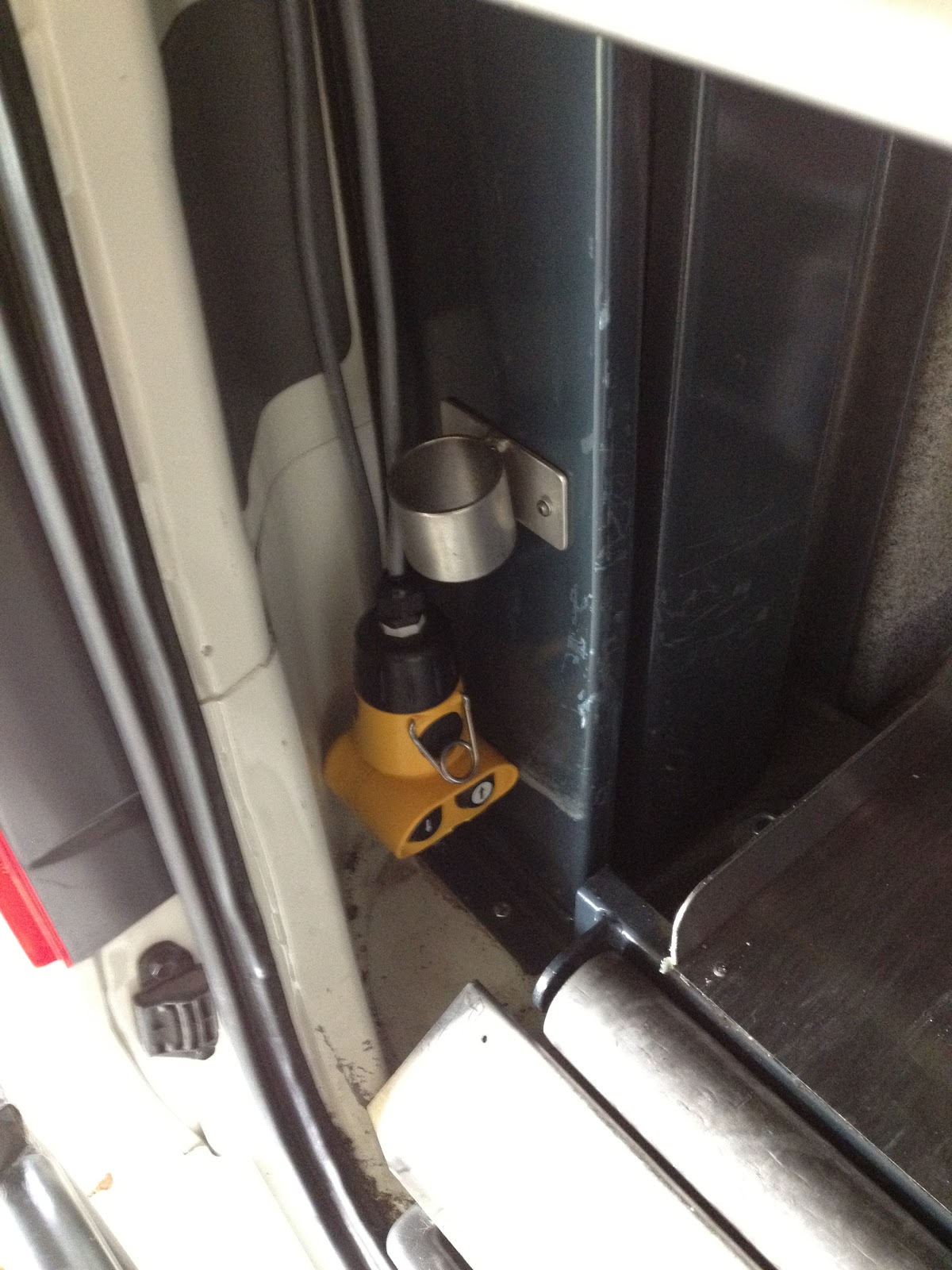 |
| The switch to raise and lower the lift. |
 |
| Stretchers sitting inside the van. |
 |
| The clamp used to keep the stretchers in place. |
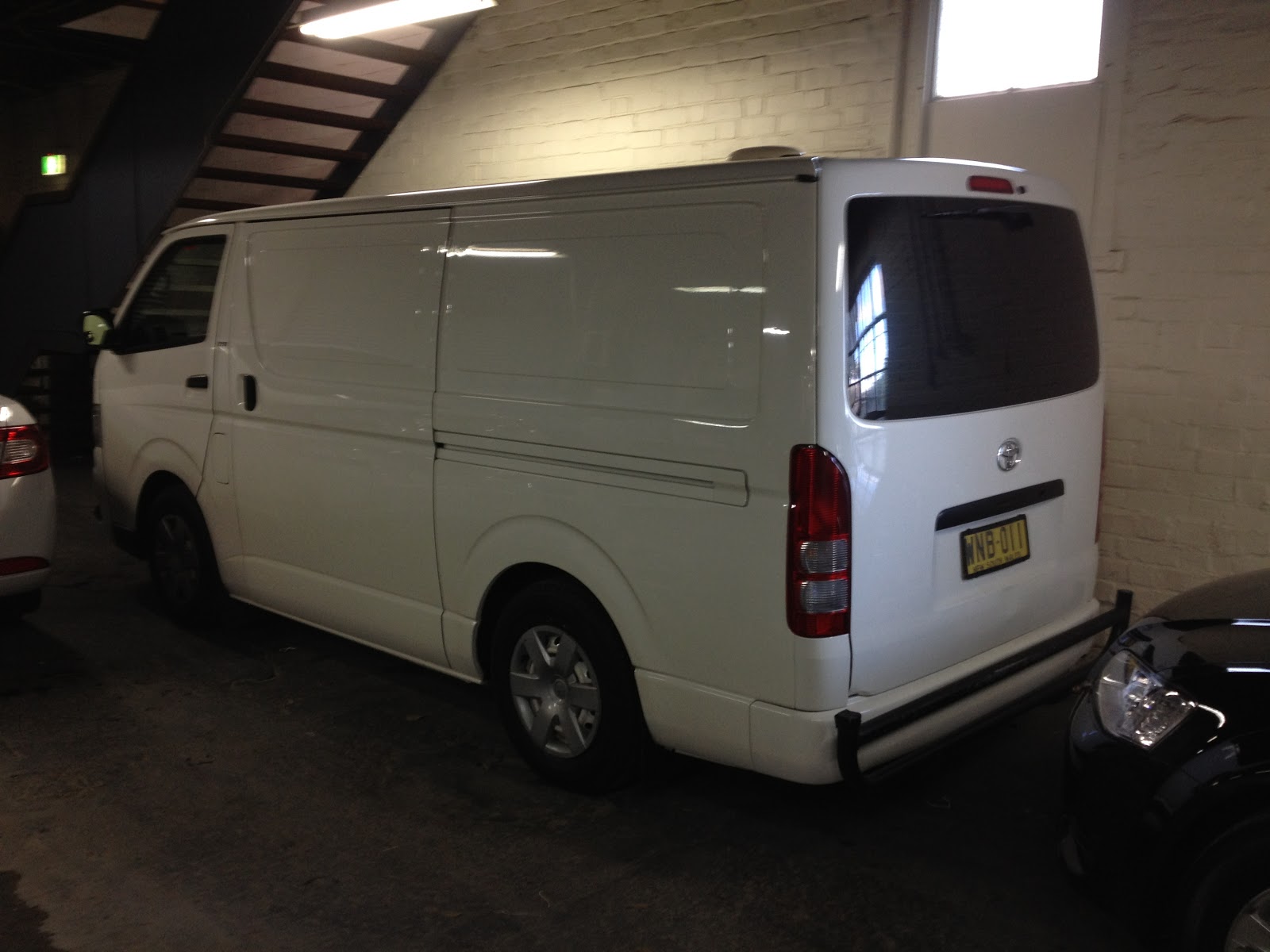 |
| Our transfer van, back in the garage after a long day. |
 |
| The transfer stretchers. The leg-less one is lying upside down and on top of the one with legs |
 |
| Inside the transfer van with no stretchers. |

This is what we will all ride in one day, a white van. It is literally the second last thing most people will be driven in after they die (the last being the hearse).
~~
2012-03-01
Funeral Terminology
There is a bit of specific terminology in the funeral industry. But actually not that much, especially when compared with other areas such as psychology, medicine, etc.
General Terminology:
General Terminology:
- DC - Death Certificate, the original is essential with all burials and cremations. Also used as authority to transfer a body.
- CC - Cremation Certificate, the original is essential with all cremations.
- Intrim - A temporary DC used to transfer a body. It is not suitable for burial or cremation.
- NDY or Not Dead Yet - Someone who is soon to die and is arranging their funeral.
Transfer Terminology:
- Transfer - The process of moving a dead body prior to any service, such as collecting a body from the hospital to bring to the funeral home. Or taking the body to the airport to be sent overseas.
- Transfer Vehicle, Ambulance Hearse - Although 'ambulance hearse' is a much older term often considered inappropriate by many, it can still be used. Either way this is the vehicle used to transfer the body. It is usually a white Toyota Hiace van.
- Ambulance Stretcher, Collapsible Stretcher - A stretcher used to transfer bodies. It has collapsable legs, like an ambulance stretcher, which fold down and in with the use of a handel.
- One-Man Stretcher, Carry Stretcher - A stretcher used to transfer bodies. It has no legs, instead only two wheels on the foot end of the stretcher. It is much lighter and cheaper than the ambulance stretcher but the lack of legs makes it difficult to carry heavy bodies.
- Slide Sheets - Large slippery sheets made from parachute material. They are used to slide or carry bodies about, often in small or awkward spaces. Although these sheets are not cheap they are durable and reusable.
- Pat Slides - A flat, thin board, smaller than the average person. It is used in hospitals and nursing homes as well to slide a body from the bed to stretcher. Or to slide a body up or down small heights.
- Evacuation Pod - This is basically like a hammock that is sealed with buckles. Used to move a body up or down stairs. One person will hold the long handles at both the foot and head end which makes the weight even and controllable, even down steep stairs or slopes.
- Seat Slide - A cloth basket like carrier with four handles. It is used to move a body from a seated position (such as on the toilet or in a chair) and onto the stretcher.
- Body Bag - A blue large plastic bag made out of tarpaulin like material used for containing and moving a body. It has a long zipper from head to toe and can be unzipped so it is completely open. Although most body bags are simple and have no handels lately there have been more with handels, and more cloth style body bags.
- Valuables - Anything on the body other than clothes. Such as jewellery, pictures, watches, money, etc. It does not have to be worth anything. All valuables should be noted on the transfer sheet and in the mortuary book.
- ID Tag, Wrist Tag - An armband placed around at least one, but sometimes both wrists of the deceased. There should always be at least one on the body at all times. The wirst tag is similar to a hospital or club wrist band, plastic and secured with one press button that cannot be undone once fastened. Some places use different colours to represent different things, such as yellow for valuables to be returned to the family and blue for valuables to stay with the body or red for no valuables.
Funeral & Hearse Terminology:
- Goose Neck - The stopper used in a hearse to keep the coffin in place. It is slotted into special holes along the middle of the hearse and tightened with a horizontal screw with a rubber stopped on the end.
- Pegs - The small metal 'sticks' used to keep the coffin straight as it is loaded or unloaded from the hearse. They have rubber on the top to prevent damage to the coffin.
- Ropes - The long flat ropes used to manually lower the coffin at the grave.
- Automatic Lower - A device used at the graveside to lower coffins automatically. It can only be used on certain lawn graves. Basically it uses clockwork style gears inside to keep the speed steady and slow.
- Wing Droos, Side Doors - When referring to the hearse this is describing the small doors on either side that open to the space under where the coffin sits. The space underneath the coffin is completely hollow and designed to store things, these doors give access to that area.
- Coffin Bars - Long bars used to carry a coffin. At least two are placed under the coffin, one at each end, and one person will carry the bar on either side. This means at least four people will carry the coffin with both hands, which makes it much easier.
- Catafalgue - A special and specific object at crematoriums. This is what the coffin is placed on at the crematorium, be it fixed to the front or movable and on wheels.
- Crypt, Vault - A special above ground 'burial' for the deceased. Usually refers to a small stone building where four to ten coffins can sit on each level. It sometimes has two levels, one on the surface and one underground.
- Cortege - The process of cars following the hearse. They should (by law) have their lights on, but not hazard lights or high beams. The cortege should also have right of way (by law) at roundabouts and other intersections without lights. It is also highly illegal to cut-off a cortege, but this is difficult to prove or police.
- Police Cortege, Police Honour Guard - A special cortege which has police guiding it or blocking traffic at least part of the way. Very rare now with few funerals having police escorts unless the deceased had direct ties to the police or was extremely important. This type of cortege will often speed slightly and run read lights. They will also follow each other a lot closer in this type of cortege.
- Family Car, Mourning Car - The car provided by the funeral company to transport the family, friends of the deceased or the priest or celebrant. For example Greek Orthodox funerals must provide a free car for the priest, although they will often charge the family secretly.
- Zink Liner - A special inside lining made of zink. It is used for international transfers or for coffins going into a vault. The zink liner prevents fluids and gases getting in or out of the coffin.
- Grave Marker - A simple marker used to indicate where someone was recently buried. It can be used temporarily or in lieu of a gravestone. Most often it is a simple white wooden cross.
Mortuary Terminology:
- TP - A temporary, simple embalming of the body. It is much quicker and easier than a complete embalm.
- Aneurysm Hook - Perhaps one of the most useful and versatile tools in the mortuary. And it looks and feels great! With a flat hook on one end and a rounded scraper on the other it can be used in endless ways. Plus the gap in the middle makes it great for tying suture corde to, this means the needle wont go falling off the table.
- Forceps - Scissor like tool that seals, grabs and clamps rather than cuts.
- Trocar - An ancient device used to inject and/or remove fluids from a body.
This is a picture of just about every tool used in embalming or the mortuary in general. Starting from left to right at the top you can see the trocar, other similar fluid removing/adding tools, forceps and clamps and finally the different gauges of needles used for suturing and other such tasks. On the second, bottom row we see scalpels, scissors, a few different aneurysm hooks, tweezers and finally different attachments for the trocar.
~~
2012-02-13
My First Transfer
In about my second week at the funeral home they sent me on my first transfer. It was over at St Vincents Public Hospital. I still remember it; the anticipation, the nervousness, the excitement. I had no idea what to expect. While they had explained ‘transfers’ to me a couple of times I had never actually seen one let alone been on one. And here I was, going to collect my first body from a hospital. Transfers are a two person operation, in this case the guy who went with me was a veteran of the industry. ‘Garry’ has been doing transfers and working funerals for longer than I have been alive. And it shows as he is quite good at it. In fact he is very good at just about everything he does and he would later become my favourite hearse driver.
At this time we still had the Ford Falcon station-wagon. This held only two stretchers at a time but was a little more palatable than the van. So we would use it for quick or nursing home transfers. Garry and I hoped in the wagon, he drove while i held the paperwork. They explained that I would have to check everything, but I knew he would be looking over my shoulder to make sure I got it right. Which actually made me feel better that there would be less chance of a mistake, but also worse as I had someone watching my every move.
He made sure to explain the process to me as we drove out. How he would be looking over what I did, for my sake as much as anything else. That discretion and appropriate behaviour was always crucial. He told me the sort of things to look for on a DC or CC and how imporant they are. Then he told me about a couple of stories from his transfer days. The usual things about how hospitals work, nothing special.
We arrived at the hospital and headed in to reception together. He introduced me to the receptionist, a nice older lady behind the large desk. She handed me the appropriate papers and then we headed off to the mortuary. He drove up what looked like a park, ignoring and passing several ‘No Entry’ signs as he did so. I assumed this was alright, but was still surprised.
Upon arriving at the mortuary he started to reverse up into the garage. This is when I first noticed that due to the capsule to contain and hide the stretchers the back window was completely blacked out. The only way to see behind was through the wing mirrors. And yet the middle rear-view mirror remained attached to the windscreen. Noticing me see the mirror he commented that it was being kept there as they intended to sell the car later and removing it would count as an after market modification. Which could reduce its value. It was funny how we could be talking about the resale value of a car while picking up a body from the hospital.
Even though the rear vision was limited to two wing-mirrors he reversed it in without issue. Obviously he had done this many times before. Now we were inside he showed me the stretcher. Something I had never seen in action before. It was relatively simple once you got the idea. He demonstrated how to grab the stretcher and squeeze a little handle on the right as you pulled it out. This made the legs fold down. Then he put it back in, squeezing the same handle just as the first legs of the stretcher kissed the back of the car. He gave me a go at it, although I had trouble at first by the second or third time it was easy.
This was all done while the mortician got the body out. This mortician is a very nice guy, easy to get along with and very professional. So he had no issue with us having a little practice in the garage. Actually he was taking great amusement and interest in the whole spectacle. Garry and the mortician obviously knew each other exchanging pleasantries and asking how each others kids were; after all they had been working together for decades. As we entered the mortuary Garry grabbed some gloves out of a box on the wall, as he did so he informed me that all hospitals would have gloves. But not nursing homes or the coroners.
The mortuary was connected directly to the small garage by a roller door. It had a white roof with creme walls and a floor to match. The fluro lights gave it a cold and very bright atmosphere. An old computer sat quietly on one side by a large square cut into the floor. I would later learn that this square was actually a weighing machine and was in just about every hospital. On the other side of the room proudly stood a row of stainless steel draws. They glistened under the fluro lighting. In the middle of the room was a trolley with a long blue lumpy bad on it. Inside the bag was the body.
The mortician and Garry then showed me how to check the body for valuables and put on the wrist tag. Garry then signed the mortuary book, showing me how to do so as he did it. Next we all stood opposite the our stretcher and grabbed the body bag together. Then we pulled him across onto our stretcher. Our stretcher come with two seat-belts, one set at the foot end and one set at the head end. We buckled then tightened these to prevent the body moving about on the stretcher.
Finally we were ready to load the stretcher into our wagon. Loading the stretcher was more difficult with weight on it. Although it was not perfect I got it in. We said our goodbyes to the mortician and moved off.
Back at the base we revered up to the mortuary and unloaded the stretcher. Then we transferred the body to one of our trays. Garry and I then filled out our whiteboard and mortuary book together before I took the paperwork into the office as he put the wagon away.
~~
At this time we still had the Ford Falcon station-wagon. This held only two stretchers at a time but was a little more palatable than the van. So we would use it for quick or nursing home transfers. Garry and I hoped in the wagon, he drove while i held the paperwork. They explained that I would have to check everything, but I knew he would be looking over my shoulder to make sure I got it right. Which actually made me feel better that there would be less chance of a mistake, but also worse as I had someone watching my every move.
He made sure to explain the process to me as we drove out. How he would be looking over what I did, for my sake as much as anything else. That discretion and appropriate behaviour was always crucial. He told me the sort of things to look for on a DC or CC and how imporant they are. Then he told me about a couple of stories from his transfer days. The usual things about how hospitals work, nothing special.
We arrived at the hospital and headed in to reception together. He introduced me to the receptionist, a nice older lady behind the large desk. She handed me the appropriate papers and then we headed off to the mortuary. He drove up what looked like a park, ignoring and passing several ‘No Entry’ signs as he did so. I assumed this was alright, but was still surprised.
Upon arriving at the mortuary he started to reverse up into the garage. This is when I first noticed that due to the capsule to contain and hide the stretchers the back window was completely blacked out. The only way to see behind was through the wing mirrors. And yet the middle rear-view mirror remained attached to the windscreen. Noticing me see the mirror he commented that it was being kept there as they intended to sell the car later and removing it would count as an after market modification. Which could reduce its value. It was funny how we could be talking about the resale value of a car while picking up a body from the hospital.
Even though the rear vision was limited to two wing-mirrors he reversed it in without issue. Obviously he had done this many times before. Now we were inside he showed me the stretcher. Something I had never seen in action before. It was relatively simple once you got the idea. He demonstrated how to grab the stretcher and squeeze a little handle on the right as you pulled it out. This made the legs fold down. Then he put it back in, squeezing the same handle just as the first legs of the stretcher kissed the back of the car. He gave me a go at it, although I had trouble at first by the second or third time it was easy.
This was all done while the mortician got the body out. This mortician is a very nice guy, easy to get along with and very professional. So he had no issue with us having a little practice in the garage. Actually he was taking great amusement and interest in the whole spectacle. Garry and the mortician obviously knew each other exchanging pleasantries and asking how each others kids were; after all they had been working together for decades. As we entered the mortuary Garry grabbed some gloves out of a box on the wall, as he did so he informed me that all hospitals would have gloves. But not nursing homes or the coroners.
The mortuary was connected directly to the small garage by a roller door. It had a white roof with creme walls and a floor to match. The fluro lights gave it a cold and very bright atmosphere. An old computer sat quietly on one side by a large square cut into the floor. I would later learn that this square was actually a weighing machine and was in just about every hospital. On the other side of the room proudly stood a row of stainless steel draws. They glistened under the fluro lighting. In the middle of the room was a trolley with a long blue lumpy bad on it. Inside the bag was the body.
The mortician and Garry then showed me how to check the body for valuables and put on the wrist tag. Garry then signed the mortuary book, showing me how to do so as he did it. Next we all stood opposite the our stretcher and grabbed the body bag together. Then we pulled him across onto our stretcher. Our stretcher come with two seat-belts, one set at the foot end and one set at the head end. We buckled then tightened these to prevent the body moving about on the stretcher.
Finally we were ready to load the stretcher into our wagon. Loading the stretcher was more difficult with weight on it. Although it was not perfect I got it in. We said our goodbyes to the mortician and moved off.
Back at the base we revered up to the mortuary and unloaded the stretcher. Then we transferred the body to one of our trays. Garry and I then filled out our whiteboard and mortuary book together before I took the paperwork into the office as he put the wagon away.
~~
House Transfers
This is the most unpredictable and delicate form of transfer. Because of this it is the most interesting and also the most difficult. It involves going into someone private residence to remove a dead body, often in front of family or friends.
One must always be on guard and act professionally when doing a house transfer. You should never forget that not only are you moving a body, a loved one but you are also doing it in someones private home. It is incredibly personal for most people.
Here is the basic procedure:
- Get the paperwork. Before you do anything make sure they have the appropriate papers. If there is no DC or interim then something signed by a doctor or other professional which declares the person dead and give you authority to remove them.
- Scope out the place, you can do this while sorting the paperwork. What you want to look for is a way in and out as well as what the situation and residence are like. Will you need to move furniture? Can you get the stretcher to the body and back? Are there any stairs or tight corners? And other similar questions. Do this before you get the stretcher out.
- Bring gloves and wear them when needed. Keep them quietly in your pocket and actually wear them, some find it awkward to put on glove in font of the family but it is your health at stake. The family may object to you wearing gloves as they do not see the deceased as ‘dirty’ or ‘diseased’. But again, it is your health and helps preserve the deceased.
- Assess the situation before starting. You do not want to be in an awkward situation where you realise the stretcher will not fit through the door with a body. Knowing what you are dealing with and talking it through with your partner can avoid an embarrassing issue later.
- Talk to the family or those who are watching. If appropriate tell them what you are going to do. Even before putting on the gloves let them know and why. Not only will this make them more comfortable but they might even help.
- Getting them involved. This is debatable and not recommended unless absolutely necessary. The family or whoever is there may be quite willing and able to help, but they are not trained or experienced. If anything goes wrong because of them it would be your fault. In situations where it would be dangerous or very impractical not to get their help, and they are willing and able, then ask them. Other times the family just want to help and doing so will make them happier. If this is the case find something simple and easy for them.
- Check for valuables!! This is one of the most important steps, but check for valuables on the body before you put them in the stretcher. Also ask the family if anything is to go with them such as clothing.
Explain what you have to do and the procedure before you do it. This will help them understand and prevent any unpleasant surprises. If it is appropriate get them involved in the process. Not only can this make it easier for you but it makes them feel better. Someone I work with is great at this. He at least gets them to at least help slide the body onto our stretcher and they always appreciate it. So if the job is difficult or dangerous and the residence are willing and able to help ask them.
I personally prefer the family or friends be out of the room when transferring the body to the stretcher. This is because it allows me to be rougher and work as I normally would without worrying about what others think. Sometimes it is impossible to move a body ‘delicately’ and watching it could look bad.
You must always wear gloves on all transfers. However with house transfers the residence may take offence to this. To them their loved one is not dirty or diseased. This is not about dirt or disease, most bodies are clean. This is about simple hygiene and cleanliness for the body as well as you. Explain to the residence about the gloves before you put them on. Keep them comfortable and informed about the process.
Never demand, never expect and never judge. These are all important when dealing with residence. Demanding things will make them unhappy and uncooperative. Expecting things will disappoint you or leave you high and dry. And never judge, everyone is different. While some people appear uncaring or cold they may simply be grieving, or did not know the deceased well. How sad are you that they are dead?
The Unpredictability:
The driveway is the first issue you may find. Many places do not have driveways meaning you need to ‘load up’ on the street. Just do what you have to do, but be quick and discrete about it. Other times there is a driveway but it is impractical or difficult to reverse into. Do not be fooled, reverse in if you can. This will make loading up easier and then you can just drive out. Reversing out is always more difficult than reversing in.
Stairs and doors are a nightmare. Not only are they difficult to get around but they are often dangerous. Stairs in particular can be slippery, steep and have tight corners. One person has a story about how the stairs collapsed as he carried a heavy body out of a house. It resulted in him being up to his waist in stairs and with a heavy stretcher with a body on top of him.
Furniture is also an issue. It is often in the way of getting the body onto the stretcher, or getting the stretcher out of the place. This can be anything from a little table by the door to a washing machine. Either way feel free to move it, ask first if the residence are about but always move it if it is in the way. Asking sometimes results in them helping, so never hesitate to ask, or simply get them to help if you need. Try to put the furniture back if you can, but this is not always impossible. And remember that when moving anything electrical or plumed in to turn it off at the source and unplug it first.
The location of the body itself is often a hazard in itself. The deceased may be on the floor of a tiny bathroom with water everywhere and not enough room for the stretcher. Or they might be in the middle of a large bed. Beds are surprisingly difficult as you cannot get a solid or stable foot hold to move the body.
The deceased will not have been cleaned in most cases. While hospitals and nursing homes will usually clean the body, or at least neaten them up the residence of houses will not. be ready for a dirty or messy body.
Three Relevant Transfers:
One transfer I remember was very interesting in terms of dealing with residence. We arrived, scoped out the place and situation. There were two people there, the son and his friend. they were fairly emotional and tense but very nice and easy to deal with. We are about to head to the car and get the stretcher when they ask if they can watch. We explain that it might not be pretty but are free to watch if they like. After unloading the stretcher we come back, slide the door open and are confronted by over 40 people in the room. The deceased’s whole family was there, from his cousins and children to his grandparents and friends. To say this made us feel awkward is a serious understatement. Imagine trying to work with over 40 emotional people watching your every move. It all went well, but i will always remember the surprise of all those people and the awkwardness.
On another transfer I had to deal with some stairs. While the family were amazingly nice and friendly the job itself was particularly difficult. The body was over 6 foot tall and he was not light. The door was right next to the stairs with very little standing room let alone enough room to carry a stretcher. And then there were the stairs. They were slippery wooden, had no railing, a tight 180 bend in the middle and went up two stories. We ended up standing him vertically in the stretcher to get him out the door. Then slowly carrying him down the stairs. It was very difficult and dangerous.
My final transfer story is a little more ‘graphic’. The deceased was on the floor in a tiny bathroom. She had slipped getting out of the bath and died on the floor. There was a puddle of water (or at least what I hope was water) all over the floor. Luckily there was no blood at least. Because of the small size of the room there was not enough room to get the stretcher in and barely enough room to stand. After much struggling and tricky maneuvering we got her onto a sheet and then dragged her out into the hall where we put her on the stretcher.
~~
This makes the whole procedure very personal for those involved. So remember, the most important thing is to be delicate and professional!! Discretion is the corner stone of this industry and it is never more important as with a house transfer. Most times the family/friends will understand what you have to do, but try to be as nice and delicate about it as possible.
As for the unpredictability, with a hospital or nursing home you will generally know what to expect. However with a house transfer you will rarely know what the situation is before you get there. And peoples residence are rarely designed to get a body out of. Think about how hard it is to move something like a couch or fridge into or out of your place. Now imagine doing it with a body, the weight is about 60-80kg at the lightest with the trolley and you have to be more delicate than you can be with furniture.
Subscribe to:
Posts (Atom)