Showing posts with label WNBull. Show all posts

2014-03-28

Bulls on King St

    Recently the funeral home where I use to work was very briefly featured on the news after two bulls ran down King St, Newtown. Here's the 7 news segment.

7News: Buffalo Roam Sydney


    Clearly, the journalists had fun squeezing in as many puns as possible.

~


2013-03-11

The Hearse - Telling them apart

    Those outside the funeral industry (as in those who have never worked for a funeral company) cannot tell hearse's apart.  Even a few within the funeral industry can have trouble identifying different hearses.

    So here is a post on how to identify a hearse.  In this post I look closely at each of the main tell-tale features of various hearses.  From the style of the roof to the wing doors.  After reading this post anyone could easily identify a hearse!

2012-11-10

WNBull History

    This year WNBull turned 120 years old, a rather significant event for the company.  But WNBull is not very effective at describing itself to others.

    Seeing as I have been looking into the history of the funeral industry I thought it only appropriate to write a post with everything I know about Bulls rich history.

2012-11-06

The Funeral Industry & the Internet: step forward or be left behind

    Overall the funeral industry has been quite late to the internet.  Even now the industry is still not truly active or taking advantage of the online opportunities.

    In this post I explain how the industry is not very internet active and why this is actually a big issue for the industry.  I also discuss why the industry is so hesitant of the internet, even at their own loss.

2012-06-16

Working Funerals - Driving in cortege WNBull style

The car I was assigned, WNB004
or 'Kevin' as I called him.
    It's been a while since I posted, I've just been too busy and too distracted to write.  But it's about time I got back into it, and what better way than writing about my favourite part of the funeral!  Driving in cortege.

    A while ago I wrote a post about how to drive in cortege from a mourners perspective.  This is my promised follow up from an undertakers perspective

2012-04-22

Funeral Fun - The attack

The garage at Newtown.
    It was a late night, just three of us were to work back after hours for a vigil when one of us was almost attacked.  This incident was perhaps one of the funniest things that has ever happened to me, I ended up laughing so much and so hard that I actually hurt my lungs a little.  I may sound a little strange or mean to laugh so much at the attack of another employee, but read on and see why.


2012-04-11

Sexism in the Funeral Industry: A case study of W.N.Bull

    The Other Side Of Funerals is about brining to light certain aspects of the funeral industry.  One of these is the issue of sexism within the industry.  To understand the issue better I thought of taking a close look at WNBull as this is a perfect example of discrimination and role assignment based on sex which is a deep and untended issue in the company.  I will also say that it is and issue in the industry as a whole and not just WNBull.

You can read my previous post on sexism in the industry by clicking here.

    It should be noted that these devisions and many of these policies are not official or written anywhere, and there have (apparently) been exceptions.  However they are strickt policies I personally saw actively put into practice regularly at WNBull.  So while not official they do exist and do influence the company heavily in many ways.


    The 'garage staff' go out on funerals, they do the transfers, prepare coffins, prepare bodies and do all the physical work or driving.  This is not sexist itself as it is the role of garage staff, they are the ones who do the physical work and the funeral labour.  However what makes it sexist is that garage staff are always male.  Women are not allowed to be, or assist, garage staff at WNBull. the garage staff also have a very informal uniform (while mostly optional) while not on a funeral or transfer.  The two groups are primarily defined and identified by sex such as "the boys in the garage".  And as such all physical labour, even office related, is done by the garage staff.  Even simple and easy tasks as taking the post up are almost always done by the garage staff.

    The 'office staff' never go out on funerals (except two who I will get to later).  They are the arrangers who go out to family homes and arrange the whole funeral with the family, then they are baned from attending the funeral itself.  This causes a tension amongst the staff who get to know a family and assist them in arranging their loved ones funeral and then do not get to see it in action.  They never see the fuit of their work.  It also means they have no experience of how WNBull operates as they have never seen a funeral by WNBull and do not know about certain procedures or places.  An example is a couple of times inappropriate chapels have been booked at crematoriums, either a chapel that is way too small or way too big, because the arranger simply does not know how big or even where that chapel is.  One must wonder why the office staff cannot, must not, go on funerals if it would help them with the job emotionally and professionally.  It is simply because they are women, all office staff are always women at WNBull and always older.  There is a strickt and almost official policy that the office must be staffed by women, except for the superior who is a guy that has been with the company for too many years to count.

    Garage and office staff do not mingle much, there is a physical separation between the two groups.  For example there are two lunch rooms, one for office staff and one for garage staff and despite being quite close to each other they are very separate and prevent interaction between the two groups.  When an office staff member did join the garage staff in their lunch room it made the boss obviously unhappy and uneasy.  The boss actually poked her head into the lunch room and made note of the mixing of the staff.  At WNBull one can go without seeing the other group of staff for a good week or more.  This in itself is not really sexist, but because of the division of gender between garage and office staff it becomes very sexist.

    Sexism is prevalent in many policies that are not in themselves sexist.  These policies become sexist because of how they are excited and their very reason for existence.  A great example of this is the policy expressly banning women from wearing pants.  The women at WNBull must always wear a long skirt of dress and are not allowed to go out on funerals, which is also related to being office staff.  These policies do not apply to the boss who is female, she is usually seen wearing pants and not just going out on funerals but also conducting them.  It is obvious that the boss does this to deliberately appear separate, more important, than the other staff.  The rules do not apply to her as she makes them and is above them.  She literally wears the pants among the women.  There is a lot of evidence to support this from her need to control everything and inability to delegate to her constant desire for power shown through changing things for the sake of it and stating her beliefe in "the power of the pencil" when referring to her her ability to make decisions about WNBull and the staff.

    This only serves to highlight the divide between staff and create a negative rift.  The women see how it is quite possible for a woman to go on (and conduct) funerals and how wearing pants can be acceptable.  Yet they are not allowed to do either and actively punished if they even discuss doing so.  Here a 'power display' policy becomes sexist in how it forces women to do something unnecessary because they are women.

    Naturally there are staff who do have a foot in both the garage and office.  To be a conductor at WNBull you must also be an arranger (but not necessarily the other way around).  And the arrangers are office staff, thus all the conductors in the garage are also office staff.  However they are not seen as proper office staff or even 'real office staff' or real arrangers.  As such I came to divide the conductors into 'garage conductors' and 'office conductors' which, was based primarily on sex.  I witnessed several important arranger meetings that the conductors were not able to attend and as such they missed key information.  The office has a 'round up' meeting every morning for its arrangers, which the conductors are extremely rarely part of.  Only once did I see a garage conductor attend a round up meeting in the whole year I was there.  Instead it was only the 'office conductors' who attended regularly out of all the conductors.  These office conductors are the office superiors (who as I discussed earlier he is the only male who works primarily in the office) and the boss (who as I discussed before is the only female allowed on funerals or to wear pants).

    There are also certain preferences and special treatments towards staff based on their placement as 'garage' (or male) and 'office' (or female).  Not only are the office staff freed from physical work, due to being both women and office staff, but they are also given things first.  A few times baskets were sent by pleased mourners, company contacts or others and always they were opened in the office and very rarely shared with the garage staff.  One particular example is of when a mourner sent a fruit basket to thank the funeral staff (who are the garage staff) for what a great job they did on the funeral.  This basket was opened and distributed in the office to those who had no part in the funeral.  The garage staff only found out because someone found the card.  Yet the office staff do not get all the perks, the garage staff get to go out, get to have free food on funerals and get to see a funeral from start to finish.  The office staff who often work on the funeral never see it pan out, never see the result of their work and as such have surprisingly low satisfaction for their work at WNBull.

    The physical separation of the two groups of staff and the different ways the groups are treated creates a rift between staff.  People who would quite like each other do not know one-another.  All they see is two groups based primarily on sex and how the other group is treated better because of it.  The women do not have to do anything physical and the men get to go on funerals.

    As a result the staff themselves become sexist even though they are not actually sexist.  It was interesting, and worrying, how people became part of such a sexist and prejudice system.  The women in the office start assigning all physical tasks and roles to the men without realising, such as physical ones.  The men started to foster attitudes of women, such as that women were not as good at driving as men or that the women were more likely to fight amongst themselves.  What should be noted is that the staff were actually not sexist (at least for the most part).  The garage staff believed the women to be capable to go funerals and the office staff believed the men to be capable of working in the office.  Yet they all fell into sex rolls and assigned sex rolls without realisation or hesitation.  The staff at WNBull became part of the sexist machine.

~~


2012-03-29

Funeral Fun - Accident on the Harbour Bridge!

    Breaking down or having an accident in a funeral car is often a little more serious than with most other cars.  Mainly because the funeral car will probably have a body or two onboard which always grabs attention.  And this attention is really unwanted for the funeral homes as it makes them look bad.  So you can imagine how bad it was when a hearse had an accident almost right ON the Harbour Bridge.  A classic Sydney icon that is a major link between two sides of the city.

    The hearse was driving along, headed to a funeral in North Sydney, so it had a coffin onboard.  It was only a small funeral so the hearse only had a conductor and driver, no cars following and nobody else inside.  It was also late afternoon and getting close to rush hour.  As they made their way onto the Harbour Bridge there was a sudden and loud bang, as thought the hearse had slamed into something.  They paused for a moment but continued on when smoke started pouring out of the engine.  They immediately pulled over and jumped out as it looked like it a fire was starting.  The engine looked totaled at the front, fluids and smoke were pouring out form underneath.  Of course the conductor grabbed his mobile and started calling the relative people, such as roadside assistance, and the office.

  Once the office found out about the accident they scrambled another hearse to go and collect the body so they could continue with the funeral, and also because they did not want to make the news with a body in a hearse having an accident.  The RTA (road maintenance people) were very quick to arrive as they had seen the accident on their cameras and promptly started diverting traffic and organising a tow truck.  Not long after the second rescue hearse arrived and they were about to get the coffin out of the first, broken hearse when the RTA stopped them.  They refused to let them move the coffin until after the broken hearse was towed off.  To the RTA the priority was on getting the road clear, which is their job.  Looking at the time the funeral staff knew they would not make the funeral in time if they waited.  So as soon as the RTA had turned their backs the funeral staff grabbed the coffin out, jogged it over to the other hearse, threw it in and sped off before anyone could stop them.

The hearse involved, much later
    The second hearse made it to the funeral in time and the family never knew about the accident that nearly delayed the whole event.  This is about when I came into the office to drop off some paperwork.  All the phones were constantly ringing, people were dashing about, it was chaotic.  As soon as I found out what had happened I immediately left and went home for the day (it was time to finish) as I knew I would be no use and did not want to get dragged into the chaos and panic.

    As for the hearse, it was towed off.  After a few hours and lots of debate the hearse was then towed over to the WNBull North Sydney branch before being taken to a mechanic a few days later.  They later found out that it had hit a road sign which was lying on the road.  This sign had then shredded the transmission and most of the engine.  After being hit the sign was then flung to the other side of the road, narrowly missing the oncoming traffic.  It is very lucky nobody was hurt and only the hearse was damaged.

    What is stranger, and luckier for the funeral home, is that it did not make the news in any way.  One would think that a hearse, with coffin inside, having an accident on its way onto the Sydney Harbour Bridge on the edge of rush hour would make the news.  But no, here are no pictures of stories to be found anywhere about the event.

~~

2012-03-26

Cultural Differences in the Hearse: American and Australian hearse

    I wrote this post about inside the hearse a while ago.  What surprised me was how few people knew about the hearse.   As a follow up I have been keeping an eye out for articles about the hearse and recently I came across this post about unusual hearses at the Chive.  It's about 'unusual' hearses, but what is interesting to me is picture 25, which although a little odd is quite a standard hearse to me.  This lead to me thinking about the cultural differences in hearse's between America and Australia and how this might indicate cultural differences in funerals as well.

2012-03-21

Coffin Costs

    The coffin is an important item to any funeral, after all, when one thinks or googles funeral the first things that come up are usually of people carrying or crying over a coffin in a cemetery.  Yet it is so expensive, disproportionately so.  A mid-range coffin will have well over 100% profit on it.  What is interesting is that people pay this cost and that once they find out about the high profit margine they are offended.  We do not like the idea of a funeral home making profits, all despite it being a business like any other.  Coles sells food, Big W sells products and funeral homes sell the process of dealing with the dead.  But they all use the same models and methods to do so.  So here I intend to examine the prices of coffins, what people get for their money and why they cost so much.

    The coffin is one of the most important items in many ways and to many people.  Coffins carry with them an emotional significance for most people, especially when they think it holds the body of their loved one.  I noticed that people will treat the coffin with reverence and significance.  Naturally this varies from culture to culture and person to  person.  For example ethnic people (such as Greeks, Lebanese, Italians, etc) will often want to 'touch' the coffin in some way or see inside it.  They touch it by either by crowding around madly and emotionally or by quietly and calmly carrying it.  Traditional Catholics on the other hand will sometimes touch the coffin by carrying it, but unless they are part of a religious order they will rarely be physically involved with the coffin and not want to see inside.  However they do gaze on it more, for them it is more visually significant than for other cultures.

Ready and waiting to be sold.
    It is also often the most expensive item at a funeral.  This is because it is all but essential for a funeral.  You have to get the body there somehow and people rarely want to see the body itself being interacted with.  People like the body to be in a box or wrapped up heavily and it is this wrapping or box that is handled.  However, while essential this is not the reason the coffin will cost so much, nor is it the reason "high end" coffins exist.  It is because of the previously mentioned significance that they are so costly.  For a low end coffin one could expect to pay $1,000.  For a midrange model one pays $2,000 to $5,000 and for the top end it would cost $6,000 or more.  

    The value for money is quite interesting.  Firstly coffins are just boxes, usually wooden, and looking at them being made this is quite clear.  Although the end product is actively deceptive of this fact, and idea I will expand in another post at another time.  But for now I will explain that they are usually chipboard, just like furniture.  Yes, until you get to the high midrange prices or higher the inside is just chipboard and it will have shiny plastic handles.  One of InvoCares favourite coffins are what people in the industry refer to as "the ikea coffins" or "the snap-together coffins.  Because they literally snak together, they arrive at the funeral home, fresh from China, as flat separate pieces in a cardboard box.  Staff then take these pieces and "whack them together", not needing any glue, nails, stapes or anything else to fix the pieces together.  Due to being made in China on mass they are very cheap for InvoCare, even after shipping they cost well under the price charged.  However they are considered to be very cheap and low quality by those I talked with in the industry.  There were often gaps of almost an inch between whole sides, exposing the contents within.  There was also an incident or two where a coffin got caught as it was lowered at the grave, quite a common affair, but on a few rare occasions they broke open, quite uncommon.  Another interesting point on the low end models is that this is where LifeArt starts and aims most of its advertising.  LifeArt are basically cardboard coffins which are said to be very cheap compared to others and also very environmental.  Luckily neither of these points are particularly true, not that the truth matters to most.  But they cost more than the basic $1,000 chipboard coffins and are made from trees as are the wooden coffins. 

    Of course this is just the low end coffins, with the midrange the quality often changes quite a bit.  For example midrange models are almost always chipboard (which is actually quite decent for a coffin) and put together in a more complex method than the 'snap together' variety.  These coffins will also sometimes feature actual metal handles rather than plastic and have more details on the body of the coffin.  But they cost $5,000 or more, so one would expect these basic changes.  Yet seeing it from the undertakers angle one wonders if this price is worth it.  People outside the industry assumed that if the coffin cost $5,000 for them then it would cost the funeral home $4,000 or more.  It was always assumed that the profit margin was low or at least modest.  When I informed them that the coffin actually cost $1,000 to $2,000 (after shipping and tax) they were quite surprised and outraged.  But why, what is wrong with a business making money?  Well, quite simply I wont answer this here, it is too long and convoluted a concept to discuss in this post.  So for now I will look at why the funeral home has such a high profit on certain coffins.

    As one conductor said "the expensive coffins are the bread and butter of the industry".  He went on to say that this large profit allows the company to survive, to pay the employee wages and cover unforeseen costs.  One would think that the "service fee" families pay for funeral would cover the cost of the funeral.  But it only covers most of it and for that funeral.  There are others where the service fee did not cover everything.  For example I waited for over an hour at RPA for the body to be released (due to the shocking attitudes and management at RPA).  So who paid for the time we spent there, for two people to just sit around for an hour or so?  Well the coffin did.  It would be wrong and inappropriate to pass this cost directly onto the family, whether they can afford it or not.  But it would be just as wrong not to pay the transfer crew for their time.  Thus instead the cost is taken off the cost of the high profit coffins.  So now you might be thinking that undertakers are basically taking the costs of funerals from those who pay for a high profit coffin.  This is essentially correct; the funeral home is doing a funeral yet charing another family for the costs that the original family would refuse.  Nothing is wrong with this practice, the costs have to be covered and it would be wrong or impossible for the funeral home to pass on these costs.  So if they want to stay in business then they have to find the money somewhere.  This somewhere is high profit coffins, if people are willing to pay this price then the funeral home has every right to charge the price.  A suit salesman once told me that he would charge over 180% profit in some suburbs for his suits to cover the costs of selling suits at a slight loss in other places.  It is simply the same process at work with coffins.

    Actually the whole coffin sale process is quite refined.  Tom Jokinen explains the American coffin sale process in 'Curtains: Adventures if an undertaker in training' (an amusing and true book).  Here he illustrates how where coffins are placed in the "show room" is strictly dictated.  And not just their hight, but their lateral location (as in which is on the right and which is on the left).  They even specifically design the pathway people will walk, working out the direction and pace of travel.  All very American and related to McDonaldization, yet in Australia we do not do things quite the same way.  The sale of coffins is often more relaxed here, although showrooms exist and are thought about they are not thought of in the same detail as in America.  In fact WNBull (a top funeral home in Sydney and one of the most expensive) did not even have a show room of any sort.  One existed in the past but they found it was not used very much or well and as such turned it into a meeting room.  This is interesting in and of itself.  That in America the show room is considered important if not essential for most funeral homes according to Jokinen.  Yet in Australia even a top funeral home did not see a need for a show room and instead thought a staff meeting room would be more effective.  Actually, not many funeral homes in Australia have show rooms.

    Many undertakers who are involved with organising a funeral for a loved one, or themselves, will tend to buy the midrange coffins.  These people will also either inspect the coffin in the trim shop, not in the show room or simply pick it from a book (like most Australians).  However they will always have a pre-determined preference for the coffin.  They know what they want, what they will pay and what they will get and they got for that.  Talking with undertakers who had organised funerals for relatives it was clear they were never sold a coffin so much as bought the coffin.  Yet more interestingly, knowing the value and markup, people with industry experience will either got for the very cheapest of the cheap of upper midrange.  From talking with them I think it is because they know the value of the cheap coffin is decent and they do not see the reasoning for paying more.  After all, these are people who have been to several funerals every day for the past few years which has made it a mundane and common affair.  When they got for the upper midrange it appears to usually be because of the "value" or "quality" that they see in these coffins.  They know what they are getting, know the high profits and yet think of these coffins as quite worth it for themselves and their loved ones. 

    If one wanted to buy and provide a coffin themselves without going through a funeral home then this is quite possible.  Simply contact a coffin manufacturer and see which one will sell a single coffin.  Almost all Australian coffin manufactures would be quite happy and willing to sell one coffin to someone (and have done so in the past, even taking custom orders).  I would recommend 'Beta Caskets' for this as they have good service, are good quality and well priced.  You might pay a lot more than it cost to make, but it would still be cheaper than buying it from a funeral home.  Again, despite knowing this and having contacts with coffin manufacturers funeral directors are still most likely to buy the coffin through the funeral home.  I have never heard of someone with industry experience buying the coffin from the manufacturer.

    Value is an complicated idea when talking about coffins.  One dimension is that they have an emotional value, playing an important role in the funeral service.  On another side they have a financial value, people want quality for paying thousands.  Yet this value decreases as price increases with top range coffins having over 100% profit for the funeral home.  At first many people find this profit avaricious, to be taking advantage of the dead and the grieving to make money.  Upon closer inspection this becomes transparently false as the money does go to covering valid unspoken costs.  Without the top end coffins there would be far fewer funeral homes and far fewer options for families.

~~

2012-03-14

Ignoring the Dead & the Consequences

    One of the biggest issues with the funeral industry is a lack of thought or discussion about it.  Not because it is a taboo or inappropriate subject, but for other reasons such as a lack of information and an odd idea that others find it upsetting or taboo.  This lack of discussion leds to serious issues and deregulation.

    Many argue that it is a 'hidden industry' and that most people do not want to know about it.  Either that it is taboo, upsetting or just something to keep quiet.  However I disagree with this entirely.  People are almost always quite happy to talk about it, and actually really interested in the industry.  This is why it started 'The Other Side of Funerals', to feed people the information they crave.

    It was almost surprising the first time I saw the white Toyota van and was told that it was the transfer vehicle.  It was very unexpected to find out that the body is picked up and brought to the funeral home in the back of a Toyota Hiace van.  What was more surprising is how I had never actually thought about this. About how the body is moved about, I knew they would die in hospital then turn up in a coffin at the funeral.  Everything in the middle was an absence, an area I had never avoided because I had never even considered it.  And I think this is the case for most people.  It is not a topic we avoid thinking or talking about, but a topic we never think or talk about.

    When driving families whilst on funerals I never brought up the topic of how the industry worked.  But it was surprising how often and keenly the family asked me about it.  Especially once they realised that I would be open, honest and still quite diplomatic and not graphic about the industry.  One would consider this to be an inappropriate time to discuss these things.  Here they are, in a black car following a hearse containing the body of their loved one.  Yet they always appreciated it, now knowing for sure that their loved one had been treated respectfully and what the basics of the process was.  I never once had a bad reaction from those who asked about the industry.

    A certain mortician at Westmead Hospital once told me about how the hospital had an open day one a year.  And once the heads of the hospital had asked if the mortuary would be appropriate or possible to include in tours.  The mortuary staff agreed, saying they had no issue with showing and explaining to people about the mortuary.  Then the first open day rolled around which would include the mortuary, the staff did not thinking many of the public would be willing or interested.  Yet they had too many people, the day was scheduled to shut at 16:00 and he said they were still letting people inside well after 19:00.  It was a huge success and very popular.  So popular in fact that the hospital then started regular tours, first focusing on bringing people from the military, police, fire brigade and so on, the aim was to let them experience a body and understand the mortuary.  But after a while the mortuary staff put a stop to the tours as they were becoming a 'freak show'.  The hospital even went as far as to invite young boy scouts to see the bodies and mortuary.  So the public is so keen and willing to see a mortuary.

    This defies what I have experienced at most hospitals.  Mortuaries are never labelled on maps or the doors, the only two exceptions I know of being Concorde and Westmead.  Instead the mortuary is down a corridor at the end of a car park and behind doors that look as though they lead to a closet.  Hospitals do their best to hid the fact that they have a mortuary, almost as though admitting its existence would be telling the patients that they will die.  They hide the mortuary as though they are hiding the fact of death within their hospital.  Yet the one time that I know of where they publicised its existence and even held tours it was hugely popular.

    Because we never think of the industry there are a lot of areas and processes which exist, yet are unknown.  They are blankes in how we think.  perhaps the best example in the movement of the body; tehy die in a nursing home and arrive at the funeral already in a coffin.  But how did this happen, how did they make it to the funeral home or into the coffin?  You probably do not know and yet it happens every day.

    There is a lot of misunderstanding about the industry.  Because many do not know much about it they believe the strangest things.  A great one is that gravediggers steal belongings from coffins, a really odd idea.  They barely have time to eat lunch let alone open a whole coffin on the chance that they would get something of value.  Or that undertakers will break a persons legs to fit them in the coffin when breaking legs involves so much work compared to bending them (you bend your legs all the time when you walk or sit, it is not hard), or getting just a bigger coffin.

    But why is it such a hidden and misunderstood industry?  If we are not against talking about it then why do we never actually talk about it?  I have heard many argue that it is a taboo topic, something inappropriate to discuss.  These people then go on to argue how this is changing over time and the industry is now more 'appropriate' to talk about.  While this may have once been true it is no longer the case these days at all.  As I said before, people are really interested in the industry and very rarely take offence to anything said.  There are two reason I believe people do not know about funerals.  The first being that they think others will be offended or find in inappropriate or upsetting.  Discussing how a body is moved and handled could upset someone whose loved one recently died.  And yet this is rarely if ever the case.  People are often more interested as they now have been involved in the process.  Plus they like to know how their loved one was treated.  The second reason is that people have little information about the industry.  How many know someone who works as an undertaker, gravedigger or another similar role?  How many have read a book or seen a movie about the funeral industry and not just one set in the industry?  There is actually rather little information or acknowledgement of the industry.

    So now you might be asking what the result of this lack of knowledge leads to.  Well, it has a direct and serious impact on the industry as a whole.  The first, and most important to many, case is with hospitals.  They hid the morgue for various reasons and this lets the place be mis-managed.  Most hospitals have decent morgues, clean enough and organised well enough.  I have noticed that those with dedicated and full-time staff are by far the best, especially compared to just having casual support staff who take care of the morgue along with many other duties.  Westmead is a good example, with dedicated staff who are responsible for everything they are also proud of everything.  The place is so neat and clean that the blue floors would be more hygienic than your kitchen stove.  With not even a paint chip or scuff mark to be seen then place is actually really nice inside.  At Westmead they also signpost the location of the mortuary, not hiding it from anyone.  However RPA there is no sign to identify it, the mortuary is located in the middle of a service corridor, scuff marks along the walls, rubbish and food processing nearby.  The support staff are always late to arrive, often making funeral staff wait an hour or more, which is then tacked onto the cost of the funeral for the family.  RPA is hated by many in the industry (myself included) and we would never want to have a loved one die in that hospital.  And it use to be worse, much worse.  The old mortuary was even more run-down and mis-managed to the point where they found a dead baby behind a fridge when renovating.  Hiding the mortuary lets problems bread and does not help anyone.

    Another issue from a lack of thought is the deregulation of the industry.  If one wants to become a funeral director all they really need is a briefcase, phone, fax and computer.  Everything else from mortuary to hearse and even staff can be leased out for the day by these "briefcase funeral directors".  The result is that they have little control or influence in the process, allowing for all kinds of misconduct and mistakes.  It was actually rather amusing but when I started in the industry it was discovered that a small catering company who had never organised a funeral got given an important state funeral in Canberra.  Obviously they were the lowest bidder andas such who knows what the funeral was like.  There are no qualifications or credentials needed to join the funeral industry, if you want to join all you should have is a drivers license, and even that is optional.  This deregulation is also having an impact in transfers.  I have heard stories from funeral directors where they have done police transfers, pulling bodies out of cars or taking them from the crime scene to the coroners.  And all they get is a regular suit and a pair of latex gloves.  Appart from the gloves there is little to no protective equipment.  It is not like the movies, or like America, where the coroners has a special and dedicated transfer crew.  Instead in Australia it is just a local funeral home who will take the body from one place to the next.  Yes, just a couple of undertakers working for minimum wage, with no training and no protective equipment are the ones who transfer bodies about.

    Overall the funeral industry is a hidden and unknown one.  But not because it is taboo so much as people do not know about it and some think it will offend people.  This lack of public knowledge lends room for misconduct and deregulation.  No qualifications or training is needed to become a funeral director or transfer bodies from crime scenes or anywhere else.  If the public would look at the industry a little closer regulations which are desperately needed could be introduced.  The public would also find the work and processes to be a lot less upsetting, taboo or grose than thought.

~~

2012-03-07

Funeral Fun - 'The' Father

    This was a day that I will remember for a long time, fondly and with destine.  From the priests pants falling down during the service to the heat and work involved.  Just an unusual job on an unusual day.

    It was an abnormally hot day in the middle of an otherwise wet summer when I came into work only to find that I had an early pickup in the CBD.  This was very bad news to me as I hate driving around the CBD.  It is all kinds of awful to me, unfamiliar, crowded, bad traffic, lights every 2 blocks and if you make a wrong turn it can be ages before you can turn around.  Not to mention the lack of parking.  There would be two cars on the job with the hearse.  One was going to the CBD (me) and the other to the airport (a hire car company we contracted).  So it could have been worse, I would rather the CBD than the airport.

    Being in a hurry as this was an early pickup I did not read the day sheet properly.  So when I arrived at the fancy hotel I pulled out my day sheet only to realise I had no name of who I was picking up, just "collect father" (as in the priest) who was the brother of the deceased.  What could I do, walk up to the hotel staff asking if they had a father waiting for a funeral car?  Actually that was what I did, well, mostly.  I asked the concierge if anyone was expecting a car, specifically a funeral car.  He checked the information and nope, nothing was coming up.  Great, this meant I had to call the office.  The conductor for this job happened to answer the phone.  Which was actually rather good I thought as he was a fairly competent and approchable person.  After explaining the situation to him he looked through the paper work, finding that only the last name of father was listed.  At least this narrowed it down somewhat, at least one would think so.  Yet the concierge had two people checked in by that name and being quite early did not want to disturb them on the chance that it was the right person.  I let out a deep slow sigh, stuck, unsure what the do next.  Then the conductor told me what fathers first name "probably" was.  At least as best he could remember from meeting that father a long time ago.  So again, I relayed this information to the concierge and YES, it was right.  Finally I knew who to collect!  They paged the father and informed him I would be waiting outside by the car incase a parking officer came by.

    After a good 20 minutes the father came out wearing his standard black fatherly shirt.  I took note of how he had the hotel staff open the door, something I find interesting in people.  Most will go for the door themselves, or assume it is automatic, before the hotel staff jump in to open it.  Not this father, he was obviously use to fancy hotels.  Walking up to the car he briefly introduced himself before asking where to put his bag and preist clothing.  I take it and put it all in the car for him and start to open his door.  He stops me and asks very nicely if i could do up his buttons.  I paused for a moment and wondering where this was going when he showed me the button on one sleeve cuff and on his collar.  There was nothing wrong with this request, but it was still strange.  After buttoning him up I let him in the car before shutting the door.  Turning to leave I catch the hotel doorman's eye, he let a small smile slip across his face and winked at me as I got in.

    It was a quick drive, with not much said.  Something I learnt to get use to as some older people (but mostly middle-aged, around the age of my parents) did not 'appreciate' a young person driving them.  Father obviously had nothing against me in anyway, but probably would have just been more comfortable with someone closer to his own age.  He did tell me he preferred that fancy hotel to certain others in Sydney and Melbourne.  That hotel was much nicer to guests, with better service and good rooms.  It cost more than others but was better value.  Yes, this father had enough experience with top hotels to weigh them against each other.

    We drive back to the WNBull office in Newtown, where the hearse and coffin wait for us.  Arriving early we invited him to the reception room for a drink and let our resident bereavement councillor entertain him.  When it was time to get the coffin from our chapel into the hearse father suddenly pulled out a camera and started taking pictures.  Next he started talking about various things.  I could see the conductor out of the corner of my eye, watching the time tick by while knowing that if father held us up that he would get the blame.  So finally father was happy to go.  Right after he went to the bathroom.

    Now we were off and on the way to the cemetery at Rookwood.  The service was set to be in a small chapel by the Catholic office.  A lovely old fashioned little chapel actually.  But it had not airconditioning or ventilation.  And it was already so hot I was starting to sweat in the shade.  Tue I was in a woollen three piece suite, but it was still very hot.  And there is no shade anywhere outside that chapel.  We got father inside and I set up the table for the condolence book.  The other family car turned up, being driven by non other than the owner of the hire car company (Best Limousines Sydney - a great company infront and behind the scenes, with friendly and experienced drivers).  This was rather good as I got on well with him, a very good guy who I knew would do a good job.

    Suddenly the conductor shows up in a hurry.  He tells the two of us how he had to "help father dress".  Assisting with putting on his robes and straightening his clothes.  Then he had to organise the stuff for communion and the prayers for the service.  By now he had done or assisted with all the priests duties (including dress) expect say the service itself.  Next thing I know he hands me a piece of paper and tells me I am in charge of booking the function for the wake.  The family have decided they want a wake at the cafe at the main gate to Rookwood cemetery.  Wonderful, now I will have to wait about to take father back to the hotel.  I could feel the day just slip away.  The hire car driver was actually really unhappy as he got paid by the job, not by the hour and now a three hour job looked like six hours work.  Anyway, as unhappy as I was I rang up the cafe and explained what we needed.  They told me that they were unimpressed at not having it booked and an hours notice not being good.  After a nice chat with the guy we settled on just a few sandwiches and some basic drinks like coffee for a few people.  Here is where I had a stroke of genius out of the blue and would later help.  I catered for 20 people when only 15 were at the service, incase others showed up as they were expecting over 20 people to attend the funeral.

    The service went on, us sweating away in the heat.  It was time for the thurible - basically incense.  My task was simply to take it outside once finished with, nice and easy.  But standing up there I was sweating so much.  To the point where I was wiping sweat back with the sleeve of my suit in front of everyone.  And so was everyone else, it was too hot and we were too inappropriately dressed to care.  I took the thurible, ran it outside and came back in to laughter and the conductor standing between father and the audience with his coat open, much like Batman.  The two then slid off into the sacristy and shut the door before coming back out and continuing.  I was soon told that fathers pants had fallen down right there next to the coffin in full view for everyone.  That the conductor had 'shielded his dignity' and helped do up his pants in the sacristy.  The conductor had to go as far as tucking fathers shirt in as well.  Poor conductor, oh how I laughed at him later.

    We drove around to the graveside, by now it was blistering hot and not a cloud would hang about to protect us.  Even the plastic silver handels on the car were so hot that they were uncomfortable to use.  It was an unpleasant burial that took all too long.  After the burial we drove around to the cafe where sandwiches and cold drinks were waiting.  The family and father moved over toward them eagerly, sitting down for a nice relaxing lunch.  It was apparently clear that they had no intention of inviting either the hire car driver or myself.  Most people may think this to be common, that funeral directors do not eat at the wake with the family.  Yet I found that we often do.  About 25% of the time I drive a family they will eagerly invite me into the wake for some refreshments.  But not this time, they spared not even a though for us and on such a hot day to.  No matter what I was getting fed, my mind was made up.  Unfortunately this was not a buffet where I could sneak food away.  So I approached the cafe staff.  Explaining how hot and tired we were, and that 20 had been catered for but only 12 arrived.  Obviously also a little but off by the family he quietly said that he could slip us a couple of sandwiches and a cold drink each.  Through creativity and asking nicely I got fed after all.

    Quite a while passed before they showed signs of leaving.  A young guy being driven by the hire car driver approached us asking if we could take the father and he to an old grave.  We did not want to at all, but had to.  We agreed, but only if they actually knew where the grave was as Rookwood is rather large (it's the second largest cemetery in the world).  The guy insisted that father knew where the grave was and would show me as we drove.

    Hopping in the car I asked father which way.  He said he was unsure.  A great start.  He would know once we got back to the other grave we had just been to that day, he was just unsure the way back to that grave.  An even better start.  I had images of father driving us all over Rookwood.  But amazingly enough once back at the other grave he took us straight to the street he 'knew' it was in.  As we drove up the street he peered out the window, constantly instructing me "faster", "no no, slower", "no, go faster", "wait, slow down" every few seconds, the whole way.  After going up and down a few times he decided to get out and walk.  So there the hire car driver and I waited, in the sun, in a cemetery on a boiling hot day in three piece wool suits.  Sure by now I had heat stroke, or was at least just sick of the day, I was ready to leave.  At least I was paid by the hour, not by the job like the hire car driver.  He was now watching a three hour job turn into eight hours.  And the airconditioning in his car had suddenly failed.  It was now alternating between blowing cold and hot air.

    Father finally came back, telling us he was ready to go.  About time.  We drove back to the city and I dropped him off at the hotel.  It was an uneventful ride back with us exchanging some basic but pleasant small talk.  I helped him out, turned to get his stuff out of the boot when he suddenly said that "the hotel staff will get that" and promptly walked off.  He never even thanked me or any other staff that day.  The conductor had done his pants up organised so much for him.  I had waited about in the sun for ages, taking him out of my way to an old grave.  Yet he could not even spare a "bye".  I do not expect much from people, not a tip, not even a "thank you".  But the last thing he said to me was literally "the hotel staff will get that".  I have never experienced something so rude and inconsiderate as to be totally dismissed by someone after helping them so much.  After spending the day with them.  I, and the other funeral staff, were just 'the staff' to him, no different to the hotel staff.  Not people but a group 'the staff'.  And yes, I later developed heatstroke, and had to see a doctor, after waiting about in the sun for him at the grave.

    So that is how I got fed for free on a boiling hot day.  Got heatstroke waiting for a father.  Saw a fathers pants fall down mid ceremony and then never got treated as a person by the father I had helped so much.


~~

2012-03-06

Funeral Fun - The Crowed and Dementia Lady

    As a family car driver it is quite common to be out and about on the roads all day.  You may get a pickup so early that you barely have time to get changed and go, then finish so late the sun has gone down.  But you get use to it after a while, and do little things to make the day go by a bit easier.  Such as keeping snack on your person to much on when nobody is looking.

    One of these days however had been so long and tiring.  In fact it had been a long week of me racing about doing lots of things in each day.  It was the middle of the week and I had to pick up the wife of the deceased at 13:15.  The day sheet specified that she did not want to get there too early, before the coffin was at and in the church and was to call her on approach 5minutes before I arrived.  And considering the service started at 13:30 and church was literally 5 minutes drive away this could be an issue.  But no worries, I worked out a way that would take up some time, plus by the time she actually got in the car we would not be there too early.

    When it was time to set off I said bye to the conductor, telling him I would not be there before 13:30.  He replied that he knew the situation and would make sure the coffin was in before I even picked her up.  Little did we know things would not turn out this way.

    I arrived at the nursing home, a rather nice middle-class one with lots of independent living.  As traffic was good and the distance short I got there at 13:00, too early.  Again, I was not worried as it gave me time to make sure the car was clean and organised and to phone her without driving.  I had a habit of calling 15minutes before the pickup time and let them know I would be 5 minutes early.  Not too early as to hurry them but definitely not late either.  This was because many a time the family would more about the pickup time about.  So I called at 13:00, informing the wife that I would be there at about 13:10 and there was no need to hurry as I knew the church was close.  This is something I soon regretted.  The wife was a lovely lady, very kind and nice, but mostly checked out.  We later discovered she had milde to moderate dementia and the event of her husbands sudden death exacerbated it.  She had trouble making, and communicating, decisions or information over the phone.  At first she was quite happy with what I told her, then suddenly worried insisting I arrive at 13:45.  Both not wanting to wait about and not wanting to rush over to the church I informed her that the service would start around then and it was probably best she arrive a little before to touch base with the priest, funeral staff and other mourners.  At first the conversation was very pleasant although confusing.  However it began to deteriorate into just confusion and indecision.  So I suggested and settled on picking her up at 13:20.

    After waiting about for ages it was finally time to get her.  I drove in and waited in the car park as instructed.  Eventually the wife and her sister, who was a sister (nun) came down.  We introduced ourselves and exchanged pleasantries, they were both quite nice people.  And off we went to the church.

    Driving up to the church we come around the last corner and are greeted with the sight of a small crowd around the back of the hearse.  There is the conductor and hearse driver and a bunch of people all doing something with the coffin inside the hearse.  Obviously things had not gone to plan, a fact which I would like to prevent the wife noticing more for her sake than anything else.  So I look about but the only place to park is right behind the hearse and the crowd, right in front of the ordeal.   As I pull up the conductor sees me, races over and opens my door, while the car is still moving.  I was just so shocked, this conductor is such a composed person who is really difficult to rattle.  Yet here he is, opening my door before I even stop to tell me there is a problem.

    Luckily, due possibly to her dementia she never noticed and upon seeing my door open also opened her door, proceeding to hope out as she did so.  Between the sight at the hearse and conductor opening my door so suddenly and unexpectedly I was surprised and still moving slightly.  Thankfully she was not hurt and got out like nothing was wrong.

    After everyone was out of the car the hearse driver, conductor and I went over to the coffin still in the hearse out front of the church.  Without wasting time talking we got a young kid to help us (the deceased was heavy) and took the coffin out, into the church.  The hearse driver and I went to one side where I asked what happened, why the coffin was not in place already.

    He told me that the staff member who was sent to help us had been called away by the big boss when he was only 5minutes from the church.  The boss had him race back to the office to get a payment check for the priest for this job, then come all the way back to the church.  Obviously he arrived late, unable to help.  All four of us were less than impressed, the whole point of having him on the funeral was defeated.  But this did not explain the crowd.  So I asked about why there were all those people fussing behind the hearse.  The hearse driver explained that they had found two people quite willing to help carry in, the young boy wo had helped us and a middle aged man.  However as they had pulled the coffin out the man told them he had bad knees and did not think he could hold the weight.  Seeing him start to wobble the conductor insisted they put the coffin straight back into the hearse.

    When the conductor came out he told us that the priest had already been paid, by the family, and did not need us to pay him to.  he could not understand the cheque that was so important (even if we did need to pay him, we could post the cheque as we have done before).  The conductor then rang up the office, not wanting to pay the priest twice for one job.  In a 'brilliant' move our office insisted he ask the wife about the payment.  Yes, our office wanted the conductor of her husbands funeral on her husbands funeral if she had paid the priest.  Even though I reminded the office and conductor of her dementia.  If she had trouble telling time then organising a payment might not be easy or reliable.  But the office insisted that the conductor ask.

    So the service ended, everyone is out the front milling about and the conductor seized this opportunity to ask the wife.  It was as good a time as any that would be found during a funeral.  He came back over to us after some time with his head in his hands.  The poor lady had no idea one way or the other and was now convinced she had to still pay him.  The priest was set to get paid three times for one job, at about $250 per job that would amount to a nice bit.  Another stick in the score for our offices ingrained inefficiency and borderline incompetence.

    Driving the wife to the cemetery she had no idea and was quite happy considering the circumstances.  Given that the funeral was exacerbating moderate dementia she only had a lose grasp on the situation.  But with her sister the sister looking out for her she would be fine.  However she later wanted to stop for a coffee after the cemetery service, something I did not want to do.  So in another post I'll explain the time I prevented a nice old lady with dementia stopping for a coffee.

~~

2012-02-29

Dignity, Discretion & Personalisation

   It is interesting how important ‘dignity’, ‘discretion’ and ‘personalisation’ are in this industry.  Looking at the ‘Statewide Mortuary Transfers’ website one can see that dignity and discretion is extremely important.  These terms are mentioned several times when talking about staff, facilities and the vehicles.  When talking about the vehicles it even states that they all use “one person stretchers on wheels, similar to those used in modern ambulances.  This ensures a high level of dignity”.  It is interesting how important it is that the equipment be modern and dignifying.  And that they use similar equipment to ambulances.  Most people in this industry would know Statewide is an impressive company.  They are always professional and immaculate, sometimes more so than some funeral directors themselves.  So it is strange that they feel the need to state it on their website.

   Again, looking at the InvoCare website the idea of dignity and discretion is highlighted.  In their corporate profile they talk about “building trusting relationships”, maintaining a high quality and standards and “personalising the service to reflect the life of the individual”.  This sort of wording can be seen in any funeral home website or advertising.  Dignity is just so important with this job.  Yet it is un-assumed.  The way they all emphasise dignity gives them impression that the general public assumes there is no dignity in the industry.  After being asked certain questions and the way others talk about what we do I have realised that most people think there is little to no dignity in death.  And they worry about this with regards to their loved ones.

   While it is true, death and dignity do not go hand in hand they do have a relationship with each other.  The way people are treated after they die would not be called ‘dignified’ if they were alive.  Certain things, such as putting a nappy on them, or dressing them the way we do would be wrong if they were alive.  They, however are not alive and these actions are quite reasonable if not for the best once the person is dead.  Lets look at the nappy.  If a person were alive putting a plastic nappy on them would be insulting in most cases.  It would be uncomfortable and degrading.  Once they are dead this becomes a nice way of preventing ‘spills’ or smells which would be unseemly.  On the funeral or during a viewing the last thing people would want are strong unpleasant smells from their loved one.  So dignity never goes but changes after death.  Even so many in the industry highlight and emphasise how they maintain dignity and many on the outside wonder if it exists at all.

   The other thing they emphasise is personalisation, either through ‘personal service’ or ‘personalising the service’.  A good example of this is the W.N.Bull slogan “leaders in personal service”.  This slogan can be found below the logo on just about everything to do with the company.  You would be hard pressed to find the W.N.Bull logo without it making the company image strongly tied to the slogan.  There are two intertwined reasons why funeral homes place so much importance on personal service.  Firstly they do not want to be seen as a “cold” or “uncaring” place that treats the deceased as an object rather than a person.  Obviously this would create a bad image, which would damage business and drag down the reputation of an otherwise good funeral company.  And reputation is vital in this business amongst the companies.  One can see all this with the rumours of InvoCare being an American corporation.  When InvoCare buys a new funeral home fresh rumours begin to circulate about its American ties.  As a result that funeral home almost always loses business initially.  I saw this myself with W.N.Bull, once InvoCare bought the business work dropped off as rumours rose about the foreign ownership of InvoCare and now of W.N.Bull.

   Gossip is ripe in this industry with true and false rumours being spread about each other.  As such negative stories spread around wildly and damage the companies image.  The other reason that they promote personal service is more obvious and immediate.  People do not want their loved one objectified.  They want them to be treated appropriately.  Many just go with the cheapest or easiest as they do not see the difference in price being worth it.  And it is true, most funeral companies will do a good job.  Or at least the vast majority of mourners will not notice the difference.  After all, many people do not know the coffin should always be turned clockwise.  However many people do care about personal service, and this is a main area that W.N.Bull makes its money.  Driving families over the year the topic of why they chose Bulls has come up surprisingly often.  The vast majority of reasons can be broken down into two main, loosely related reasons.  The first is that previous members of the family (such as grandparents) went through Bulls and it has basically become a family ‘tradition’.  The other reason is, as one mourner once said, they “wanted a more personal service than the big companies” could provide.  They paid a lot more (sometimes up to double) than the larger funeral companies charge primarily for the personal service.  People do not want their loved one to be just another job amongst many, to be in a mass production style system like their groceries or other products.  And that is why many people use Bulls.  They do not have a ‘mass production’ system like many larger companies (such as Guardian or White Ladys).  At Bulls they do one funeral a day per crew as opposed to the six or seven per day per crew with the larger companies.  And this does allow for better focus, learning the name of the deceased and their family, something that is basically impossible for the crews doing more than one per day.  The down side of this is that Bulls have to charge more per funeral, which is understandable.  And as I stated previously most people are willing to pay as much as double to know they are getting that personal service.  That their loved one is being cared for and treated as a persona rather than just another job.  In the end personal service is very important to many mourners and funeral homes.

   Personalising the service itself is not as common but is tied heavily into personal service, and it does come up occasionally.  The best, and most interesting place to find this is on the InvoCare website in the section where they talk about the company.  It basically states that attitudes towards funerals are changing over time.  It is becoming more acceptable to talk about them and “they are now looked upon as a chance to ‘celebrate a life’ through personalising the service to reflect the life of the individual and generally making the service itself special”.  Here they emphasise personalised service over personal service.  I find it a strange and interesting concept to raise, as if there is an assumption that funerals are from a cookie cutter mould with little variation.  What is more interesting is that this is often true in my experience so far.  Especially with traditional Catholic funerals (which is the vast majority of W.N.Bulls work) it could be anyone who has died.  The priests rarely if ever refer to the deceased and focus on the bible and religious ceremony instead.  Sometimes the only way you would know it was a funeral would be because of the coffin and some specific rituals performed only at funerals.  Even at non religious funerals the service follows a fundamental pattern and rarely differs.  It is just strange that something one would think so personal and so individual usually follows a predefined and predictable pattern.

So one is left wondering why personal service is so important to both the consumers/mourners and with funeral companies. Rarely any funeral services are personalised and even those that are follow certain patterns and times. And we should also wonder why dignity and discretion are so important to promote. The act of promoting them so heavily leaves an assumption that those outside the funeral industry see it as inhumane and cold. After all, funeral companies would not spend so much time and money emphasising these ideas if they were un-needed. Even though these three ideas are considered important (by both the funeral industry and the public) we should really question their importance.

~~

2012-02-19

Working Funerals - The Hearse Revealed

    If the transfer van is the silent workhorse of the funeral industry then the hearse is the racehorse everyone watches.  Yet most people do not really look at it, let alone know how a hearse works.  I have found people will watch the hearse, it is a fancy different car carrying a coffin.  But people will not look at it properly.  The watching is mostly superficial and not intense.  It is as though to look too closely would be wrong.  So here is the hearse revealed for what it is, just another car.

    Unlike America no car companies make hearses in Australia.  Instead the hearse is a regular car that has been modified.  Funeral homes will buy a car form the dealer, then take it to a third party car modification place, such as Hadleys, to be turned into a hearse.  Each funeral home can make the hearse the way they want to which ensures it is individual to that company.  They usually use a bottom end or mid-range car, such as a commodore, rebadged to pretend it is a top end car.  They have to pay for the brand new car which can be about $40,000, then roughly another $60,000 to get it modified.  All in all a brand new hearse can easily cost over $100,000 and take a month or more to make.  And they do not need a fancy car for a hearse, it looks no different and costs so much more.  So getting a basic car and converting it makes sense when you think about it.

    There are a few types of hearses in a large variety of colours from new to old.  From black Holdens to white Chryslers.  If a funeral home wants a specific hearse it can be made.  And if the family want a specific hearse it can be found.  But at their heart all of the hearses are the same.  My experience has mostly been with the W.N.Bull fleet, so I will focus on those hearses.

    W.N.Bull has a fleet of three early 2000s Holden Statesman hearses and one 2011 Holden Commodore hearse rebadged as a caprice.  This is the only company to use actual Statesman cars as a hearse and not just re-badged commodores.  Although now InvoCare owns the company this policy has changed and they are now getting Commodores.

Statesman hearse drivers side wing door.
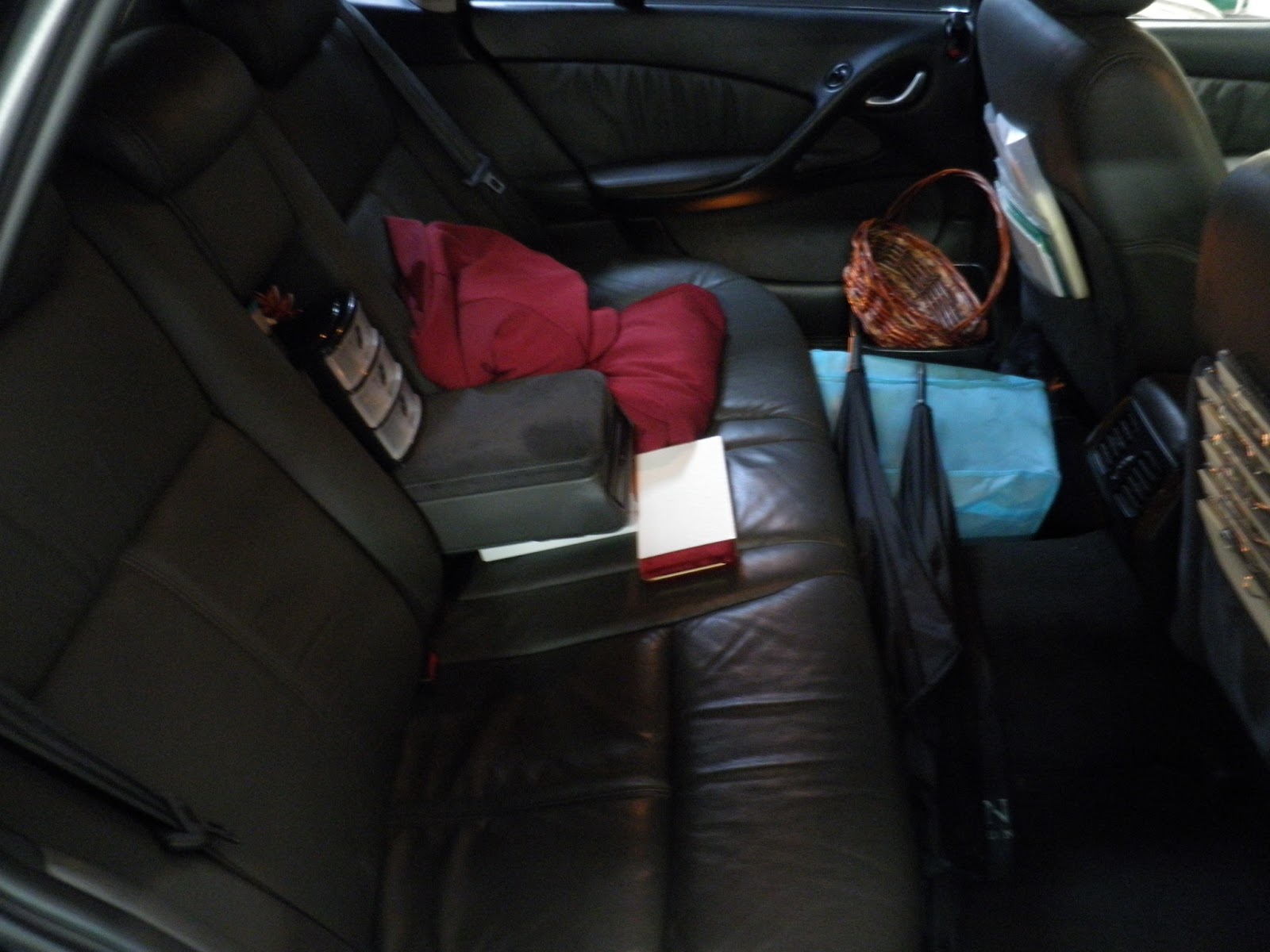
    The hearse has a lot of space, and a lot of doors.  And every hearse will have different ways to open these doors.  The wing doors are the small doors on either side of the hearse that open up the space underneath where the coffin sits.  Here is where we keep tables, chairs, umbrellas, a CD player, the church trolly and much more.  In some hearses they have a button behind the back passenger seats, in others they have the buttons on the middle console by the drivers seat.  And a few have handles on the wing doors themselves.  The handle option is becoming more popular as it is easier to open.  If the wing door gets stuck, which happens a fair bit, or is on a slope and liable to hit something if it swings open then it is a two person job.  One will press the button while the other stands by the door and makes sure it opens correctly. Whereas a hearse that has handles on the wing doors can be opened by just one person in these situations.  The down side is many find the handles to be unappealing and I have heard it costs more.

    The rear (or boot) door that opens to the coffin can be opened in many different ways.  Some will have a button by the drivers seat, like many boot doors.  Others have a button under a wheel arch or by the back number plate.

    Some terminology:
- The gooseneck; is the device used to keep the coffin in place.  It is a simple chrome piece that slots into two holes and is then tightened.
- The bar; is an extendable bar at the back of the hearse.  The foot of the coffin is placed on this as it is slid in or out of the hearse.
- Wing doors; are the small doors on either side of the hearse that open up the space underneath where the coffin sits.
- Duel cab; refers to the number of seats.  A duel cab hearse has four passenger doors and is much longer than a two door hearse.

All photos were taken with an iPhone, so excuse the low quality of some.

Statesman hearse front.
Caprice hearse rear. You can clearly see ordinary commodore mud flaps and tail lights.
Caprice hearse front.
Statesman hearse drivers side wing door.
Caprice hearse passenger side wing door, with protective carpet down.
Inside the statesman hearse wing door.
Inside the passenger side wing door, with protective carpet up.
Caprice hearse wing door.
Inside the caprice hearse wing doors.
Button to open the wing doors in the caprice hearse.
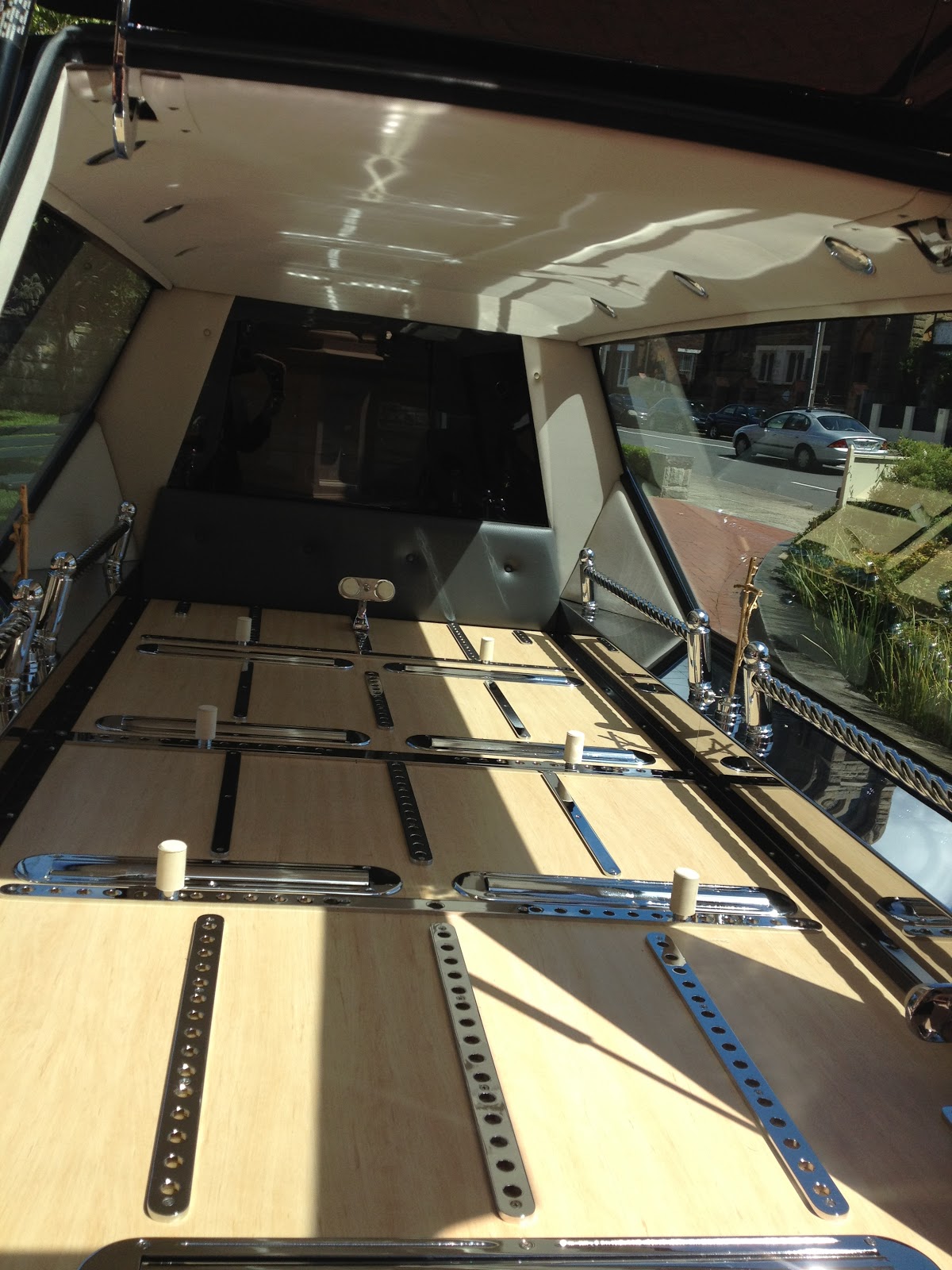
From inside the hearse, looking into where the coffin sits.
Inside the statesman hearse cabin.
Back seats inside the statesman hearse cabin.
Inside the statesman hearse cabin.
The 'bar' on the statesman hearse.
The foot of the coffin is placed on this as it is taken in or out
to protect the bumper and make it easier to load or unload.
You can see the silver holy water container to the right at the back.
The great cover with a handel in the middle opens a small compartment where the
crucifixes and other small stuff is kept.
The 'pegs' to the side are what help aline the coffin as we slide it in or out.
They can be moved in or out depending on what is needed and have rubber on the tops to prevent damage.
The rollers along the bottom make sliding the coffin about easy. 
Straightening the foot of a coffin just after loading up.
The windows separating the coffin from the cabin can be slid open to gain access to the foot of the coffin.
The cabin of the statesman hearse with doors open.
Back of the statesman hearse after loading.
The door is always left open once a coffin is inside while the hearse is in the garage.
Rear bar in.
Rear bar extended.
The "goose neck" is what keeps the coffin in place. It sits at the head end (by the door) and is slotted into two holes to hold it. Then it is tightened to keep the coffin still. It is a fancy version of the same thing used in the transfer cars to keep stretchers in place.
The Caprice hearse outside a church in Waverley.


The Caprice hearse outside a church in Waverley.


The caprice hearse open, ready for the coffin to come out of the church.

The great cover with a handel in the middle opens a small compartment where the
crucifixes and other small stuff is kept.
You can see the silver holy water container to the right at the back.

Inside the caprice.


Returning home after a rainy day. The family had scattered frangipani flowers on top and inside the hearse.
~~