The concept of the American funeral comes from the Australian funeral industry, it is because of the industry that it has a presence. Which I find amusingly ironic in a sense, how the American funeral is considered an ever-present threat to the Australian funeral, and yet it can only exist directly because of the Australian funeral; without the Australian industry there would be no American funeral.

Showing posts with label custom. Show all posts
Showing posts with label custom. Show all posts
2013-06-03


2013-05-20
The Negatives of the American Funeral
In this pervious post I discussed at the definition of the American funeral, the five key points which make up our understanding of this concept as the Australian industry uses it.
Just the idea, the notion and nothing more, of American funerals is a source of anxiety and concern with those in the Australian funeral industry. I have found an actual and ever present worry that the Australian industry will "slip" into American styles. So let's look at what is so bad about the American funeral as viewed by the Australian industry.
Just the idea, the notion and nothing more, of American funerals is a source of anxiety and concern with those in the Australian funeral industry. I have found an actual and ever present worry that the Australian industry will "slip" into American styles. So let's look at what is so bad about the American funeral as viewed by the Australian industry.
2013-05-13
Origins of the American Funeral
The American funeral has an interesting history, which is unfortunately difficult to follow and mostly based on rumours and anecdotes. It is not a new idea by any means, but is one which has changed over time.
2013-04-04
Upright Burial
The concept of burying coffins standing up (vertically rather than horizontally) is by no means a new one. This is an older idea and one brought up every so often, but it is about time I gave my own personal thoughts on the matter in a short post.
2013-02-25
Appropriate In a Cemetery
What is appropriate in a cemetery is quite a debatable thing, but I have found that many take a reverential and highly respectful view of cemeteries. However, this view requires a certain distancing from the cemetery, that those who think this way cannot understand the cemetery itself and cannot visit cemeteries regularly.
2013-02-22
Working Funerals - Why Foot First
This is an oddly common question, and one I had not really looked into or thought much about until others asked me. The foot first method has a strong symbolism to it, but it also has a very practical reason.
2013-01-21
Are We Too Comfortable?
A couple of people have said how some topics on my blog are a little 'out there' or 'uncomfortable' in a way. That I basically talk about sensitive things which makes them a little uncomfortable.
But is this a bad thing? Perhaps it is about time some things were said as we have gotten too comfortable.
But is this a bad thing? Perhaps it is about time some things were said as we have gotten too comfortable.
2012-12-18
Fetishism of The Dead Body
In this post I explore our relationship with dead bodies and how we turn them into The Dead Body (TDB). This was something I wanted to write as an essay and do properly back in early October. But unfortunately I never found the time. Instead enjoy this informal and casual post of mine, it was written for fun so with luck it should be fun to read.
2012-12-14
Death & Funerals: Children
In these series of posts I will be looking informally at the taboo nature of death and funerals. This post looks at the relationship of children to death and funerals.
2012-12-13
Death & Funerals: Shit
In these series of posts I will be looking informally at the taboo nature of death and funerals. This post focuses on how we avoid the topic. Specifically how death is handled (and possibly thought of) in the same way as excrement.
2012-12-12
Death & Funerals: Sex
In these series of posts I will be looking informally at the taboo nature of death and funerals. This post explores how death and funerals are like sex in our avoidance of them.
2012-12-11
Death & Funerals: Life
I have put together four articles looking at specific aspects of the taboo nature of death. They are only short and rather basic, written more for fun and to brainstorm than to actually put something 'proper' together. Basically I have been trying to read through some 'heavy' stuff. Like Merleau-Ponty's "Phenomenology of Perception", which is an incredibly dense book. So I felt like something a bit fun and light for a change of pace. After all, it's the time of year when we should be relaxing a little and having fun!
This post focuses on the separation of life and death, how this appears simple and clean. But is actually blurry and loaded with controversy.
This post focuses on the separation of life and death, how this appears simple and clean. But is actually blurry and loaded with controversy.
2012-11-17
Working Funerals - Neighbour calls police about body at funeral home
Very recently I had a talk with the people at Divinity Funerals. I was told a funny story about how one neighbour is reluctant to have a funeral home so close.
One night there was a viewing in the funeral home chapel, nothing new. After the viewing they were loading the coffin into the car to take back to the mortuary. When suddenly "everything was blue and red" as police swamped them.
It turned out the neighbour had seen them loading the coffin into the car, and called the police. Saying how the neighbour was putting a dead body in a van. Forgetting to mention that it was a funeral home and a coffin. Naturally the police were not too impressed and quite apologetic to the funeral staff. Saying how they would make a note in the system about that number, and they had told off the neighbour.
It goes to show how reluctant some are to have a funeral home close to them. Getting approval to build a new funeral home is incredibly difficult from councils and residents.
My research is finding a main way people chose the funeral home is by how close it is to them. When a death occurs people want the funeral place to be nearby, many say how this is convenient and nice. Which is also evident by the way InvoCare spends so much to rent so many offices around Sydney. Clearly they think it is financially worth it.
Yet when there is no personal death most do not want the funeral home as a neighbour. Other than when needed the funeral home should be distant to them, over there and not over here. This is known as Not In My Back Yard (NIMBY) to some. How we want something close to us when we need it but distant when we don't.
The funeral home is unfortunately stuck in this paradox. The company needs to be close to residents and commercial areas for customers as this is a major decider for many customers. But then the same people do not want the funeral home close when they are no longer customers. Keeping the funeral home near but at arm's length.
An unfortunate down side to this is it encourages superficial shop fronts and briefcase funeral directors. The mortuary, where the dead are dealt with, are removed, confined to industrial areas.
An~~
One night there was a viewing in the funeral home chapel, nothing new. After the viewing they were loading the coffin into the car to take back to the mortuary. When suddenly "everything was blue and red" as police swamped them.
It turned out the neighbour had seen them loading the coffin into the car, and called the police. Saying how the neighbour was putting a dead body in a van. Forgetting to mention that it was a funeral home and a coffin. Naturally the police were not too impressed and quite apologetic to the funeral staff. Saying how they would make a note in the system about that number, and they had told off the neighbour.
It goes to show how reluctant some are to have a funeral home close to them. Getting approval to build a new funeral home is incredibly difficult from councils and residents.
My research is finding a main way people chose the funeral home is by how close it is to them. When a death occurs people want the funeral place to be nearby, many say how this is convenient and nice. Which is also evident by the way InvoCare spends so much to rent so many offices around Sydney. Clearly they think it is financially worth it.
Yet when there is no personal death most do not want the funeral home as a neighbour. Other than when needed the funeral home should be distant to them, over there and not over here. This is known as Not In My Back Yard (NIMBY) to some. How we want something close to us when we need it but distant when we don't.
The funeral home is unfortunately stuck in this paradox. The company needs to be close to residents and commercial areas for customers as this is a major decider for many customers. But then the same people do not want the funeral home close when they are no longer customers. Keeping the funeral home near but at arm's length.
An unfortunate down side to this is it encourages superficial shop fronts and briefcase funeral directors. The mortuary, where the dead are dealt with, are removed, confined to industrial areas.
An~~
2012-07-02
The Naked Dead: How we engage with the dead through their nakedness
I have written a short essay on how we engage and entangle with the world around us. Specifically I look at nakedness and the dead body. Through this I explore the idea that we connect with the dead body before us and bring it into our being. We feel its nakedness and exposure, so we cover it up.
This is the first 'formal' essay I have written on the funeral industry and for this blog. It was rather interesting and fun to write, so I hope it's fun to read. The essay itself is not too long but I have provided a short summary anyway.
This is the first 'formal' essay I have written on the funeral industry and for this blog. It was rather interesting and fun to write, so I hope it's fun to read. The essay itself is not too long but I have provided a short summary anyway.
2012-03-26
Cultural Differences in the Hearse: American and Australian hearse
I wrote this post about inside the hearse a while ago. What surprised me was how few people knew about the hearse. As a follow up I have been keeping an eye out for articles about the hearse and recently I came across this post about unusual hearses at the Chive. It's about 'unusual' hearses, but what is interesting to me is picture 25, which although a little odd is quite a standard hearse to me. This lead to me thinking about the cultural differences in hearse's between America and Australia and how this might indicate cultural differences in funerals as well.
2012-02-19
Working Funerals - The Hearse Revealed
 If the transfer van is the silent workhorse of the funeral industry then the hearse is the racehorse everyone watches. Yet most people do not really look at it, let alone know how a hearse works. I have found people will watch the hearse, it is a fancy different car carrying a coffin. But people will not look at it properly. The watching is mostly superficial and not intense. It is as though to look too closely would be wrong. So here is the hearse revealed for what it is, just another car.
Unlike America no car companies make hearses in Australia. Instead the hearse is a regular car that has been modified. Funeral homes will buy a car form the dealer, then take it to a third party car modification place, such as Hadleys, to be turned into a hearse. Each funeral home can make the hearse the way they want to which ensures it is individual to that company. They usually use a bottom end or mid-range car, such as a commodore, rebadged to pretend it is a top end car. They have to pay for the brand new car which can be about $40,000, then roughly another $60,000 to get it modified. All in all a brand new hearse can easily cost over $100,000 and take a month or more to make. And they do not need a fancy car for a hearse, it looks no different and costs so much more. So getting a basic car and converting it makes sense when you think about it.
There are a few types of hearses in a large variety of colours from new to old. From black Holdens to white Chryslers. If a funeral home wants a specific hearse it can be made. And if the family want a specific hearse it can be found. But at their heart all of the hearses are the same. My experience has mostly been with the W.N.Bull fleet, so I will focus on those hearses.
W.N.Bull has a fleet of three early 2000s Holden Statesman hearses and one 2011 Holden Commodore hearse rebadged as a caprice. This is the only company to use actual Statesman cars as a hearse and not just re-badged commodores. Although now InvoCare owns the company this policy has changed and they are now getting Commodores.
 |
Statesman hearse drivers side wing door. |
The rear (or boot) door that opens to the coffin can be opened in many different ways. Some will have a button by the drivers seat, like many boot doors. Others have a button under a wheel arch or by the back number plate.
Some terminology:
- The gooseneck; is the device used to keep the coffin in place. It is a simple chrome piece that slots into two holes and is then tightened.
- The bar; is an extendable bar at the back of the hearse. The foot of the coffin is placed on this as it is slid in or out of the hearse.
- Wing doors; are the small doors on either side of the hearse that open up the space underneath where the coffin sits.
- Duel cab; refers to the number of seats. A duel cab hearse has four passenger doors and is much longer than a two door hearse.
All photos were taken with an iPhone, so excuse the low quality of some.
 |
| Statesman hearse front. |
 |
| Caprice hearse rear. You can clearly see ordinary commodore mud flaps and tail lights. |
 |
| Caprice hearse front. |
 |
| Statesman hearse drivers side wing door. |
|
| Statesman hearse drivers side wing door. |
 |
| Caprice hearse passenger side wing door, with protective carpet down. |
 |
| Inside the statesman hearse wing door. |
 |
| Inside the passenger side wing door, with protective carpet up. |
 |
| Caprice hearse wing door. |
 |
| Inside the caprice hearse wing doors. |
 |
| Button to open the wing doors in the caprice hearse. |
 |
| From inside the hearse, looking into where the coffin sits. |
 |
| Inside the statesman hearse cabin. |
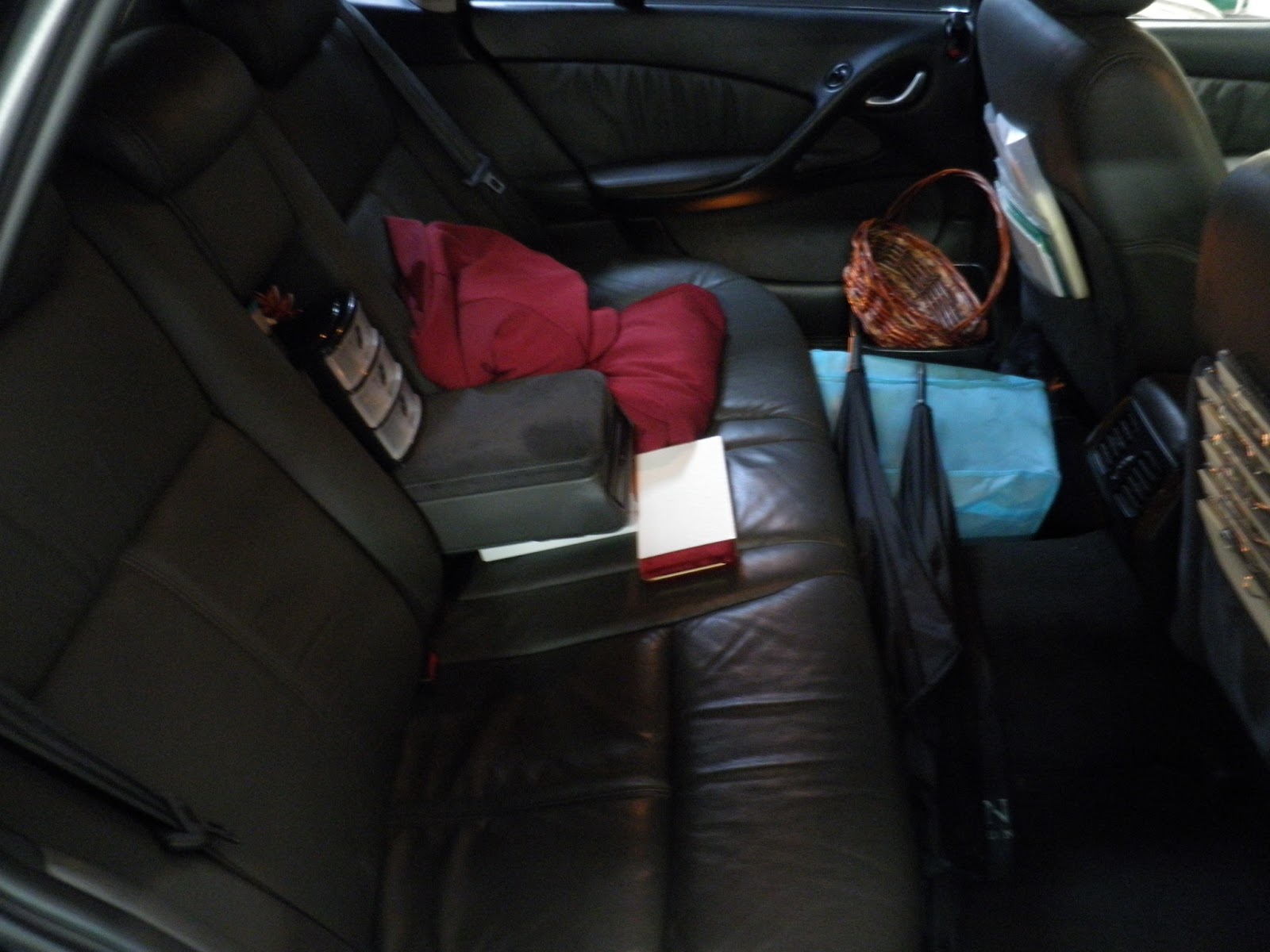 |
| Back seats inside the statesman hearse cabin. |
 |
| Inside the statesman hearse cabin. |
 |
| The 'bar' on the statesman hearse. The foot of the coffin is placed on this as it is taken in or out to protect the bumper and make it easier to load or unload. You can see the silver holy water container to the right at the back. The great cover with a handel in the middle opens a small compartment where the crucifixes and other small stuff is kept. |
 |
| The 'pegs' to the side are what help aline the coffin as we slide it in or out. They can be moved in or out depending on what is needed and have rubber on the tops to prevent damage. The rollers along the bottom make sliding the coffin about easy. |
 |
| Straightening the foot of a coffin just after loading up. The windows separating the coffin from the cabin can be slid open to gain access to the foot of the coffin. |
 |
| The cabin of the statesman hearse with doors open. |
 |
| Back of the statesman hearse after loading. The door is always left open once a coffin is inside while the hearse is in the garage. |
 |
| Rear bar in. |
 |
| Rear bar extended. |
 |
| The "goose neck" is what keeps the coffin in place. It sits at the head end (by the door) and is slotted into two holes to hold it. Then it is tightened to keep the coffin still. It is a fancy version of the same thing used in the transfer cars to keep stretchers in place. |
 |
| The Caprice hearse outside a church in Waverley. |

 |
| The Caprice hearse outside a church in Waverley. |


 |
| The caprice hearse open, ready for the coffin to come out of the church. |
 |
| The great cover with a handel in the middle opens a small compartment where the crucifixes and other small stuff is kept. |
 |
| You can see the silver holy water container to the right at the back. |
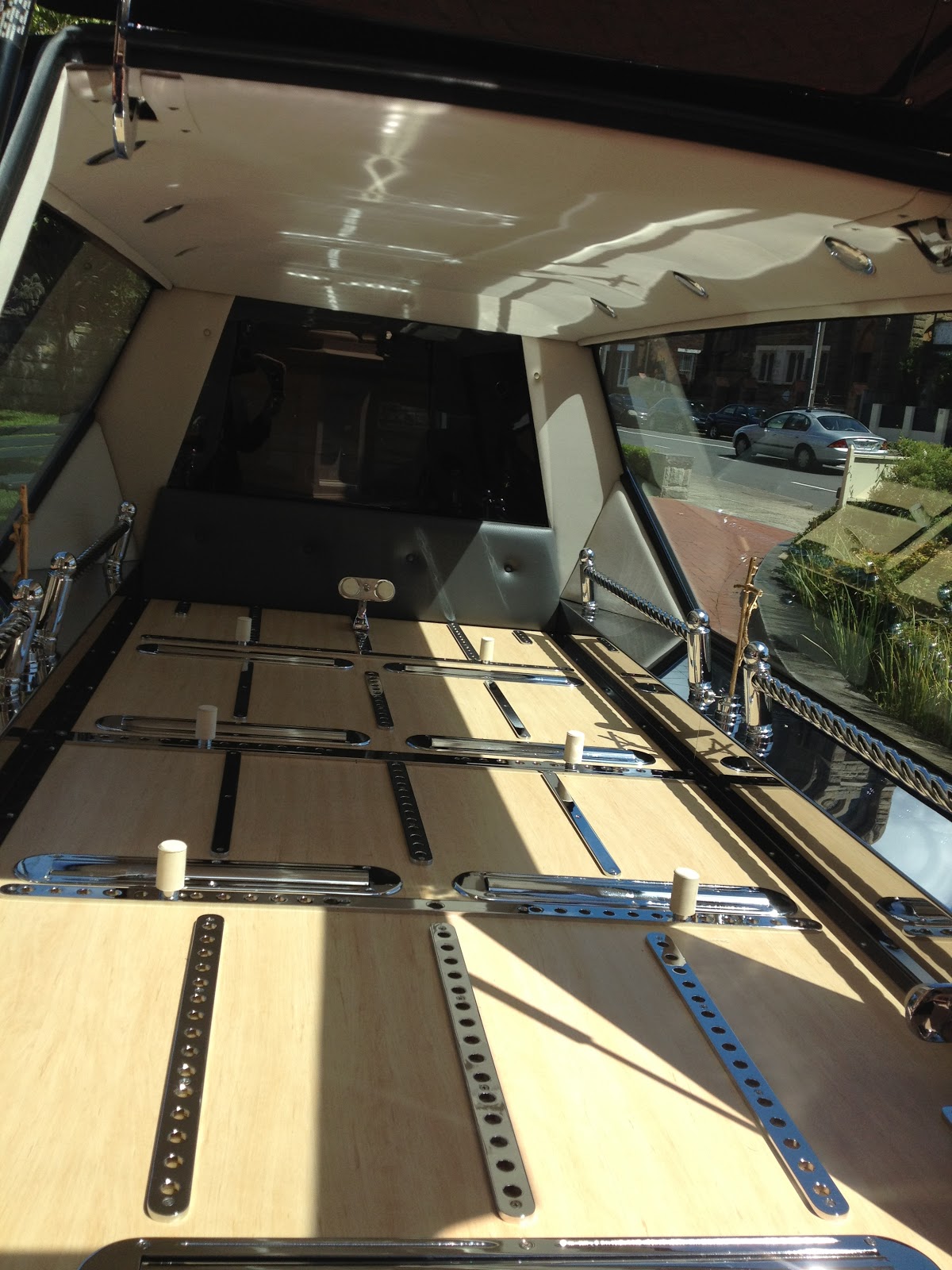 |
| Inside the caprice. |


 |
| Returning home after a rainy day. The family had scattered frangipani flowers on top and inside the hearse. |
Subscribe to:
Posts (Atom)