Channel 10's 'The Project' had a segment on the modern funeral, on the 22nd of February 2013. How funerals in the "last five years" are moving to a more personal service as the funeral service and the funeral industry modernises.

Showing posts with label service. Show all posts
Showing posts with label service. Show all posts


2012-11-11
Working Funerals - Turning the coffin mistakes
A while ago I wrote a post on how to turn the coffin after a service. Just a basic guide for those who have limited experience with this.
Since then I have been asked about mistakes that are made when turning the coffin. What mistakes are made and how to avoid them. Here are the four most common mistakes I have seen and how to prevent them.
Since then I have been asked about mistakes that are made when turning the coffin. What mistakes are made and how to avoid them. Here are the four most common mistakes I have seen and how to prevent them.
2012-10-31
New Surveys !!!
I have put together three separate surveys to explore different concepts within the funeral industry. All three surveys will be very useful to me (and others) so please, do them if you have the time.
They are all relatively short, and take an average of 10 minutes or less each.
As always, the surveys are completely anonymous and confidential. If there are any issues or questions do not hesitate to contact me: theothersideoffunerals@gmail.com
First Survey - Funeral Company Knowledge:
The first survey looks at how well people know the funeral companies operating in Sydney. In this survey I explore memory (both recognition and recall) to see if people actually know and remember different companies.
Anyone can do this survey, as the focus is on Sydney companies yet mand are national brands. It is also applicable for both funeral staff and non-funeral staff.
You can complete the survey by following the link below:
<> Unfortunately you have to copy and paste a url for certain questions. I cannot embed the image :( so I understand it's not ideal, but it's the best I can do <>
This survey might be most interesting to funeral companies, to see if their methods actually work. Although it has several limitations, the point of this survey is to see if a certain concept is worth future exploration.
Second Survey - Funeral Attendance:
The second survey is aimed at exploring funerals people have attended as a mourner. There are a few things at work in this survey, the results could be rather useful. While anyone can do this survey the focus is on the role of the mourner.
You can complete the survey by following the link below:
This survey is fairly simple, and aimed only at those who have attended a funeral as a mourner. With luck the results might be quite informative of funeral practices and attitudes.
Third Survey - Age & Working Funerals:
The third and final survey looks at age and funerals. How we perceive the age of staff working in the industry and how age plays a role. This survey is for funeral staff only, those who currently work or have worked in the funeral industry.
You can complete the survey by following the link below:
This survey explores a rather important and common issue in the industry. Age and the funeral industry are contentious topics, so it would be interesting to investigate things like ageism.
Other & Future Work:
If you are interested in participating in future research, as an individual or on behalf of a group/company, please email me: theothersideoffunerals@gmail.com.
I am always looking for people willing to participate in a study of ageism, and to a lesser extent sexism, within the funeral industry. If you or anyone you know are interested in this please email me: theothersideoffunerals@gmail.com. As always all information and participation will be kept confidential, no personal identity or details will be recorded.
Alternatively you can leave a comment on this post, I will read all comments left on the blog.
An~~
They are all relatively short, and take an average of 10 minutes or less each.
As always, the surveys are completely anonymous and confidential. If there are any issues or questions do not hesitate to contact me: theothersideoffunerals@gmail.com
First Survey - Funeral Company Knowledge:
The first survey looks at how well people know the funeral companies operating in Sydney. In this survey I explore memory (both recognition and recall) to see if people actually know and remember different companies.
Anyone can do this survey, as the focus is on Sydney companies yet mand are national brands. It is also applicable for both funeral staff and non-funeral staff.
You can complete the survey by following the link below:
<> Unfortunately you have to copy and paste a url for certain questions. I cannot embed the image :( so I understand it's not ideal, but it's the best I can do <>
This survey might be most interesting to funeral companies, to see if their methods actually work. Although it has several limitations, the point of this survey is to see if a certain concept is worth future exploration.
Second Survey - Funeral Attendance:
The second survey is aimed at exploring funerals people have attended as a mourner. There are a few things at work in this survey, the results could be rather useful. While anyone can do this survey the focus is on the role of the mourner.
You can complete the survey by following the link below:
This survey is fairly simple, and aimed only at those who have attended a funeral as a mourner. With luck the results might be quite informative of funeral practices and attitudes.
Third Survey - Age & Working Funerals:
The third and final survey looks at age and funerals. How we perceive the age of staff working in the industry and how age plays a role. This survey is for funeral staff only, those who currently work or have worked in the funeral industry.
You can complete the survey by following the link below:
This survey explores a rather important and common issue in the industry. Age and the funeral industry are contentious topics, so it would be interesting to investigate things like ageism.
Other & Future Work:
If you are interested in participating in future research, as an individual or on behalf of a group/company, please email me: theothersideoffunerals@gmail.com.
I am always looking for people willing to participate in a study of ageism, and to a lesser extent sexism, within the funeral industry. If you or anyone you know are interested in this please email me: theothersideoffunerals@gmail.com. As always all information and participation will be kept confidential, no personal identity or details will be recorded.
Alternatively you can leave a comment on this post, I will read all comments left on the blog.
An~~
2012-07-20
Quality Funerals
Quality of a funeral and a funeral home is something which does come up, especially with those in the industry or those who are interested in the industry. What I have noticed is that many of these people use little procedures or practices to value a funeral home. Things like which way they turn the coffin. Yet most mourners do not notice these things, nor care when they are told about them. The way an undertaker looks at a funeral is completely different from the way a mourner looks at it.
From this we can learn a lot about the role of the mourner and of the undertaker and start to question what is actually important in a funeral. How perhaps many of the practices on a funeral are more for the undertakers than the mourners.
From this we can learn a lot about the role of the mourner and of the undertaker and start to question what is actually important in a funeral. How perhaps many of the practices on a funeral are more for the undertakers than the mourners.
2012-05-26
Attending a Funeral - Cemetery tips
One big thing to remember is that the cemetery is almost exactly like the beach. It is hot in summer and cold in winter, the ground is soft and slippery, there is limited parking, there is basically no shelter from the rain or sun. Overall think of going to the cemetery as going to the beach in formal clothing.
- Do not worry: Unfortunately a lot of people have issues with cemeteries. However cemeteries are not spiritual, not creepy, they're just a place. And they're everywhere. Sydney Town Hall Station is built on an old cemetery and when they were building Town Hall they never found all the bodies. Cemeteries are scattered and forgotten under many cities, especially older cities. So chances are you walk through them regularly. Cemeteries are just spaces, and often quite beautiful spaces. Waverley cemetery is one of the most beautiful places in Sydney with the right light. In the end a cemetery is what you make of it. So make it what you want it to be.
- Look up the time and location: As with almost all my funeral tips knowing where and when you should be is key. Look up the address and directions before the day. It is rather embarrising to get lost on the way to a funeral Most cemeteries cannot be put into a GPS, and even then people get lost within the cemetery grounds.
- Find the grave: Do not bet on following a cortege to find the grave. If you get lost, separated or there is no cortege contact the cemetery office. The office details can be found by simply 'googeling' the cemetery name. Many cemetery websites also have downloadable maps to help navigate the place. Cemeteries are like mazes, there is something that makes most of them difficult to navigate.
- Umbrella: Bring one or two even if there is no chance for rain. They are a great source of shade which will keep you cool and comfortable. The funeral directors should provide umbrellas if you ask (you can even keep it if they aren't looking as you leave). However do not rely on this and be prepared.
- Water: This one is obvious but so many people forget. Bring a small bottle of water and sip at it just before, during and after the service. Being in a cemetery is surprisingly dehydrating even in cool weather. And it is always better to risk needing to go to the bathroom over risking fainting due to dehydration/heatstroke (which I have seen happen). Australia is hot, be read for it.
- Sunscreen: Again, this should be obvious and if you do not bring and use sunscreen on sunny days it is your own loss. Skin cancer is a big issue in Australia and sunscreen is cheap and easy, so why not?
- Chairs: Funeral homes and cemeteries should provide some chairs. But does not always happen, and even then they will usually only provide 4 to 6 chairs. So if chairs are needed make sure the funeral home knows before the day and how many they will need. Or bring a few chairs yourself if you are able.
- Stay out of the way: Keep out of the way of funeral and other staff. If they look like they need help then offer, but otherwise let them do their job. This makes everything go quicker and smother for everyone.
- Keep up and keep together: Most cemeteries are big or confusing places with narrow and twisty roads. It is incredibly embarrassing to get lost only a corner away from the grave. So do not fall behind and stay behind the hearse.
- Do NOT get out until the right time: At almost every cemetery the cortege will stop by an office to get paperwork before going to the grave. These offices usually have a car park and toilets, so quite often people will park thinking that this is where they should stop. Next thing they know the hearse and other cars have gone leaving them lost and alone. It happens too often, even if the funeral staff warn people. So STAY IN YOUR CAR until you either see the grave itself (make sure it is the right one though) and/or it is obvious that the cortege has arrived. You know this has happened when all the undertakers get out of their cars/hearse and not just one person.
- Walk: You do not have to park right next to the grave. Sometimes you it is dangerous or inappropriate to park close by and you will just take a space of an older or less able person who cannot walk far or over rough terrain. Other times your car will get in the way of staff or other funeral processions, so do not park on corners, do not park too close together and be ready for a short 2 minute walk. I will say I find it is generally but not always SUVs (o four wheel drives) that park inappropriately in their attempt to get as close as possible.
- Wear appropriate shoes: The ground at cemeteries is spongy, slippery and soft, so wear shoes for this. The most common inappropriate shoe is a stiletto. I have seen women seriously damage their ankles because of their shoes. And I have no sympathy for them. To wear high stilettos to a cemetery is stupid and dangerous. It will inconvenience everyone and just make the person with the shoes look silly. It is better to wear sneakers or boots and look a little strange than bend an ankle in front of everyone.
- Mud, live with it: Cemeteries are dirty places, there is a lot of digging going on and as such there is a lot of lose dirt. So when it rains there is a lot of mud. Live with it and deal with it later. There is no point holding people up while you scrape the mud off your shoes before you get in the car. Simply get the bigger lumps off, get in the car and more out of the way of others. Once the mud dries it will scrape off very easily and usually as people try to clean it off their shoes they spread it over their clothes. If desperte use the corner of gutters or grates of drains to scrape away mud. Tissues are also handy.
- Know how to drive: Most cemeteries, especially old ones, tend to have narrow streets. With tight corners, slopes, and dead ends. Driving through a cemetery may mean squeezing down a narrow street between graves and cars. Or perhaps you will have to go around an incredibly tight corner. Either way, knowing how to drive will help.
Just remember, think of the cemetery as the beach. Prepare for it in the same way except you will be wearing formal clothing.
If there's any specific questions or concerns not addressed here feel free to contact me and I if I can I will help however possible.
~~
2012-05-23
How to - Carrying & moving the coffin
Foot first. This is something which a lot of people do not notice and do not do. But it is a key thing which should always be done. When moving the coffin take the foot end first. In a car the coffin should have the foot end towards the driver so again, it travels foot first even when being driven. This has a symbolic meaning in that it represents the person walking. As though they are still moving of their own to the next place. However it also has a practical reason in that it prevents the body from 'purging'. Purging is where the body basically throws up fluids. So keep the head raised will keep the fluids down.
Turn clockwise. This is symbolic of the moving of life. It directly represents the turning of the clock and the passage of time. However always turning clockwise also means you will know what everyone is doing. There will be no surprises if you follow a pattern.
Wheel by the thumbscrews. When wheeling the coffin always hold the thumbscrews and not the handels. Holding the thumbscrews will be daunting to the inexperienced yet it gives much better grip and control. The handels are too low for most people so it will mean bending awkwardly and possibly bad for people. This also does not look good. To see the paul bearers bending awkwardly as they wheel the coffin. More importantly holding the handels give little grip which could lift the coffin off the trolley. For better control and comfort hold the thumbscrews. It does not just look better but is better.
Keep in step. Many people struggle with this, and while not essential it does help. Keeping in step prevents treating on anyones toes and looks nice. To keep in step just copy the person in front of you. Move as and when they move and everything will be fine. If you are at the front of the coffin (the foot end) copy the person leading the coffin, be they the conductor, a priest or whoever else might be in front. If nobody is leading the coffin just walk evenly and do not worry too much.
Keep it level. When going up or down stairs keep the coffin level as much as possible. By keeping the coffin level it makes sure nothing on top (such as flowers) will fall off. It also makes it much easier and safer for everyone involved. To keep the coffin level those at the low end will have to lift it up as much as practical.
Carry by one handel. Unless you are picking up, raising, or placing down the coffin only use one handel. Sometimes people try to use both hands to carry the coffin, but this never works and just makes it awkward. You should only ever need to use one hand on one handel to carry a coffin safely. Simply use your hand that is closest to the coffin. If carrying coffins regularly swap sides to prevent strains or developing a 'preferred side'.
Face the foot end. The coffin should always travel foot first. I cannot stress this enough. Thus you should always face the foot end when carrying the coffin. So if you are getting the coffin out of a hearse or off something face the foot end. It is amusing to see people getting a coffin out of a hearse and they instinctively face away from the hearse. Away from the foot end. Instead they should face towards the hearse when pulling the coffin out. As shown in the picture above.
Do not stress or worry. Carrying the coffin can be a worrying thing for a lot of people. Yet it is not that difficult. Nobody has dropped a coffin as far as I know. There are stories of close calls, where a handel came off as they were carrying, yet in every case the coffin was caught. So the chances of you dropping a coffin, or tripping, while carrying it is very, very, low.
Keep out of the way. Do as the funeral conductor instructs when they instruct. It is better to do nothing than to do something wrong. So sit tight and wait for a signal, either from the conductor or a pre-determined point in the service. I have seen families jump up too early to carry a coffin. They're too eager and nervous. Then they got in the way when the funeral staff moved up to turn the coffin, which made the family feel bad. So sit tight, stay still and be where you are suppose to be. That way everything will be fine.
Following this stay out of the way and move away when you are done. Especially at the graveside when the funeral staff tell you to move away then move away. Often the conductor will be holding the coffin, on his own, so it is heavy and awkward. The last thing he needs is someone standing in the way asking if he has the coffin.
This of course is not everything to do with moving a coffin. But it is a start and should help the nervous or inexperienced. Look to the conductor, or the hearse driver, if you are unsure about what to do. In he end it is an easier and less stressful task than one would think.
This of course is not everything to do with moving a coffin. But it is a start and should help the nervous or inexperienced. Look to the conductor, or the hearse driver, if you are unsure about what to do. In he end it is an easier and less stressful task than one would think.
~~
2012-05-01
Working Funerals - Turning the coffin
At my grandfathers funeral I couldn't help but notice the mistakes the undertakers made when turning the coffin. The mistakes wren't serious or disrespectful and they went un-noticed to the other mourners. But after working funerals I saw these little mistakes. And this made me realise how many mistakes can be made when turning the coffin, so I thought a little guide might help.
Turning the coffin is a rather important part of the service, and it is a part many overlook or dismiss. It is also a rather simple procedure that has plenty of room for errors.
'Turning the' coffin refers to the act of rotating the coffin at the end of a funeral service to take it to the next or final stage. This is done while family, friends or other mourners are watching and is a part of the service itself. Mourners or staff can turn the coffin, but it is usually the undertakers who do it.
Any movement of the coffin is important and potentially emotional for most mourners. So turning the coffin is very significant for most people. It is also done infront of many people and its always watched intently. As such it should always be done right. Thus an article explaining how to turn the coffin could be helpful to mourners or funeral directors alike.
Here is my step by step guid on how to properly turn a coffin:
Just remember not to worry too much about it and if you are unsure of what to do don't do anything. A great rule for funerals is do nothing if you are unsure. It is much better to do nothing than do something wrong. When turning the coffin generally wait to see what the hearse driver or conductor are doing before you act. And if you are the hearse driver or conductor you should know what you are doing and not really need this guide.
~~
Turning the coffin is a rather important part of the service, and it is a part many overlook or dismiss. It is also a rather simple procedure that has plenty of room for errors.
'Turning the' coffin refers to the act of rotating the coffin at the end of a funeral service to take it to the next or final stage. This is done while family, friends or other mourners are watching and is a part of the service itself. Mourners or staff can turn the coffin, but it is usually the undertakers who do it.
Any movement of the coffin is important and potentially emotional for most mourners. So turning the coffin is very significant for most people. It is also done infront of many people and its always watched intently. As such it should always be done right. Thus an article explaining how to turn the coffin could be helpful to mourners or funeral directors alike.
Here is my step by step guid on how to properly turn a coffin:
 |
| Fig1. Getting into position. |
1. The hearse driver and other staff member will wait near the coffin before moving over and preparing it. This involves removing any symbols (items placed on top or near the coffin) or obstructions (such as the pascal candle or tables). As they approach they should bow to the stage or coffin depending on tradition or practice.
 |
| Fig2. Getting ready to turn. |
2. The staff move into position, the hearse driver goes to the head end and the other staff member goes to the foot end.
3. They pause for a moment and when the hearse driver signals they place their hands on the coffin.
4. The staff want to have a firm but dignified hold of the coffin. It should not be grabbed and moved like a box or furniture but it does need a firm grasp to keep control.
5. After placing their hands on the coffin the staff pause and again wait for the hearse drivers signal.
 |
| Fig 3. Turning the coffin. |
6. When the hearse driver signals the staff turn the coffin clockwise. It must always be turned clockwise! Turning the coffin in this direction represents the passage of time, it is an old and symbolic tradition.
7. It might be necessary to perform a three-point-turn in tight spaces. There is nothing wrong with this if movements are kept to a minimum where possible. Be sure to discuss this with the conductor or hearse driver before going up to turn.
 |
| Fig 4. Finishing the turn. |
8. The assisting staff at the foot end should make sure the coffin is straight. To do this they pull the coffin down the isle towards them a very short distance. Never pull the coffin too far in this direction and do not worry about getting the coffin perfectly straight.
9. The staff will move off as previously instructed by the conductor.
Some simple key things to remember are:
- Pause after approaching the coffin, pause again after placing your hands on it and make a final pause after turning the coffin. This makes the whole thing appear much more respectful and professional.
- Look for the hearse drivers signals, move when they move and move as they move. Again, it will look professional and like you are a team.
- Do not move too far. Restrict all movements as much as is practical otherwise mistakes can be made.
- Flow steadily, do not move suddenly or jerkily. Think of the process as like a dance, move with a rhythm and do not make sudden or unexpected movements.
- If a mistake is made ignore it if you can. Most mourners will not notice mistakes unless the undertakers make them noticeable. So if you can get away with a mistake then do so.
- Know the crew and other staff. This is difficult with large companies who change crews and staff often. But if you can get to know them do so. It really helped me, to know how and when each hearse driver liked to turn the coffin. Then I could match their styles and appear more professional and I would notice quicker if something went wrong. We all have our personal tastes and touches, getting to know these will go a long way.
- Communicate! This is perhaps the best and most important thing. Listen to the conductor and hearse driver. Do no over discuss what is to happen but make sure everyone is on the same page and you know not only your role but what others are meant to do. This means if something goes wrong or someone goes missing you can easily step in.
Just remember not to worry too much about it and if you are unsure of what to do don't do anything. A great rule for funerals is do nothing if you are unsure. It is much better to do nothing than do something wrong. When turning the coffin generally wait to see what the hearse driver or conductor are doing before you act. And if you are the hearse driver or conductor you should know what you are doing and not really need this guide.
~~
2012-04-28
The Order of Service - Dealing with Death
The 'order of service' can be called many things, for example the Catholics would refer to it as a "mass book". Despite the many names it is always the same thing at every funeral. There may be slight variations but basically it is the booklet which lists what is to happen at the funeral and gives some information about the deceased or their family.
One thing I noticed during my grandfathers funeral was how much effort and care was put into making the order of service. My aunt, who was organising it, wanted to get the working and design perfect. Which was a tricky task considering she had a couple of days to organise and print them off. After printing them off we all helped to fold them. Here again I noticed how much care was put into folding them, everyone made sure the folds were straight and crisp. For everyone the orders of service were very important and personal. This has made me realise how the order of service can be used to help deal with the loss of a loved one.
An issue I've realised with organising funerals is how little progress there appears to be. One can spend a week arranging and organising a funeral for their loved one and yet it does not feel like much gets done. Important and emotional decisions are made and yet there is nothing to show for it. For example when people pick a coffin it is usually through a book. They look through the book at the pictures and pick the one they like. No different from how one would pick furniture out of a catalogue. This distances people from the significance and emotions of their decision. Then after all these decisions are made people do not see them enacted until the day of the funeral. Going back to the example of the coffin, it is not seen until the funeral. It is an emotional and expensive thing which is not seen until the end. This creates a sense of stagnation as though little progress has been made. That the decisions made have little impact. Which is not a good feeling for the family or friends.
Here is where the order of service can be used to counter this. The family can be directly involved in all aspects of the booklets. They can design them, print them and sort them. They can be involved throughout the process and see it develop first hand. As such this will help to create a sense of progress and make people feel involved in the funeral process.
Yet the order of service is so much more than this. It is a representative and physical part of the funeral and deceased. The order of service is treated as a physical part of the funeral process and is bound up with many emotions. The way my grandmother held the first printout was a great display of this. She held it with longing care. A sad smile slid slowly over her and she looked over the book for a while before handing it back. It was not just a book but a bit of her husband, one of the very last bits of him, and it was a bit of his funeral yet to come. In other words the order of service is an actual piece of the funeral process and the deceased. This is most obvious in the way that the order of service often has a picture the and dates of birth and death of the deceased.
Unlike many other parts this is one people can hold and keep. The coffin for example is possibly more important (emotionally and physically) but it cannot be taken home. It canot be kept and it is barely interacted with. On the other hand there is the order of service is something people can take and keep as long as they like. When working as an undertaker I found people really wanted an order of service, and that almost everyone kept them. Rarely where the orders of service left behind in the chapel and when they were left it was by the immediate family. This was because the family had been distracted by other things such as carrying the coffin and often left other personal belongings behind as well. Or because they had a copy or two at home and knew they could (and would) print more copies later.
It is also a piece that can be sent and given to others who did not attend the funeral. Thus it can make people who did not attend feel part of the funeral process. They were not able to go but could bring a bit of the funeral to them. I noticed this while working in the funeral industry, that many who could not go would ask the family for an order of service. Then at my grandfathers funeral I saw how the family overseas who could not make it were really happy to get an order of service. It's a really nice gesture that will make people feel involved and part of the event.
This post only covers the surface of the order of service. It is a very complex and intricate thing which is bound up with a lot of emotions and meanings. This makes it the perfect thing to help people deal with the upcoming funeral and death of a loved one. So pay attention to the order of service and try to involve people in its creation.
~~
A Personal Death - The funeral
 |
| Fig 1. Front of the little handout. It's actually a really nice silver, but my scanner can't pick it up properly |
Firstly I'll run through the funeral, what happened to give some background understanding of the event. The family car arrived, which was blue, for my grandmother and off we went. The funeral was only a short distance away so the trip was quick. On arrival I saw the hearse was also blue, I'd never seen a blue hearse so that was rather fun. It was just a basic ford hearse, a fairly common one and no different to many others I had seen save its color. We entered the chapel, a rather nice and spacious place. The coffin was down at the end, lying parallel to the stage and with the podium slightly to the side. The service went well, short and to the point while still covering the details. It was a fairly formal service, kind of surprising considering how liberal my grandfather and the family were and are. At the end of the service I and three other family members wheeled the coffin out, loaded him into the hearse and watched it drive off. Then we all went back inside the chapel and had some food. The food was provided by Celest Catering, who are InvoCare's preferred caterers as they always do a very good job. Overall it was a good funeral and everyone came away happy.
 |
| Fig 2. Back of the handout. His date of birth is wrong here. He was born 11 of September 1929. |
Naturally working in a funeral home I have developed a different view and understanding of funerals. I do not and cannot see them the same way as I did before joining the industry. It's strange how others do not see the same things I do when we are presented with the same scene. For example I noticed that they turned the coffin anti-clockwise instead of clockwise, and that the conductor only used one hand while simultaneously talking to the family. To me these are two rather large mistakes, the coffin should always be turned clockwise (to represent the passage of time) and it should be treated as important enough to use both hands. While I noticed this nobody else did, none of my family or the other mourners saw the mistake. Once I mentioned it they realised, but until I said it they never thought of it.
 |
| The blue ford hearse. |
Not only do I see these little mistakes but I see the whole funeral differently to others. To me it is not as sad as other people found it, well, that isn't right. I have been to a lot of funerals and as such they have become mundane and predictable. In just one year I lost count of how many funerals I went to. So for me a funeral was almost like another day at work. However most other people go to a handful of funerals in their whole life. For them it is a special unique event which they have little experience with.
 |
| The hearse moving away, taking him to the crematorium. |
However my previous experience at funerals has almost always been as an undertaker and not as a mourner. One moment in particular made me realise how I didn't actually know what to do as a mourner and how others must feel at funerals. The desire not to mess up, to get everything right and yet the lack of experience or understanding about what is going on. This moment was just after we loaded the coffin into the hearse. I went to stand next to the hearse driver and realised that was wrong, it was were the undertakers stood, not the mourners. Then I stood there for a moment, unsure where to go. So I took a few steps back and stood with the crowd of mourners. But it was really surprising, how my instinct kicked in and I made my way to stand next to the staff and did not know where to stand as a mourner.
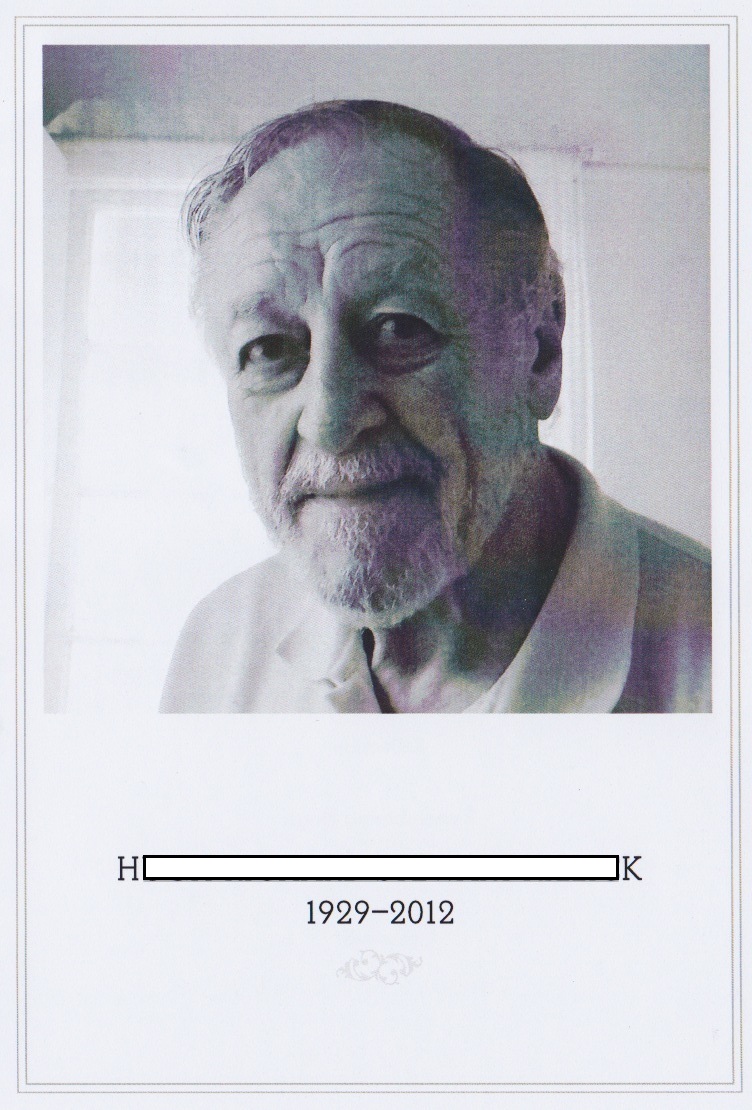 |
| Front of the Order of Service book. |
I also felt like this as I entered the funeral, it was so odd to be signing the book rather than getting people to sign. As I walked in I felt as though I should be behind the table with the book. It was so very unnatural to be standing in the room as a mourner. Then sitting there at the front during the service was also odd. I had always existed outside the service until the end points. I would wait outside, or sit way at the back, never had I sat down amongst the other mourners. All through the service I felt out of place, that I should be at the back with the other undertakers.
Now I know how many mourners feel at funerals. Unsure what to do or where to go, and with so much pressure to behave properly. A funeral is a rather busy event with a lot to know and yet nobody to tell you. So I will make more posts about how to be a mourner at a funeral and hopefully this will help someone someday.
One of my other uncles on the other side of the family, unrelated to my grandfather attended the funeral. He had gotten on really well with my grandparents for several years and it was nice he could come. After the funeral I was chatting to him and he said how strange it was that nobody was in tears much. To me that was normal, people were sad but not bawling their eyes out. Yet to him, being Greek, people are normally very emotional at funerals, and with life in general. I thought that was an intriguing comment about the emotional display. It really supports this other post of mine about how emotional displays (such as crying) is socially and culturally learned rather than instinctive.
And all this is after just one year in the industry! It makes me wonder how other undertakers who have been doing this for decades feel as a mourner. Perhaps they do not feel as out of place as I did or maybe they feel more out of place.
As for the funeral home I would be happy to go back to them. The staff were nice, approachable and acted professionally. So overall I feel there was good value for money and they did do a good job. The mistakes they made would go unnoticed with most mourners and did not impact affect the service.
 |
| Inside the chapel. |


 |
| The family car which drove my grandmother. |
|
| The blue ford hearse. |


 |
| Securing the coffin. |

 |
| Walking the hearse off. |

 |
| The hearse about to turn onto the road and drive away. |
 |
| Inside the Order of Service, first page. |
 |
| Inside the Order of Service, second (and last) page. |
 |
| Back of the Order of Service book. |
~~
2012-04-25
A Personal Death - The little details
Tomorrow is my grandfathers funeral. If you read yesterdays post then you know that by now I'm in Brisbane to help prepare for the event. We arrived at the airport just before lunch, checked into our bead and breakfast and then headed over to meet up with my uncle and aunt at my grandmothers for lunch. There were so many things I had never seen organised or being finalised. I have been on many funerals and only ever seen these things in their final and finished stage. So this was a fascinating and very informative. Overall it was a fairly nice day, but it was not without issues.
My grandmother has dementia, bad enough that the doctors have determined she is no-longer mentally competent to sign legal documents, yet she is not completely lost. She has a bad understanding of time, thinking of a quick moment as an eternity and then thinking of a long time as just a second. She has no issue with the idea that she went skydiving with my grandfather yesterday and will go to his funeral tomorrow. Naturally everyone wants to keep talk of the funeral to a minimum around her, when she stresses her dementia gets worse. Plus it obviously upsets her as she really cared for her husband.
At one stage about 5 of us gathered to the side and quietly discussed tomorrow. Basically when and what was happening. My cousin was concerned about the weight of the coffin as we would be carrying it. I told her about how there won't be far to go or much weight, at the foot end everything is rather light. This is because well over half of our weight is above our waist, from the waist down there is very little weight. The coffin itself should only be about 20kg and he was losing weight towards the end (as he was unable to eat or drink) os he wouldn't weigh much more than that. Knowing this really comforted her and she was happier about the idea of carrying.
I think most people are nervous about carrying a coffin if they've never done it before, as with most new things. There is a lot of anticipation and pressure, you're up there, infront of people and carrying something, no, someone who is very important to them. To drop the coffin, trip or just mess up would be terrible. I remember this from the first couple of times I carried, the nervousness I felt. But everything went fine and stories of dropped coffins are so very rare. There are plenty of close calls where a handel has come off or someone trips as they are walking with the coffin. However in every case they or someone else saves the coffin. The most common time a coffin is dropped is when it's being lowered, not carried. Yet that's another story as it's not what we are doing on this funeral.
Something that I had never thought about and is very important is the orders of service. Someone has to print them, or organise them to be printed. In this instance my aunt printed them off (and did a good job) then brought them over for us to fold. It was almost strange how much emphasis and importance these booklets had. They were only one A4 page folded in half and yet a lot of work and effort had gone into them. My aunt was so concerned with the wording that she had been tempted to reprint all 100 just to change a few words which nobody else noticed. My other family were then so attentive to folding the booklets, making sure each and every fold was straight and sharp.
I'd never thought much of the orders of service (or mass booklets) before today. I mean, they have always been very important to me. I knew how the family love getting a few extra to sent to "those who were unable to make it" to the funeral as I use to say. The order of service was always an important tool on the funeral as it gave an idea of how long things would take, what was to happen (and when) and where the family was going back to if I was driving them. I also knew how people loved to get one, that it was such an important part of the funeral, like a pice of the service that they could take home and literally hold onto. So the order of service was always important to me, but not in the same way as I now see it. I saw how much effort and attention was put into this single A4 page and how much it meant to everyone.
It is a actually a physical piece of the funeral that people can hold and keep. A piece that the family can directly make and shape. They see little impact of their decisions until the day. For example they pick the coffin, where the funeral is and so on. Yet none of these things are seen or happen until the day. To pick a coffin out of a book does not feel like much of a decision or that important. All they did was talk of prices and pick a picture from a book. We put more effort into buying a TV and inspect it before buying it. It is not until the funeral that most people will actually see the coffin or the other decisions they made.
Even then many of the more important choices are invisible to families. They make quite important decisions and yet never ever see the result or progress of these choices. For example how many see or know about how the body makes it to the funeral home. Another and more relatable example is clothing. Families often put a fair bit of thought into what the deceased should wear or have in the coffin. Then in many of these cases they never see inside the coffin. They do not see the deceased wearing the clothes, holding what they are meant to and so on. This creates a tension, to make important emotional decisions then be totally divorced from the results has a dehumanising effect which makes the whole thing a little unreal. To be separated from the outcome of our emotional decisions reduces the importance and reality of these decisions.
The order of service is a wonderful way to counter all this. It is a product families can see as it's being made; how it's being made, when it's completed and so on. It is something they can put emotion into and personalise, such as including photos and dates of the deceased. And it is something they can actively participate in, from designing it to printing it or even just folding copies. It is something they can 'create' and make. It then becomes so much more than just a 'booklet', it is a physical piece of the funeral and the deceased. What lead me to realise this was the way my grandmother held the first test copy, she held it with longing care. A sad smile slid slowly over her and she looked over the book for a while before handing it back. It was not just as book but a bit of her husband, one of the very last bits and a bit of his funeral yet to come.
Now I realise the significance of the order of service and will do a post dedicated to it another time. Things to include and avoid, it's significance and how this simple bit of paper might very well be an unsung tool to deal with the death of a loved one. It makes me wonder what other little details actually hold more significance than I realise. Things like the food I had always thought of as vital are treated as trivial while the other supposedly mundane and unimportant are treated as crucial.
All is set and we are just waiting for the funeral now. And 'waiting' is the perfect word, I notice the family are basically counting down the time. Time has become more important, 10 tomorrow morning now has more meaning and significance than it did yesterday morning. They wait and I wait, it will be a long night for some and a short night for others. But I think everyone will remember tonight.
~~
Another strange realisation has just crept into my mind as I finish up the post. Both in this post and in earlier conversations I refer to my grandfather in his coffin as "the coffin", just as I would at a funeral as an undertaker. I talk of him in the coffin no different to any other dead person who I'd never met on a funeral I had no personal attachment to. While strange, and arguably impersonal, I do not know any other way to refer to it or him. He is "the coffin" to me once the lid is on. And I realise that others also referred to "the coffin", but did they learn this from me?
My grandmother has dementia, bad enough that the doctors have determined she is no-longer mentally competent to sign legal documents, yet she is not completely lost. She has a bad understanding of time, thinking of a quick moment as an eternity and then thinking of a long time as just a second. She has no issue with the idea that she went skydiving with my grandfather yesterday and will go to his funeral tomorrow. Naturally everyone wants to keep talk of the funeral to a minimum around her, when she stresses her dementia gets worse. Plus it obviously upsets her as she really cared for her husband.
At one stage about 5 of us gathered to the side and quietly discussed tomorrow. Basically when and what was happening. My cousin was concerned about the weight of the coffin as we would be carrying it. I told her about how there won't be far to go or much weight, at the foot end everything is rather light. This is because well over half of our weight is above our waist, from the waist down there is very little weight. The coffin itself should only be about 20kg and he was losing weight towards the end (as he was unable to eat or drink) os he wouldn't weigh much more than that. Knowing this really comforted her and she was happier about the idea of carrying.
I think most people are nervous about carrying a coffin if they've never done it before, as with most new things. There is a lot of anticipation and pressure, you're up there, infront of people and carrying something, no, someone who is very important to them. To drop the coffin, trip or just mess up would be terrible. I remember this from the first couple of times I carried, the nervousness I felt. But everything went fine and stories of dropped coffins are so very rare. There are plenty of close calls where a handel has come off or someone trips as they are walking with the coffin. However in every case they or someone else saves the coffin. The most common time a coffin is dropped is when it's being lowered, not carried. Yet that's another story as it's not what we are doing on this funeral.
Something that I had never thought about and is very important is the orders of service. Someone has to print them, or organise them to be printed. In this instance my aunt printed them off (and did a good job) then brought them over for us to fold. It was almost strange how much emphasis and importance these booklets had. They were only one A4 page folded in half and yet a lot of work and effort had gone into them. My aunt was so concerned with the wording that she had been tempted to reprint all 100 just to change a few words which nobody else noticed. My other family were then so attentive to folding the booklets, making sure each and every fold was straight and sharp.
I'd never thought much of the orders of service (or mass booklets) before today. I mean, they have always been very important to me. I knew how the family love getting a few extra to sent to "those who were unable to make it" to the funeral as I use to say. The order of service was always an important tool on the funeral as it gave an idea of how long things would take, what was to happen (and when) and where the family was going back to if I was driving them. I also knew how people loved to get one, that it was such an important part of the funeral, like a pice of the service that they could take home and literally hold onto. So the order of service was always important to me, but not in the same way as I now see it. I saw how much effort and attention was put into this single A4 page and how much it meant to everyone.
It is a actually a physical piece of the funeral that people can hold and keep. A piece that the family can directly make and shape. They see little impact of their decisions until the day. For example they pick the coffin, where the funeral is and so on. Yet none of these things are seen or happen until the day. To pick a coffin out of a book does not feel like much of a decision or that important. All they did was talk of prices and pick a picture from a book. We put more effort into buying a TV and inspect it before buying it. It is not until the funeral that most people will actually see the coffin or the other decisions they made.
Even then many of the more important choices are invisible to families. They make quite important decisions and yet never ever see the result or progress of these choices. For example how many see or know about how the body makes it to the funeral home. Another and more relatable example is clothing. Families often put a fair bit of thought into what the deceased should wear or have in the coffin. Then in many of these cases they never see inside the coffin. They do not see the deceased wearing the clothes, holding what they are meant to and so on. This creates a tension, to make important emotional decisions then be totally divorced from the results has a dehumanising effect which makes the whole thing a little unreal. To be separated from the outcome of our emotional decisions reduces the importance and reality of these decisions.
The order of service is a wonderful way to counter all this. It is a product families can see as it's being made; how it's being made, when it's completed and so on. It is something they can put emotion into and personalise, such as including photos and dates of the deceased. And it is something they can actively participate in, from designing it to printing it or even just folding copies. It is something they can 'create' and make. It then becomes so much more than just a 'booklet', it is a physical piece of the funeral and the deceased. What lead me to realise this was the way my grandmother held the first test copy, she held it with longing care. A sad smile slid slowly over her and she looked over the book for a while before handing it back. It was not just as book but a bit of her husband, one of the very last bits and a bit of his funeral yet to come.
Now I realise the significance of the order of service and will do a post dedicated to it another time. Things to include and avoid, it's significance and how this simple bit of paper might very well be an unsung tool to deal with the death of a loved one. It makes me wonder what other little details actually hold more significance than I realise. Things like the food I had always thought of as vital are treated as trivial while the other supposedly mundane and unimportant are treated as crucial.
All is set and we are just waiting for the funeral now. And 'waiting' is the perfect word, I notice the family are basically counting down the time. Time has become more important, 10 tomorrow morning now has more meaning and significance than it did yesterday morning. They wait and I wait, it will be a long night for some and a short night for others. But I think everyone will remember tonight.
~~
Another strange realisation has just crept into my mind as I finish up the post. Both in this post and in earlier conversations I refer to my grandfather in his coffin as "the coffin", just as I would at a funeral as an undertaker. I talk of him in the coffin no different to any other dead person who I'd never met on a funeral I had no personal attachment to. While strange, and arguably impersonal, I do not know any other way to refer to it or him. He is "the coffin" to me once the lid is on. And I realise that others also referred to "the coffin", but did they learn this from me?
2012-04-24
A Personal Death - Arranging the funeral
My grandfather died last week, not to anyones surprise and in some ways actually welcomed. The whole process of his death and organising the funeral was interesting and very relevant to this blog. Hopefully by examining this from a personal perspective I can get and share a deeper understanding of how funerals are done. But from the perspective of a family mourner rather than an undertaker.
My grandfathers health had been deteriorating over the last couple of years so everyone saw it coming, even him. He had gone into hospital a few weeks before his death to treat his sore foot. During the exames they found a serious cancer and admitted him where his health worsened rapidly. His last few weeks were spent bed ridden, unable to eat or speak. So his death was not as unpleasant as it could have been.
When the doctors informed us he had a week or less to live a few of the family came to me about funeral information. After all, I do have some experience in the industry, however I reminded them that I only had one years experience and was just a 'pleb' amongst many. Even so I was able to help and suggest some things. Because my grandfathers' brother is in England and quite old himself he would be unable to attend the funeral. So I said we should make sure to send him an order of service or anything else like that.
Things were left here and no more plans for his funeral were organised. Many of his family (such as myself) live in Sydney which makes it difficult to organise things all the way up in Brisbane. The family in Brisbane have been very busy with things I can't go into. So they were unable to make anymore arrangements.
However I think there was another more important reason for delaying plans for his funeral. It was as though not planning his funeral while he was still alive was delaying or denying his death. In reality everyone (including him) knew his death was coming, yet nobody was pushing toward organising his funeral. this delay came from emotion rather than reason. Quite understandable really as death and loved ones are more emotional than reasonable things for us. So the delay in organising his funeral until after his death was predictable and understandable. Perhaps this is why most people do not organise funerals until after the person is dead, even when they see it coming.
After his death there was movement within the family. People had to be called and the news passed around. There was a lot of talk about the funeral, what should be done and when it could be held. ANZAC Day was around the corner (and still is as I write this) which limited the possible days. There was an interesting and strange sense of urgency here. Once he was dead that the funeral should be held sooner than later. While there was not 'rush' there was most certainly a 'hurry' to get it sorted. I found this interesting, how the funeral arrangements had been delayed (actively on some levels) while he was still alive, even though everyone knew how long was left, yet now after his death were urgent. It was almost as thought there was an unspoken and uncertain time limit. From working in the industry I know how a funeral could be delayed as long as desired. Refrigeration (which is standard) can preserve a body for a week or more and embalming can preserve a body forever if done right. So it was not as thought he would 'go bad' or something while the funeral was arranged. On some level I think everyone knew this, but it was not the reason for the urgency. The urgency came from a desire to 'finish the business' so to speak, closure in other words. He was now dead for sure and people wanted to deal with it through putting him to rest.
In Brisbane they approached a couple of funeral homes before settling with an InvoCare owned one. We planed a small service within the funeral home chapel, after which his coffin will be carried out and taken to the crematorium for a No Service No Attendance (NSNA). The reception or wake will be held in the same chapel after he is driven away. To be honest I was a little disappointed because driving in cortege is the best part of the funeral to me. It would have been good to experience this from a mourners perspective. But this way was considerably cheaper, simpler and easier for my grandmother, all of which I think he would have preferred.
All in all the funeral is costing about $8,000, not too high a price considering. But I worked at one of the most expensive funeral homes in Sydney and had little to do with prices or costs. So while I thought $8,000 was a little high for such a simple service the price is understandable and reasonable. My grandmother did not see it this way, she thought the price was well and truly too high and was quite unhappy about it. But that is just her way and she appears to have accepted it. Again, it's interesting from a mourners perspective to be talking about 'costs' and 'prices' in relation to a dead loved one. It is not putting a value on their life (or death in this case) but it is still strange. And I'm not sure why it's strange, it just is. It's also surprising that my initial reaction at hearing the price was to think of it as high without thinking Once I heard a breakdown of the costings and thought about it I realised how it was, or is, a decent price for what we get.
Anyway, there it stands, I'll fly up to Brisbane with some family tomorrow morning (ANZAC Day), a day before the funeral so we can spend time with the family. The funeral will be held the next day (Thursday)
On a side note one thing that also interests me is how the funeral is with InvoCare (Metropolitan to be exact) and my attitudes considering I know how they operate. They are a good and bad company when handeling the dead. Everything is quite respectful and decent. Yet it is a modern process, much like McDonalds. I'll go into detail about this in another post, but for now I will say that while the staff and this system try to be personal and caring they do not always succeed. The system becomes cold to remain efficient. Yet knowing this I have no issue with my grandfather going through the InvoCare system. They may be cold, efficient and profit driven but what big company isn't? At least they genuinely try to do right by the mourners and deceased.
~~
My grandfathers health had been deteriorating over the last couple of years so everyone saw it coming, even him. He had gone into hospital a few weeks before his death to treat his sore foot. During the exames they found a serious cancer and admitted him where his health worsened rapidly. His last few weeks were spent bed ridden, unable to eat or speak. So his death was not as unpleasant as it could have been.
When the doctors informed us he had a week or less to live a few of the family came to me about funeral information. After all, I do have some experience in the industry, however I reminded them that I only had one years experience and was just a 'pleb' amongst many. Even so I was able to help and suggest some things. Because my grandfathers' brother is in England and quite old himself he would be unable to attend the funeral. So I said we should make sure to send him an order of service or anything else like that.
Things were left here and no more plans for his funeral were organised. Many of his family (such as myself) live in Sydney which makes it difficult to organise things all the way up in Brisbane. The family in Brisbane have been very busy with things I can't go into. So they were unable to make anymore arrangements.
However I think there was another more important reason for delaying plans for his funeral. It was as though not planning his funeral while he was still alive was delaying or denying his death. In reality everyone (including him) knew his death was coming, yet nobody was pushing toward organising his funeral. this delay came from emotion rather than reason. Quite understandable really as death and loved ones are more emotional than reasonable things for us. So the delay in organising his funeral until after his death was predictable and understandable. Perhaps this is why most people do not organise funerals until after the person is dead, even when they see it coming.
After his death there was movement within the family. People had to be called and the news passed around. There was a lot of talk about the funeral, what should be done and when it could be held. ANZAC Day was around the corner (and still is as I write this) which limited the possible days. There was an interesting and strange sense of urgency here. Once he was dead that the funeral should be held sooner than later. While there was not 'rush' there was most certainly a 'hurry' to get it sorted. I found this interesting, how the funeral arrangements had been delayed (actively on some levels) while he was still alive, even though everyone knew how long was left, yet now after his death were urgent. It was almost as thought there was an unspoken and uncertain time limit. From working in the industry I know how a funeral could be delayed as long as desired. Refrigeration (which is standard) can preserve a body for a week or more and embalming can preserve a body forever if done right. So it was not as thought he would 'go bad' or something while the funeral was arranged. On some level I think everyone knew this, but it was not the reason for the urgency. The urgency came from a desire to 'finish the business' so to speak, closure in other words. He was now dead for sure and people wanted to deal with it through putting him to rest.
In Brisbane they approached a couple of funeral homes before settling with an InvoCare owned one. We planed a small service within the funeral home chapel, after which his coffin will be carried out and taken to the crematorium for a No Service No Attendance (NSNA). The reception or wake will be held in the same chapel after he is driven away. To be honest I was a little disappointed because driving in cortege is the best part of the funeral to me. It would have been good to experience this from a mourners perspective. But this way was considerably cheaper, simpler and easier for my grandmother, all of which I think he would have preferred.
All in all the funeral is costing about $8,000, not too high a price considering. But I worked at one of the most expensive funeral homes in Sydney and had little to do with prices or costs. So while I thought $8,000 was a little high for such a simple service the price is understandable and reasonable. My grandmother did not see it this way, she thought the price was well and truly too high and was quite unhappy about it. But that is just her way and she appears to have accepted it. Again, it's interesting from a mourners perspective to be talking about 'costs' and 'prices' in relation to a dead loved one. It is not putting a value on their life (or death in this case) but it is still strange. And I'm not sure why it's strange, it just is. It's also surprising that my initial reaction at hearing the price was to think of it as high without thinking Once I heard a breakdown of the costings and thought about it I realised how it was, or is, a decent price for what we get.
Anyway, there it stands, I'll fly up to Brisbane with some family tomorrow morning (ANZAC Day), a day before the funeral so we can spend time with the family. The funeral will be held the next day (Thursday)
On a side note one thing that also interests me is how the funeral is with InvoCare (Metropolitan to be exact) and my attitudes considering I know how they operate. They are a good and bad company when handeling the dead. Everything is quite respectful and decent. Yet it is a modern process, much like McDonalds. I'll go into detail about this in another post, but for now I will say that while the staff and this system try to be personal and caring they do not always succeed. The system becomes cold to remain efficient. Yet knowing this I have no issue with my grandfather going through the InvoCare system. They may be cold, efficient and profit driven but what big company isn't? At least they genuinely try to do right by the mourners and deceased.
~~
2012-04-20
Macquarie Park Videos
Originally I wasn't going to post these, they're basically advertisements and as such are a bit bias. However they're a good look at the place and show a bit of detail. Plus most people like to see things. So rather than just explaining and describing Macquarie Park I thought some videos would be nice.
Macquarie Park Cemetery and Crematorium
A background of the crematorium and a look at the facility. Note the emphasis on 'caring', 'personal' and 'modern' facilities and staff.
Produced by Sonic Sight.
Macquarie Park Cemetery and Crematorium - The Chapels
This looks specifically at the crematorium chapels, showing how they are set up and what is offered. It shows how the service can be recorded, what the chapels look like and so on.
Produced by Sonic Sight.
Macquarie Park Cemetery and Crematorium - Funeral Advice
A look at the services available and how Macquarie Park will make the funeral as "easy" and "smooth"as possible to arrange and carry out. It shows the function rooms (only briefly) and the playground for children.
Produced by Sonic Sight.
These three videos are an interesting look into how Macquarie Park wants to be seen and used by others. That it is convenient (or "easy"), efficient, caring, personal and most of all modern. The emphasis on the technology provided and how it can be integrated into a funeral is quite interesting and not something most other crematoriums emphasise or even provide.
Either way I hope these videos give a better understanding of the place and how it operates. It is the model of a modern and efficient system that does a good job and delivers value for money.
~~
Macquarie Park Cemetery and Crematorium
A background of the crematorium and a look at the facility. Note the emphasis on 'caring', 'personal' and 'modern' facilities and staff.
Macquarie Park Cemetery and Crematorium - The Chapels
This looks specifically at the crematorium chapels, showing how they are set up and what is offered. It shows how the service can be recorded, what the chapels look like and so on.
Macquarie Park Cemetery and Crematorium - Funeral Advice
A look at the services available and how Macquarie Park will make the funeral as "easy" and "smooth"as possible to arrange and carry out. It shows the function rooms (only briefly) and the playground for children.
These three videos are an interesting look into how Macquarie Park wants to be seen and used by others. That it is convenient (or "easy"), efficient, caring, personal and most of all modern. The emphasis on the technology provided and how it can be integrated into a funeral is quite interesting and not something most other crematoriums emphasise or even provide.
Either way I hope these videos give a better understanding of the place and how it operates. It is the model of a modern and efficient system that does a good job and delivers value for money.
~~
2012-03-11
No Coffee Today
Follow this link for the post on the beginning of this funeral. But to summarise it had not gone to plan so far, from the lady having dementia, which was exacerbated by the funeral of her husband to the point where she had trouble understanding and making decisions all the way to the mess with the coffin at the start of the funeral service. Overall it had been a long day for everyone.
I was driving the nice lady with dementia and her sister who was a sister, the funeral now over our destination was Rookwood. The drive itself was nice enough, the three of us in the car were having fun looking at the strange way the hearse was going to avoid an accident on the highway. By the time we were pulling up to the gates of Rookwood it had been a long drive and I was a little tired, thinking of how I still had to take them home later.
Next to the gates is a nice cafe with big signs, you have to pass it to enter the cemetery. As we drove past the old lady with dementia exclaimed "oh! A coffee shop, I think I'll have a coffee after the service" to which her sister agreed. I did not want to stop at the cafe, not at all. All I wanted was to end the day and go home, not sit and wait in the cold at some cafe while they had coffee for who knows how long.
The final service was over and it was time to go home. I knew the nice old lady with dementia would have forgotten about the coffee and her sister was not super set on a coffee. So I thought I would try something. As we exited the cemetery and were about to pass the cafe I informed them that there were some famous peoples graves just to the side. They just so happened to be on the opposite side to the cafe. The two ladies looked for the famous graves, missing the cafe. Shortly before we got back to her home the nice lady with dementia said how she was glad to get home soon as she really felt like a coffee now.
Yes, I basically said "look over there" and distracted a lovely old lady and exploited her dementia to prevent her from getting coffee.
~~
I was driving the nice lady with dementia and her sister who was a sister, the funeral now over our destination was Rookwood. The drive itself was nice enough, the three of us in the car were having fun looking at the strange way the hearse was going to avoid an accident on the highway. By the time we were pulling up to the gates of Rookwood it had been a long drive and I was a little tired, thinking of how I still had to take them home later.
Next to the gates is a nice cafe with big signs, you have to pass it to enter the cemetery. As we drove past the old lady with dementia exclaimed "oh! A coffee shop, I think I'll have a coffee after the service" to which her sister agreed. I did not want to stop at the cafe, not at all. All I wanted was to end the day and go home, not sit and wait in the cold at some cafe while they had coffee for who knows how long.
The final service was over and it was time to go home. I knew the nice old lady with dementia would have forgotten about the coffee and her sister was not super set on a coffee. So I thought I would try something. As we exited the cemetery and were about to pass the cafe I informed them that there were some famous peoples graves just to the side. They just so happened to be on the opposite side to the cafe. The two ladies looked for the famous graves, missing the cafe. Shortly before we got back to her home the nice lady with dementia said how she was glad to get home soon as she really felt like a coffee now.
Yes, I basically said "look over there" and distracted a lovely old lady and exploited her dementia to prevent her from getting coffee.
~~
2012-03-08
Working Funerals - The Rain
This storm reminds me of working in the rain. Surprisingly enough the work is very different when it rains, especially if it rains heavily like this.
Driving, now that is a main issue in the rain. Not that it is more dangerous, it really is not too different in terms of safety. But there is a lot more traffic which means you will need to leave much sooner than you would normally. I tended to add about half an hour to my estimated drive time when picking up families in heavy rain. Sometimes it took even longer and I was nearly late a couple of times, not how the family would want to start a funeral. Once it took 45minutes to get onto the Harbour Bridge. Generally it takes longer to get on things like freeways, tunnels, bridges and so on. But once on them they usually move at a decent pace. Just be patient but confidant, scoot up the side lane then merge back into the traffic. This could save you a lot of time.
The funeral is also a very different affair in the rain. And here is where it is actually quite dangerous for you and others. Those designing churches rarely think of using the churches. Something which I hate and illustrates a lack of care for those who attend or use the church, but this is a topic for another discussion. Due to this lack of thought the church will often have steps, usually marble and with a good height to them. It does look nice, very pretty actually, but it is not practical at all. It means you have to carry a heavy coffin and do not often have a chance to wheel it in. And in the rain these lovely steps are so slippery. I have great balance, but due to inappropriate shoes (which look good but are not practical) nearly fell over several times on the job. And many others did not just nearly fall on these sharp stairs. So watch your and others step at the church, yet think of your stability before trying to save others from falling. There is little point trying to save someone and going down as well.
Umbrellas are a must. As the family get in the car inform them that you have plenty of umbrellas for everyone. Each family car should carry about six to eight and each hearse should have eight to twelve. Telling the family about having umbrellas will make them happy and relax them a bit. Talking of umbrellas keep one next to the drivers seat, out of the way of everyone. This will mean you can grab it and open it up as you jump out, keeping you dry. Then you can hand it straight to the family, or use it to keep you dry while you get more umbrellas.
Working at a crematorium is a great thing in the rain or heat. Some have covers over the main door but most do not. However either way they are inside and airconditioned. However, knowing luck, you will probably work a cemetery on these days. The cemeteries are muddy in the rain. Just think about it, they have a lot of dirt, a lot of sloping lawns perfect for funnelling rain and very few trees. A perfect combination for mud and puddles. Many, like Rookwood, are built on clay (as the ground is useless for anything else). The mud/clay at these places (especially Rookwood) is so sticky and difficult to clean off. I have had mud sit on my shoes for weeks to the point where I used boot polish to basically paint over it. The best and easiest way to get rid of the mud is not to worry and let it dry. Then scrape it off and finally finish it off with a damp rag. You can also use a vacuum to get it off the carpet in the cars. Many times the families will get in your car and try not to get the mud anywhere. In doing this they usually get it on the seat as well which is harder to clean. Tell them not to worry about it, that you are experienced at cleaning it off and it will give you something to do later. That way they only get it on the carpet which means just one easy spot to clean rather than several.
Watch the puddles at cemeteries and do not step on fresh graves. If you step on a fresh grave it may sink by a good foot or so. You could break or twist an ankle this way, or just embarrass yourself as many have. It is much the same for large puddles, unless you know how solid the ground beneath is and how deep the water actually is do not walk on it. The mourners are idiots, most of them will walk over these hazards and hurt or embarrass themselves. So direct people around the dangers. This also creates a well trodden path; a nice solid walkway that is safe for you and others to walk on.
At the end of the day you will probably get wet if it is rainy. You are working outside, you are moving about and active. So just resign yourself to your fate and be prepared to get wet. It is not the end of the world and you will (probably) dry off later.
Some bullet points to remember:
- Traffic is heavier, add 30minutes to travel time, especially if going onto something like the Harbour Bridge or M5.
- Keep plenty of umbrellas and inform the mourners you have them.
- Churches and other places can be slippery, pay special attention to stairs.
- Watch for mud and avoid it where possible.
- Keep away from fresh graves and puddles, they can snik and break or twist an ankle or just hurt ones dignity.
- Be prepared to get wet, you will.
~~
Driving, now that is a main issue in the rain. Not that it is more dangerous, it really is not too different in terms of safety. But there is a lot more traffic which means you will need to leave much sooner than you would normally. I tended to add about half an hour to my estimated drive time when picking up families in heavy rain. Sometimes it took even longer and I was nearly late a couple of times, not how the family would want to start a funeral. Once it took 45minutes to get onto the Harbour Bridge. Generally it takes longer to get on things like freeways, tunnels, bridges and so on. But once on them they usually move at a decent pace. Just be patient but confidant, scoot up the side lane then merge back into the traffic. This could save you a lot of time.
The funeral is also a very different affair in the rain. And here is where it is actually quite dangerous for you and others. Those designing churches rarely think of using the churches. Something which I hate and illustrates a lack of care for those who attend or use the church, but this is a topic for another discussion. Due to this lack of thought the church will often have steps, usually marble and with a good height to them. It does look nice, very pretty actually, but it is not practical at all. It means you have to carry a heavy coffin and do not often have a chance to wheel it in. And in the rain these lovely steps are so slippery. I have great balance, but due to inappropriate shoes (which look good but are not practical) nearly fell over several times on the job. And many others did not just nearly fall on these sharp stairs. So watch your and others step at the church, yet think of your stability before trying to save others from falling. There is little point trying to save someone and going down as well.
Umbrellas are a must. As the family get in the car inform them that you have plenty of umbrellas for everyone. Each family car should carry about six to eight and each hearse should have eight to twelve. Telling the family about having umbrellas will make them happy and relax them a bit. Talking of umbrellas keep one next to the drivers seat, out of the way of everyone. This will mean you can grab it and open it up as you jump out, keeping you dry. Then you can hand it straight to the family, or use it to keep you dry while you get more umbrellas.
Working at a crematorium is a great thing in the rain or heat. Some have covers over the main door but most do not. However either way they are inside and airconditioned. However, knowing luck, you will probably work a cemetery on these days. The cemeteries are muddy in the rain. Just think about it, they have a lot of dirt, a lot of sloping lawns perfect for funnelling rain and very few trees. A perfect combination for mud and puddles. Many, like Rookwood, are built on clay (as the ground is useless for anything else). The mud/clay at these places (especially Rookwood) is so sticky and difficult to clean off. I have had mud sit on my shoes for weeks to the point where I used boot polish to basically paint over it. The best and easiest way to get rid of the mud is not to worry and let it dry. Then scrape it off and finally finish it off with a damp rag. You can also use a vacuum to get it off the carpet in the cars. Many times the families will get in your car and try not to get the mud anywhere. In doing this they usually get it on the seat as well which is harder to clean. Tell them not to worry about it, that you are experienced at cleaning it off and it will give you something to do later. That way they only get it on the carpet which means just one easy spot to clean rather than several.
Watch the puddles at cemeteries and do not step on fresh graves. If you step on a fresh grave it may sink by a good foot or so. You could break or twist an ankle this way, or just embarrass yourself as many have. It is much the same for large puddles, unless you know how solid the ground beneath is and how deep the water actually is do not walk on it. The mourners are idiots, most of them will walk over these hazards and hurt or embarrass themselves. So direct people around the dangers. This also creates a well trodden path; a nice solid walkway that is safe for you and others to walk on.
At the end of the day you will probably get wet if it is rainy. You are working outside, you are moving about and active. So just resign yourself to your fate and be prepared to get wet. It is not the end of the world and you will (probably) dry off later.
Some bullet points to remember:
- Traffic is heavier, add 30minutes to travel time, especially if going onto something like the Harbour Bridge or M5.
- Keep plenty of umbrellas and inform the mourners you have them.
- Churches and other places can be slippery, pay special attention to stairs.
- Watch for mud and avoid it where possible.
- Keep away from fresh graves and puddles, they can snik and break or twist an ankle or just hurt ones dignity.
- Be prepared to get wet, you will.
~~
2012-03-06
Funeral Fun - The Crowed and Dementia Lady
As a family car driver it is quite common to be out and about on the roads all day. You may get a pickup so early that you barely have time to get changed and go, then finish so late the sun has gone down. But you get use to it after a while, and do little things to make the day go by a bit easier. Such as keeping snack on your person to much on when nobody is looking.
One of these days however had been so long and tiring. In fact it had been a long week of me racing about doing lots of things in each day. It was the middle of the week and I had to pick up the wife of the deceased at 13:15. The day sheet specified that she did not want to get there too early, before the coffin was at and in the church and was to call her on approach 5minutes before I arrived. And considering the service started at 13:30 and church was literally 5 minutes drive away this could be an issue. But no worries, I worked out a way that would take up some time, plus by the time she actually got in the car we would not be there too early.
When it was time to set off I said bye to the conductor, telling him I would not be there before 13:30. He replied that he knew the situation and would make sure the coffin was in before I even picked her up. Little did we know things would not turn out this way.
I arrived at the nursing home, a rather nice middle-class one with lots of independent living. As traffic was good and the distance short I got there at 13:00, too early. Again, I was not worried as it gave me time to make sure the car was clean and organised and to phone her without driving. I had a habit of calling 15minutes before the pickup time and let them know I would be 5 minutes early. Not too early as to hurry them but definitely not late either. This was because many a time the family would more about the pickup time about. So I called at 13:00, informing the wife that I would be there at about 13:10 and there was no need to hurry as I knew the church was close. This is something I soon regretted. The wife was a lovely lady, very kind and nice, but mostly checked out. We later discovered she had milde to moderate dementia and the event of her husbands sudden death exacerbated it. She had trouble making, and communicating, decisions or information over the phone. At first she was quite happy with what I told her, then suddenly worried insisting I arrive at 13:45. Both not wanting to wait about and not wanting to rush over to the church I informed her that the service would start around then and it was probably best she arrive a little before to touch base with the priest, funeral staff and other mourners. At first the conversation was very pleasant although confusing. However it began to deteriorate into just confusion and indecision. So I suggested and settled on picking her up at 13:20.
After waiting about for ages it was finally time to get her. I drove in and waited in the car park as instructed. Eventually the wife and her sister, who was a sister (nun) came down. We introduced ourselves and exchanged pleasantries, they were both quite nice people. And off we went to the church.
Driving up to the church we come around the last corner and are greeted with the sight of a small crowd around the back of the hearse. There is the conductor and hearse driver and a bunch of people all doing something with the coffin inside the hearse. Obviously things had not gone to plan, a fact which I would like to prevent the wife noticing more for her sake than anything else. So I look about but the only place to park is right behind the hearse and the crowd, right in front of the ordeal. As I pull up the conductor sees me, races over and opens my door, while the car is still moving. I was just so shocked, this conductor is such a composed person who is really difficult to rattle. Yet here he is, opening my door before I even stop to tell me there is a problem.
Luckily, due possibly to her dementia she never noticed and upon seeing my door open also opened her door, proceeding to hope out as she did so. Between the sight at the hearse and conductor opening my door so suddenly and unexpectedly I was surprised and still moving slightly. Thankfully she was not hurt and got out like nothing was wrong.
After everyone was out of the car the hearse driver, conductor and I went over to the coffin still in the hearse out front of the church. Without wasting time talking we got a young kid to help us (the deceased was heavy) and took the coffin out, into the church. The hearse driver and I went to one side where I asked what happened, why the coffin was not in place already.
He told me that the staff member who was sent to help us had been called away by the big boss when he was only 5minutes from the church. The boss had him race back to the office to get a payment check for the priest for this job, then come all the way back to the church. Obviously he arrived late, unable to help. All four of us were less than impressed, the whole point of having him on the funeral was defeated. But this did not explain the crowd. So I asked about why there were all those people fussing behind the hearse. The hearse driver explained that they had found two people quite willing to help carry in, the young boy wo had helped us and a middle aged man. However as they had pulled the coffin out the man told them he had bad knees and did not think he could hold the weight. Seeing him start to wobble the conductor insisted they put the coffin straight back into the hearse.
When the conductor came out he told us that the priest had already been paid, by the family, and did not need us to pay him to. he could not understand the cheque that was so important (even if we did need to pay him, we could post the cheque as we have done before). The conductor then rang up the office, not wanting to pay the priest twice for one job. In a 'brilliant' move our office insisted he ask the wife about the payment. Yes, our office wanted the conductor of her husbands funeral on her husbands funeral if she had paid the priest. Even though I reminded the office and conductor of her dementia. If she had trouble telling time then organising a payment might not be easy or reliable. But the office insisted that the conductor ask.
So the service ended, everyone is out the front milling about and the conductor seized this opportunity to ask the wife. It was as good a time as any that would be found during a funeral. He came back over to us after some time with his head in his hands. The poor lady had no idea one way or the other and was now convinced she had to still pay him. The priest was set to get paid three times for one job, at about $250 per job that would amount to a nice bit. Another stick in the score for our offices ingrained inefficiency and borderline incompetence.
Driving the wife to the cemetery she had no idea and was quite happy considering the circumstances. Given that the funeral was exacerbating moderate dementia she only had a lose grasp on the situation. But with her sister the sister looking out for her she would be fine. However she later wanted to stop for a coffee after the cemetery service, something I did not want to do. So in another post I'll explain the time I prevented a nice old lady with dementia stopping for a coffee.
~~
One of these days however had been so long and tiring. In fact it had been a long week of me racing about doing lots of things in each day. It was the middle of the week and I had to pick up the wife of the deceased at 13:15. The day sheet specified that she did not want to get there too early, before the coffin was at and in the church and was to call her on approach 5minutes before I arrived. And considering the service started at 13:30 and church was literally 5 minutes drive away this could be an issue. But no worries, I worked out a way that would take up some time, plus by the time she actually got in the car we would not be there too early.
When it was time to set off I said bye to the conductor, telling him I would not be there before 13:30. He replied that he knew the situation and would make sure the coffin was in before I even picked her up. Little did we know things would not turn out this way.
I arrived at the nursing home, a rather nice middle-class one with lots of independent living. As traffic was good and the distance short I got there at 13:00, too early. Again, I was not worried as it gave me time to make sure the car was clean and organised and to phone her without driving. I had a habit of calling 15minutes before the pickup time and let them know I would be 5 minutes early. Not too early as to hurry them but definitely not late either. This was because many a time the family would more about the pickup time about. So I called at 13:00, informing the wife that I would be there at about 13:10 and there was no need to hurry as I knew the church was close. This is something I soon regretted. The wife was a lovely lady, very kind and nice, but mostly checked out. We later discovered she had milde to moderate dementia and the event of her husbands sudden death exacerbated it. She had trouble making, and communicating, decisions or information over the phone. At first she was quite happy with what I told her, then suddenly worried insisting I arrive at 13:45. Both not wanting to wait about and not wanting to rush over to the church I informed her that the service would start around then and it was probably best she arrive a little before to touch base with the priest, funeral staff and other mourners. At first the conversation was very pleasant although confusing. However it began to deteriorate into just confusion and indecision. So I suggested and settled on picking her up at 13:20.
After waiting about for ages it was finally time to get her. I drove in and waited in the car park as instructed. Eventually the wife and her sister, who was a sister (nun) came down. We introduced ourselves and exchanged pleasantries, they were both quite nice people. And off we went to the church.
Driving up to the church we come around the last corner and are greeted with the sight of a small crowd around the back of the hearse. There is the conductor and hearse driver and a bunch of people all doing something with the coffin inside the hearse. Obviously things had not gone to plan, a fact which I would like to prevent the wife noticing more for her sake than anything else. So I look about but the only place to park is right behind the hearse and the crowd, right in front of the ordeal. As I pull up the conductor sees me, races over and opens my door, while the car is still moving. I was just so shocked, this conductor is such a composed person who is really difficult to rattle. Yet here he is, opening my door before I even stop to tell me there is a problem.
Luckily, due possibly to her dementia she never noticed and upon seeing my door open also opened her door, proceeding to hope out as she did so. Between the sight at the hearse and conductor opening my door so suddenly and unexpectedly I was surprised and still moving slightly. Thankfully she was not hurt and got out like nothing was wrong.
After everyone was out of the car the hearse driver, conductor and I went over to the coffin still in the hearse out front of the church. Without wasting time talking we got a young kid to help us (the deceased was heavy) and took the coffin out, into the church. The hearse driver and I went to one side where I asked what happened, why the coffin was not in place already.
He told me that the staff member who was sent to help us had been called away by the big boss when he was only 5minutes from the church. The boss had him race back to the office to get a payment check for the priest for this job, then come all the way back to the church. Obviously he arrived late, unable to help. All four of us were less than impressed, the whole point of having him on the funeral was defeated. But this did not explain the crowd. So I asked about why there were all those people fussing behind the hearse. The hearse driver explained that they had found two people quite willing to help carry in, the young boy wo had helped us and a middle aged man. However as they had pulled the coffin out the man told them he had bad knees and did not think he could hold the weight. Seeing him start to wobble the conductor insisted they put the coffin straight back into the hearse.
When the conductor came out he told us that the priest had already been paid, by the family, and did not need us to pay him to. he could not understand the cheque that was so important (even if we did need to pay him, we could post the cheque as we have done before). The conductor then rang up the office, not wanting to pay the priest twice for one job. In a 'brilliant' move our office insisted he ask the wife about the payment. Yes, our office wanted the conductor of her husbands funeral on her husbands funeral if she had paid the priest. Even though I reminded the office and conductor of her dementia. If she had trouble telling time then organising a payment might not be easy or reliable. But the office insisted that the conductor ask.
So the service ended, everyone is out the front milling about and the conductor seized this opportunity to ask the wife. It was as good a time as any that would be found during a funeral. He came back over to us after some time with his head in his hands. The poor lady had no idea one way or the other and was now convinced she had to still pay him. The priest was set to get paid three times for one job, at about $250 per job that would amount to a nice bit. Another stick in the score for our offices ingrained inefficiency and borderline incompetence.
Driving the wife to the cemetery she had no idea and was quite happy considering the circumstances. Given that the funeral was exacerbating moderate dementia she only had a lose grasp on the situation. But with her sister the sister looking out for her she would be fine. However she later wanted to stop for a coffee after the cemetery service, something I did not want to do. So in another post I'll explain the time I prevented a nice old lady with dementia stopping for a coffee.
~~
Subscribe to:
Posts (Atom)