Showing posts with label cremate. Show all posts

2013-09-25

Guest Post - Pros & Cons of Cremation vs. Burial

    Here's a short guest post about the positives and negatives of both cremation and burial. It is an interesting debate, to go with cremation or burial.


Death is an aspect of life that most people fail to understand. Even though everyone is going to experience it eventually, it’s often a topic of discussion that doesn’t come up. But, regardless of how far and fast you run away from it, there is always the stunning realization that at some point in the future you will cease to be.

One way to cope with this is of course to be prepared for when it comes to fruition. This may be a thought you’d like to keep out of your head, but as you ease into your inevitable demise, you can start with simple questions such as: should I be buried or cremated?

If you’ve never taken the time to ponder this thought, here are a few pros and cons to consider as you draw nearer to the infinite beyond.

2012-04-28

A Personal Death - The funeral

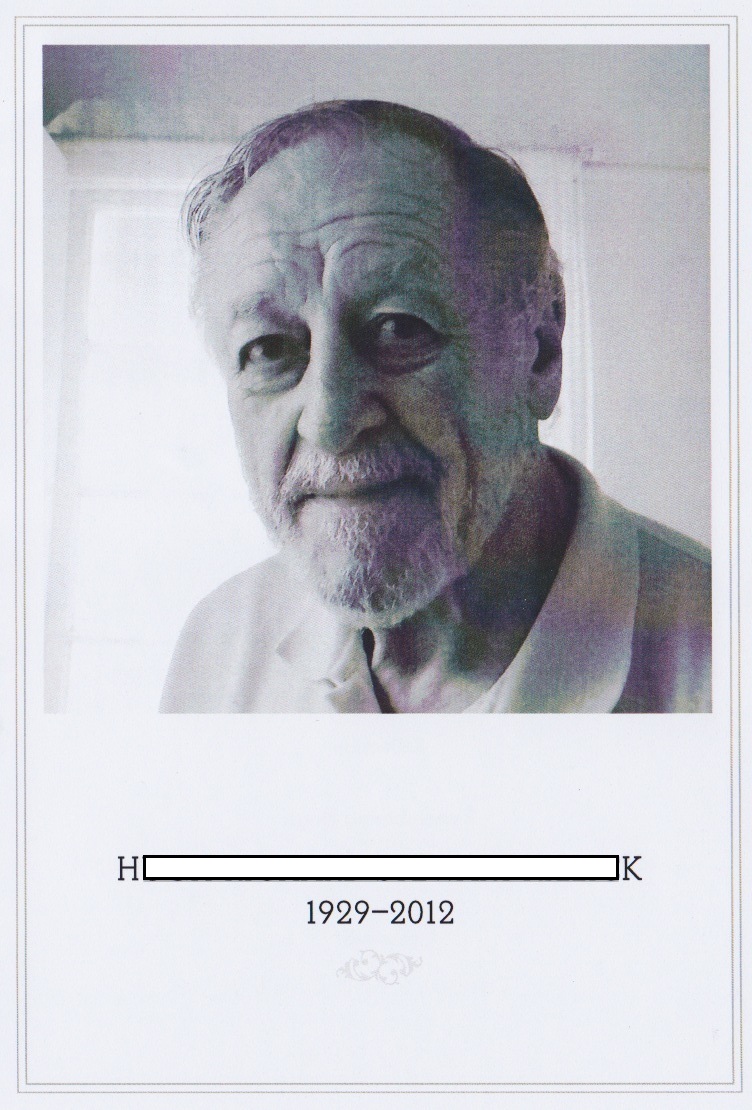
Fig 1. Front of the little handout.
It's actually a really nice silver, but
my scanner can't pick it up properly
    The funeral was held yesterday (Thursday), and overall it was exactly what was wanted and needed.  I did notice some mistakes and really interesting things

    Firstly I'll run through the funeral, what happened to give some background understanding of the event.  The family car arrived, which was blue, for my grandmother and off we went.  The funeral was only a short distance away so the trip was quick.  On arrival I saw the hearse was also blue, I'd never seen a blue hearse so that was rather fun.  It was just a basic ford hearse, a fairly common one and no different to many others I had seen save its color.  We entered the chapel, a rather nice and spacious place.  The coffin was down at the end, lying parallel to the stage and with the podium slightly to the side.  The service went well, short and to the point while still covering the details.  It was a fairly formal service, kind of surprising considering how liberal my grandfather and the family were and are.  At the end of the service I and three other family members wheeled the coffin out, loaded him into the hearse and watched it drive off.  Then we all went back inside the chapel and had some food.  The food was provided by Celest Catering, who are InvoCare's preferred caterers as they always do a very good job.  Overall it was a good funeral and everyone came away happy.


Fig 2. Back of the handout.
His date of birth is wrong here.
He was born 11 of September 1929.
    We had 100 orders of service printed up on nice paper.  My aunt organised them from the design to the printing and she did a rather good job.  It was also the exact number we needed, I noticed there were about 20 or so left over which meant everyone got one and not too many went to waste.  But we also had little hand outs which I really liked.  The hand outs were small silver cards, about double the size of a business card.  His picture was on the front, as seen in figure 1.  The back had his name, date of birth, date of death and a small message as seen in figure 2.  At the bottom of the back was an ad for the funeral home, and nobody minded this ad.  Actually I, and others, appreciated it as it's a great way to see which company did the funeral.  It is a great idea that I hope is a standard option with all InvoCare companies.

    Naturally working in a funeral home I have developed a different view and understanding of funerals.  I do not and cannot see them the same way as I did before joining the industry.  It's strange how others do not see the same things I do when we are presented with the same scene.  For example I noticed that they turned the coffin anti-clockwise instead of clockwise, and that the conductor only used one hand while simultaneously talking to the family.  To me these are two rather large mistakes, the coffin should always be turned clockwise (to represent the passage of time) and it should be treated as important enough to use both hands.  While I noticed this nobody else did, none of my family or the other mourners saw the mistake.  Once I mentioned it they realised, but until I said it they never thought of it.

The blue ford hearse.
    Another 'mistake' was the instructions given by the conductor.  The family were to wheel out then carry a short distance to the hearse.  The conductor instructed us to wheel by the handel, incredibly strange and actually quite difficult to do.  To wheel by the handel one has to bend and cannot push as hard or as accurately as needed.  Instead I have always been taught to wheel by the thumbscrews.  Taking ahold of the thumbscrews and pulling or pushing them to move the coffin is much better and safer.  It means there is no risk the coffin will slide off the trolly and needs less effort to move the thing.  So naturally I took hold of a thumbscrew and they held the handels.  Then they did not push much meaning I had to push it along, difficult to do well with just one corner.  The other issue was as we went down the stairs, the conductor had not told everyone to keep it level, as in raise the lower end.  Keeping it level makes it easier and safer to carry and means anything like flowers wont slide off.  Again, it was lucky I was at the lower end and knew to keep it level.  I feel the conductor should have given better and different instructions.

    Not only do I see these little mistakes but I see the whole funeral differently to others.  To me it is not as sad as other people found it, well, that isn't right.  I have been to a lot of funerals and as such they have become mundane and predictable.  In just one year I lost count of how many funerals I went to.  So for me a funeral was almost like another day at work.  However most other people go to a handful of funerals in their whole life.  For them it is a special unique event which they have little experience with.

The hearse moving away, taking him
to the crematorium.
    So I took pictures with my phone, which I noticed others saw as strange.  Nobody took issue with my taking photos (mainly as I was discrete) but they did not like it.  It made them uncomfortable, and when I questioned this they could not exactly say why.  They said it was "unusual" or "not normally done", but this is not a good reason as while the unusual our strange can make us uncomfortable it was not the impression I got.  I'm not sure why it made people uncomfortable but it was because it was more than just 'unusual' to them.  It was almost wrong, taboo or inappropriate to be taking pictures there and then.  But I took them anyway, and know that in the future others will appreciate it.


    However my previous experience at funerals has almost always been as an undertaker and not as a mourner.  One moment in particular made me realise how I didn't actually know what to do as a mourner and how others must feel at funerals.  The desire not to mess up, to get everything right and yet the lack of experience or understanding about what is going on.  This moment was just after we loaded the coffin into the hearse.  I went to stand next to the hearse driver and realised that was wrong, it was were the undertakers stood, not the mourners.  Then I stood there for a moment, unsure where to go.  So I took a few steps back and stood with the crowd of mourners.  But it was really surprising, how my instinct kicked in and I made my way to stand next to the staff and did not know where to stand as a mourner.

Front of the Order of Service book.
    The next thing was when they shut the door of the hearse I immediately thought of going back inside and moving the trolley which the coffin had been wheeled on.  I even started to move off and realised everyone else was still standing and watching the hearse.  Without instruction or communication they had all just known to wait until it was out of sight.  Whereas I was wanting to move away, because as an undertaker we are not to move until the back door is shut.  Once shut we immediately make our way about to the various things that need doing.  And this is exactly what I was instinctively doing, to me shutting the door is the signal to move away.  People do not normally notice but all the undertakers will evaporate away from the hearse at this point.  Thus I found it strange and awkward that everyone stood about and expected me to stand about also, normally I can and should leave at this point.  It was just really strange and uncomfortable for me.  It was that unsure feeling as though something had been forgotten.  Like wondering if you really locked the car, or left a light on or whatever.

    I also felt like this as I entered the funeral, it was so odd to be signing the book rather than getting people to sign.  As I walked in I felt as though I should be behind the table with the book.  It was so very unnatural to be standing in the room as a mourner.  Then sitting there at the front during the service was also odd.  I had always existed outside the service until the end points.  I would wait outside, or sit way at the back, never had I sat down amongst the other mourners.  All through the service I felt out of place, that I should be at the back with the other undertakers.

    Now I know how many mourners feel at funerals.  Unsure what to do or where to go, and with so much pressure to behave properly.  A funeral is a rather busy event with a lot to know and yet nobody to tell you.  So I will make more posts about how to be a mourner at a funeral and hopefully this will help someone someday.

    One of my other uncles on the other side of the family, unrelated to my grandfather attended the funeral.  He had gotten on really well with my grandparents for several years and it was nice he could come.  After the funeral I was chatting to him and he said how strange it was that nobody was in tears much.  To me that was normal, people were sad but not bawling their eyes out.  Yet to him, being Greek, people are normally very emotional at funerals, and with life in general.  I thought that was an intriguing comment about the emotional display.  It really supports this other post of mine about how emotional displays (such as crying) is socially and culturally learned rather than instinctive.

    And all this is after just one year in the industry!  It makes me wonder how other undertakers who have been doing this for decades feel as a mourner.  Perhaps they do not feel as out of place as I did or maybe they feel more out of place.

    As for the funeral home I would be happy to go back to them.  The staff were nice, approachable and acted professionally.  So overall I feel there was good value for money and they did do a good job.  The mistakes they made would go unnoticed with most mourners and did not impact affect the service.


Inside the chapel.


The family car which drove my grandmother. 
The blue ford hearse.


Securing the coffin.
Walking the hearse off.


The hearse about to turn onto the road and drive away.
Inside the Order of Service, first page.
Inside the Order of Service, second (and last) page.

Back of the Order of Service book.

~~

2012-04-25

A Personal Death - The little details

    Tomorrow is my grandfathers funeral.  If you read yesterdays post then you know that by now I'm in Brisbane to help prepare for the event.  We arrived at the airport just before lunch, checked into our bead and breakfast and then headed over to meet up with my uncle and aunt at my grandmothers for lunch.  There were so many things I had never seen organised or being finalised.  I have been on many funerals and only ever seen these things in their final and finished stage.  So this was a fascinating and very informative.  Overall it was a fairly nice day, but it was not without issues.

    My grandmother has dementia, bad enough that the doctors have determined she is no-longer mentally competent to sign legal documents, yet she is not completely lost.  She has a bad understanding of time, thinking of a quick moment as an eternity and then thinking of a long time as just a second.  She has no issue with the idea that she went skydiving with my grandfather yesterday and will go to his funeral tomorrow.  Naturally everyone wants to keep talk of the funeral to a minimum around her, when she stresses her dementia gets worse.  Plus it obviously upsets her as she really cared for her husband.

    At one stage about 5 of us gathered to the side and quietly discussed tomorrow.  Basically when and what was happening.  My cousin was concerned about the weight of the coffin as we would be carrying it.  I told her about how there won't be far to go or much weight, at the foot end everything is rather light.  This is because well over half of our weight is above our waist, from the waist down there is very little weight.  The coffin itself should only be about 20kg and he was losing weight towards the end (as he was unable to eat or drink) os he wouldn't weigh much more than that.  Knowing this really comforted her and she was happier about the idea of carrying.

    I think most people are nervous about carrying a coffin if they've never done it before, as with most new things.  There is a lot of anticipation and pressure, you're up there, infront of people and carrying something, no, someone who is very important to them.  To drop the coffin, trip or just mess up would be terrible.  I remember this from the first couple of times I carried, the nervousness I felt.  But everything went fine and stories of dropped coffins are so very rare.  There are plenty of close calls where a handel has come off or someone trips as they are walking with the coffin.  However in every case they or someone else saves the coffin.  The most common time a coffin is dropped is when it's being lowered, not carried.  Yet that's another story as it's not what we are doing on this funeral.

    Something that I had never thought about and is very important is the orders of service.  Someone has to print them, or organise them to be printed.  In this instance my aunt printed them off (and did a good job) then brought them over for us to fold.  It was almost strange how much emphasis and importance these booklets had.  They were only one A4 page folded in half and yet a lot of work and effort had gone into them.  My aunt was so concerned with the wording that she had been tempted to reprint all 100 just to change a few words which nobody else noticed.  My other family were then so attentive to folding the booklets, making sure each and every fold was straight and sharp.

    I'd never thought much of the orders of service (or mass booklets) before today.  I mean, they have always been very important to me.  I knew how the family love getting a few extra to sent to "those who were unable to make it" to the funeral as I use to say.  The order of service was always an important tool on the funeral as it gave an idea of how long things would take, what was to happen (and when) and where the family was going back to if I was driving them.  I also knew how people loved to get one, that it was such an important part of the funeral, like a pice of the service that they could take home and literally hold onto.  So the order of service was always important to me, but not in the same way as I now see it.  I saw how much effort and attention was put into this single A4 page and how much it meant to everyone.

    It is a actually a physical piece of the funeral that people can hold and keep.  A piece that the family can directly make and shape.  They see little impact of their decisions until the day.  For example they pick the coffin, where the funeral is and so on.  Yet none of these things are seen or happen until the day.  To pick a coffin out of a book does not feel like much of a decision or that important.  All they did was talk of prices and pick a picture from a book.  We put more effort into buying a TV and inspect it before buying it.  It is not until the funeral that most people will actually see the coffin or the other decisions they made.

    Even then many of the more important choices are invisible to families.  They make quite important decisions and yet never ever see the result or progress of these choices.  For example how many see or know about how the body makes it to the funeral home.  Another and more relatable example is clothing. Families often put a fair bit of thought into what the deceased should wear or have in the coffin.  Then in many of these cases they never see inside the coffin.  They do not see the deceased wearing the clothes, holding what they are meant to and so on.  This creates a tension, to make important emotional decisions then be totally divorced from the results has a dehumanising effect which makes the whole thing a little unreal.  To be separated from the outcome of our emotional decisions reduces the importance and reality of these decisions.

    The order of service is a wonderful way to counter all this.  It is a product families can see as it's being made; how it's being made, when it's completed and so on.  It is something they can put emotion into and personalise, such as including photos and dates of the deceased.  And it is something they can actively participate in, from designing it to printing it or even just folding copies.  It is something they can 'create' and make.  It then becomes so much more than just a 'booklet', it is a physical piece of the funeral and the deceased.  What lead me to realise this was the way my grandmother held the first test copy, she held it with longing care.  A sad smile slid slowly over her and she looked over the book for a while before handing it back.  It was not just as book but a bit of her husband, one of the very last bits and a bit of his funeral yet to come.

    Now I realise the significance of the order of service and will do a post dedicated to it another time.  Things to include and avoid, it's significance and how this simple bit of paper might very well be an unsung tool to deal with the death of a loved one.  It makes me wonder what other little details actually hold more significance than I realise.  Things like the food I had always thought of as vital are treated as trivial while the other supposedly mundane and unimportant are treated as crucial.

    All is set and we are just waiting for the funeral now.  And 'waiting' is the perfect word, I notice the family are basically counting down the time.  Time has become more important, 10 tomorrow morning now has more meaning and significance than it did yesterday morning.  They wait and I wait, it will be a long night for some and a short night for others.  But I think everyone will remember tonight.

~~

Another strange realisation has just crept into my mind as I finish up the post.  Both in this post and in earlier conversations I refer to my grandfather in his coffin as "the coffin", just as I would at a funeral as an undertaker.  I talk of him in the coffin no different to any other dead person who I'd never met on a funeral I had no personal attachment to.  While strange, and arguably impersonal, I do not know any other way to refer to it or him.  He is "the coffin" to me once the lid is on.  And I realise that others also referred to "the coffin", but did they learn this from me?

2012-04-24

A Personal Death - Arranging the funeral

    My grandfather died last week, not to anyones surprise and in some ways actually welcomed.  The whole process of his death and organising the funeral was interesting and very relevant to this blog.  Hopefully by examining this from a personal perspective I can get and share a deeper understanding of how funerals are done.  But from the perspective of a family mourner rather than an undertaker.

    My grandfathers health had been deteriorating over the last couple of years so everyone saw it coming, even him.  He had gone into hospital a few weeks before his death to treat his sore foot.  During the exames they found a serious cancer and admitted him where his health worsened rapidly.  His last few weeks were spent bed ridden, unable to eat or speak.  So his death was not as unpleasant as it could have been.

    When the doctors informed us he had a week or less to live a few of the family came to me about funeral information.  After all, I do have some experience in the industry, however I reminded them that I only had one years experience and was just a 'pleb' amongst many.  Even so I was able to help and suggest some things.  Because my grandfathers' brother is in England and quite old himself he would be unable to attend the funeral.  So I said we should make sure to send him an order of service or anything else like that.

    Things were left here and no more plans for his funeral were organised.  Many of his family (such as myself) live in Sydney which makes it difficult to organise things all the way up in Brisbane.  The family in Brisbane have been very busy with things I can't go into.  So they were unable to make anymore arrangements.

    However I think there was another more important reason for delaying plans for his funeral.  It was as though not planning his funeral while he was still alive was delaying or denying his death.  In reality everyone (including him) knew his death was coming, yet nobody was pushing toward organising his funeral.  this delay came from emotion rather than reason.  Quite understandable really as death and loved ones are more emotional than reasonable things for us.  So the delay in organising his funeral until after his death was predictable and understandable.  Perhaps this is why most people do not organise funerals until after the person is dead, even when they see it coming.

    After his death there was movement within the family.  People had to be called and the news passed around.  There was a lot of talk about the funeral, what should be done and when it could be held.  ANZAC Day was around the corner  (and still is as I write this) which limited the possible days.  There was an interesting and strange sense of urgency here.  Once he was dead that the funeral should be held sooner than later.  While there was not 'rush' there was most certainly a 'hurry' to get it sorted.  I found this interesting, how the funeral arrangements had been delayed (actively on some levels) while he was still alive, even though everyone knew how long was left, yet now after his death were urgent.  It was almost as thought there was an unspoken and uncertain time limit.  From working in the industry I know how a funeral could be delayed as long as desired.  Refrigeration (which is standard) can preserve a body for a week or more and embalming can preserve a body forever if done right.  So it was not as thought he would 'go bad' or something while the funeral was arranged.  On some level I think everyone knew this, but it was not the reason for the urgency.  The urgency came from a desire to 'finish the business' so to speak, closure in other words.  He was now dead for sure and people wanted to deal with it through putting him to rest.

    In Brisbane they approached a couple of funeral homes before settling with an InvoCare owned one.  We planed a small service within the funeral home chapel, after which his coffin will be carried out and taken to the crematorium for a No Service No Attendance (NSNA).  The reception or wake will be held in the same chapel after he is driven away.  To be honest I was a little disappointed because driving in cortege is the best part of the funeral to me.  It would have been good to experience this from a mourners perspective.  But this way was considerably cheaper, simpler and easier for my grandmother, all of which I think he would have preferred.

    All in all the funeral is costing about $8,000, not too high a price considering.  But I worked at one of the most expensive funeral homes in Sydney and had little to do with prices or costs.  So while I thought $8,000 was a little high for such a simple service the price is understandable and reasonable.  My grandmother did not see it this way, she thought the price was well and truly too high and was quite unhappy about it.  But that is just her way and she appears to have accepted it.  Again, it's interesting from a mourners perspective to be talking about 'costs' and 'prices' in relation to a dead loved one.  It is not putting a value on their life (or death in this case) but it is still strange.  And I'm not sure why it's strange, it just is.  It's also surprising that my initial reaction at hearing the price was to think of it as high without thinking  Once I heard a breakdown of the costings and thought about it I realised how it was, or is, a decent price for what we get.

    Anyway, there it stands, I'll fly up to Brisbane with some family tomorrow morning (ANZAC Day), a day before the funeral so we can spend time with the family.  The funeral will be held the next day (Thursday)

    On a side note one thing that also interests me is how the funeral is with InvoCare (Metropolitan to be exact) and my attitudes considering I know how they operate.  They are a good and bad company when handeling the dead.  Everything is quite respectful and decent.  Yet it is a modern process, much like McDonalds.  I'll go into detail about this in another post, but for now I will say that while the staff and this system try to be personal and caring they do not always succeed.  The system becomes cold to remain efficient.  Yet knowing this I have no issue with my grandfather going through the InvoCare system.  They may be cold, efficient and profit driven but what big company isn't?  At least they genuinely try to do right by the mourners and deceased.

~~

2012-04-09

Video - Cremation of a body

    After my last post someone sent me this fairly interesting youtube video.  The video shows the cremator  'burner' (or retort) in action, then what the ash is like after being burnt and how it is turned into what we know as ash.

<> WARNING!! The video does show human bones being burnt <>

    Although I personally see nothing wrong with the video, they show less than many TV shows or movies. But I understand some would not want to see this.


    Something I will note is that in America they must take the body out of the coffin before burning it.  Here in Australia this would be against the law as a body must be contained in a coffin and the crematorium staff are not allowed to open the coffin.  Of course there are exceptions for certain religions but I am not sure how that would work.  I know crematorium staff do not have the equipment or training in Australia to open a coffin nor do they want to.

    So do not worry, if your loved one was cremated in Australia they were never taken out of the coffin at the crematorium for any reason.

~~

2012-04-08

Ashes to Ashes: What ashes are really like and where they come from


A real picture of 'ash' at the end of the proces

    I thought it would be good to examine some of the misconceptions and ideas behind 'ash', how it is made and what it actually is.  When most people think of ash they think of a fine powder with an even consistency.  This is how it is depicted on TV and in the movies, as actual ash just like what is left behind after wood or coal is burnt.  Yet 'ash' is not like this, it is actually quite lumpy and grainy much like sand.

 Now to look at how the ash is made.  Firstly and most obviously the coffin is often put into a 'burner' where it will be burnt.  The average body takes about three hours to completely burn, although some can take much longer if they are 'heavier'.

    At some larger crematoriums they will get more coffins than they can process in a day.  So they place the excess coffins into a holding room, which is a special fridge just like in any mortuary.  The coffins will sit in the fridge for no more than a day as crematoriums are only allowed to hold coffins for a certain time (a day or two if I remember right).

The default plastic urn.
    Once the coffin is completely burnt the remains are removed from the burner, either by being swept out, dropped through a special grate or vacuumed out with a special machine.  These remains are nothing like ash, they are broken and burnt pieces of bone as most bones do not burn down.  Think of those who die in a fire, there are a lot of bones left behind from teeth to bits of the pelvis.  The next part of the process is aimed at turning these remains into ash.

    After being taken out of the burner the remains are placed into an odd machine.  The best way I could describe it is as a stainless steel tumble dryer.  This machines has some rocks in it and metal rods fixed to the sides.  This means that as the remains are turned and tossed about they are ground down into a powder.  It is this powder that families will receive in an urn.

    The remains, now turned to ash are put into square plastic containers at the crematorium.  This is the default urn that all ash is automatically placed in.  The crematoriums can decant the ash into another urn if the family wants.  However sometimes families will decant the ashes themselves, or quite often get the funeral home to do it.  This decanting process is quite easy and simple, it just involves pouring the ashes out of the default plastic urn into another urn of the families choosing.

    However quite often there are more ashes in the plastic urn than can fit into the special urn purchased by the deceased or family.  Surprisingly often a good inch or so of ash will be left over, so what becomes of this left over ash?  It gets tipped ever so quietly into a garden, bin or somewhere else nobody is looking.  Other times as someone is decanting the ash a gust of wind comes by, blowing ash all over the person and the room.  There is a lot of ash scattered over the trim shop and certain employees at WNBull.

    Ash does present a unique hazard, it will burn if it gets in the eyes and I have o doubt it is not good for the lungs.  Both of these are quite possible when decanting ash as it blows about fairly easily.  Luckily most do not handle ash regularly and a few exposures over the years is obviously not too harmful or there would be fewer undertakers.  Just try to be same and careful with ash and everything should be fine.

A pile of default plastic urns.
The decanting funnel.
Also known as the 'fire warden hat'.

    I found this fairly good website on cremations, it has detail but is not too detailed.  So for further reading or advice on cremations I would highly recommend this website.

"What is Cremation?" - A very good webpage specifically about how bodies are cremated.
"Why Cremation?" - Reasons for cremation and cremation statistics in America.

~~

2012-02-12

Misconceptions & Questions - Part 1

Despite being in this industry for a little under a year I have encountered many misconceptions, strange questions and surprises from people.  They range from the amusing to the absurd or even insulting.  So here is a little list of the stuff I have encountered.

Misconceptions & Questions - Part 2

Misconceptions & Questions - Part 3

Complete List of misconceptions & questions


- What is a transfer vehicle?
    The transfer vehicle is the car used to 'transfer' (pickup and transport) a body.  This involves collecting the body from the hospital, from a nursing home, from the scene of an accident, from a personal residence/house, taking the body interstate and so on.  The transfer vehicle is basically white van, often a Toyota Hicace.

Pictures of inside a transfer van

Explanation of the transfer


- The undertaker buries / cremates the body
    No, never.  The undertaker is a very different person to those who burry or cremate the body.  The people who burry the body are called "gravediggers" (or 'diggers' for short) and are more handymen or gardeners.  They also maintain the cemetery.  Those who cremate the body are crematorium staff and are similar to the diggers in that they are more handymen.  The undertaker deals with the families and the bodies, but does not "commit" the bodies.


- How long does it take a body to burn?
Most people take an average of three hours but it can vary wildly depending on size.  I have heard of how it took about 36 hours to cremate a woman who was just over 300kg.  She only just fit into the crematory.


- What is ash like after someone is cremated?
  Human ash is not like 'ash' as many expect. It is not a fine powder but rather a sandy mixture. It is grainy and rough. This is because bone does not completely burn down. So the lumps of bones left in the retort (cremator) are ground down in a special machine.


- Do you break peoples legs to fit them into the coffin?
No, never. This is simply ridiculous and so funny to me. It would take a LOT of work and effort to break or remove someones legs. It is not worth it, the undertaker would just get a bigger coffin. Or they can bend the legs, legs do bend quite easily. Think of when you sit and when you stand, your legs bend, and without any breaking!


- Do the gravediggers / crematorium staff steal belongings?
No, they do not have the equipment desired to hopen or handle an open coffin. They do not have gloves or training to do it. Many diggers or crem staff have never seen a dead body. But even if they did have the tools they never have the time. Both diggers and crem staff work constantly , they would not have time to go breaking into random coffins on the off chance of finding something valuable.

~~