Showing posts with label family. Show all posts

2012-09-14

A Personal Death - Another funeral

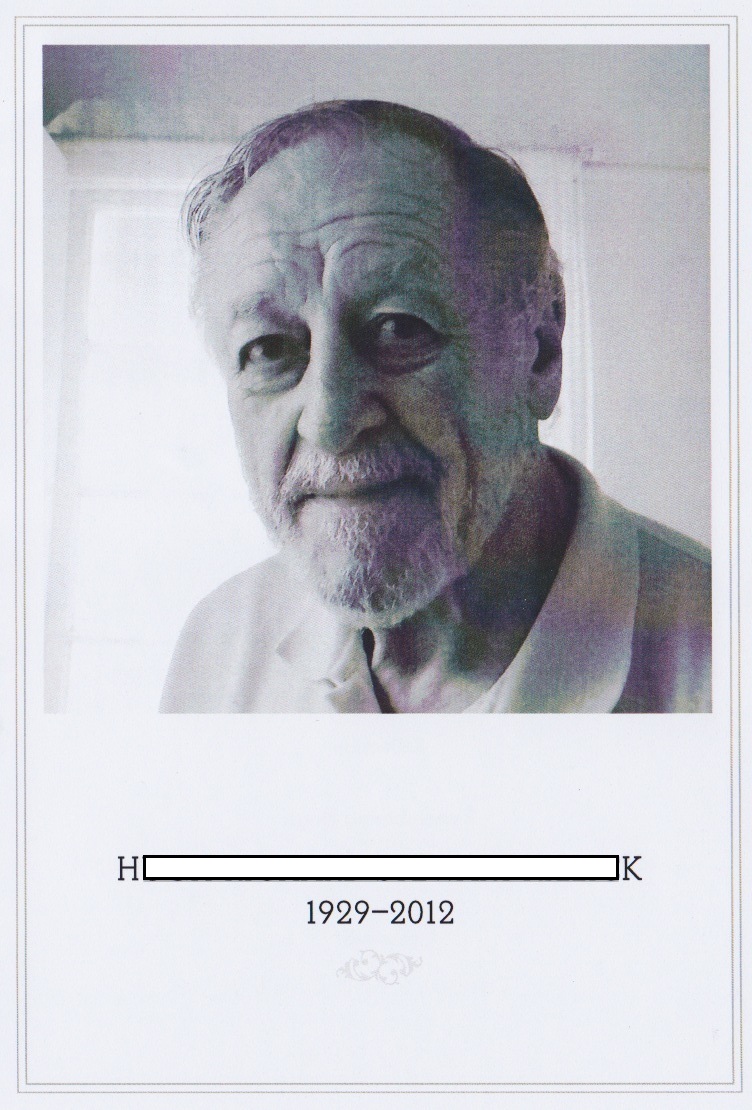
Front of the order of service.
    With my grandmothers funeral only a few months after my grandfathers we simply stuck with the same funeral home.  It was familiar and convenient and everyone was happy enough with the job they did last time.  The last funeral was not perfect, but not that bad really and the staff were nice.

    This is my experience and opinions of my grandmothers funeral.  It was an 'interesting' event.

2012-09-12

A Personal Death - The music

    In the last series of posts about my grandfathers funeral I came to a few interesting realisations.  The importance of the Order of Service.  How emotionally significant it is and how it is a piece of the funeral in many ways.  The other was the roles we play.  How being an undertaker has changed my view of funerals and how different it is from the perspective of a mourner.

    With my grandmothers funeral this was no different.  I realised a new thing and explored another in more detail.  This time my realisation was the music, how much is put into it and how trivial it actually is.

2012-09-10

A Personal Death - Again

    A while ago my grandfather died.  At the time I wrote about my experiences with it, arranging the funeral, the funeral itself and some interesting things I had never noticed or thought of before.  Now, just a few weeks ago my grandmother has also died.  So, now I am finally back in Sydney it's time I wrote about this funeral.

    Having the experience of the other funeral so recently this one was fairly different.  The circumstances behind her death were also different.  Overall it was a pleasant experience, but there are some observations and thoughts about it.

2012-04-28

The Order of Service - Dealing with Death

    At my recent grandfathers funeral I became aware of the significance of the order of service book.  How this one simple book could have such an impact upon people.  Thus I've decided to do a series of posts about it, from how and why it can help deal with death to how to make a useful and interesting booklet.  So read on and find out about an often overlooked and yet significant part of the funeral practice.

    The 'order of service' can be called many things, for example the Catholics would refer to it as a "mass book".  Despite the many names it is always the same thing at every funeral.  There may be slight variations but basically it is the booklet which lists what is to happen at the funeral and gives some information about the deceased or their family.

    One thing I noticed during my grandfathers funeral was how much effort and care was put into making the order of service.  My aunt, who was organising it, wanted to get the working and design perfect.  Which was a tricky task considering she had a couple of days to organise and print them off.  After printing them off we all helped to fold them.  Here again I noticed how much care was put into folding them, everyone made sure the folds were straight and crisp.  For everyone the orders of service were very important and personal.  This has made me realise how the order of service can be used to help deal with the loss of a loved one.

    An issue I've realised with organising funerals is how little progress there appears to be.  One can spend a week arranging and organising a funeral for their loved one and yet it does not feel like much gets done.  Important and emotional decisions are made and yet there is nothing to show for it.  For example when people pick a coffin it is usually through a book.  They look through the book at the pictures and pick the one they like.  No different from how one would pick furniture out of a catalogue.  This distances people from the significance and emotions of their decision.  Then after all these decisions are made people do not see them enacted until the day of the funeral.  Going back to the example of the coffin, it is not seen until the funeral.  It is an emotional and expensive thing which is not seen until the end.  This creates a sense of stagnation as though little progress has been made.  That the decisions made have little impact.  Which is not a good feeling for the family or friends.

    Here is where the order of service can be used to counter this.  The family can be directly involved in all aspects of the booklets.  They can design them, print them and sort them.  They can be involved throughout the process and see it develop first hand.  As such this will help to create a sense of progress and make people feel involved in the funeral process.


    The order of service are a great way to get everyone involved in the funeral process.  People can discuss and preview the design.  Later everyone can be actively involved in preparing the order of service, people could fold or staple them after they're printed.  Getting people involved like this lets people think about the funeral and death of the deceased before the event.  To build up slowly rather than be suddenly confronted with the funeral.  Plus it's a great way to bring people together, to have everyone sit around a table doing the same task, chatting and eating as they do so.  Sharing food and tasks are good ways of connecting and communicating with each other.  So this will help people process and prepare for the funeral, but it will also bring the family and friends together and prevent people feeling lonely.

    Yet the order of service is so much more than this.  It is a representative and physical part of the funeral and deceased.  The order of service is treated as a physical part of the funeral process and is bound up with many emotions.  The way my grandmother held the first printout was a great display of this.  She held it with longing care.  A sad smile slid slowly over her and she looked over the book for a while before handing it back.  It was not just a book but a bit of her husband, one of the very last bits of him, and it was a bit of his funeral yet to come.  In other words the order of service is an actual piece of the funeral process and the deceased.  This is most obvious in the way that the order of service often has a picture the and dates of birth and death of the deceased.

    Unlike many other parts this is one people can hold and keep.  The coffin for example is possibly more important (emotionally and physically) but it cannot be taken home.  It canot be kept and it is barely interacted with.  On the other hand there is the order of service is something people can take and keep as long as they like.  When working as an undertaker I found people really wanted an order of service, and that almost everyone kept them.  Rarely where the orders of service left behind in the chapel and when they were left it was by the immediate family.  This was because the family had been distracted by other things such as carrying the coffin and often left other personal belongings behind as well.  Or because they had a copy or two at home and knew they could (and would) print more copies later.

    It is also a piece that can be sent and given to others who did not attend the funeral.  Thus it can make people who did not attend feel part of the funeral process.  They were not able to go but could bring a bit of the funeral to them.  I noticed this while working in the funeral industry, that many who could not go would ask the family for an order of service.  Then at my grandfathers funeral I saw how the family overseas who could not make it were really happy to get an order of service.  It's a really nice gesture that will make people feel involved and part of the event.

    This post only covers the surface of the order of service.  It is a very complex and intricate thing which is bound up with a lot of emotions and meanings.  This makes it the perfect thing to help people deal with the upcoming funeral and death of a loved one.  So pay attention to the order of service and try to involve people in its creation.

~~

A Personal Death - The funeral

Fig 1. Front of the little handout.
It's actually a really nice silver, but
my scanner can't pick it up properly
    The funeral was held yesterday (Thursday), and overall it was exactly what was wanted and needed.  I did notice some mistakes and really interesting things

    Firstly I'll run through the funeral, what happened to give some background understanding of the event.  The family car arrived, which was blue, for my grandmother and off we went.  The funeral was only a short distance away so the trip was quick.  On arrival I saw the hearse was also blue, I'd never seen a blue hearse so that was rather fun.  It was just a basic ford hearse, a fairly common one and no different to many others I had seen save its color.  We entered the chapel, a rather nice and spacious place.  The coffin was down at the end, lying parallel to the stage and with the podium slightly to the side.  The service went well, short and to the point while still covering the details.  It was a fairly formal service, kind of surprising considering how liberal my grandfather and the family were and are.  At the end of the service I and three other family members wheeled the coffin out, loaded him into the hearse and watched it drive off.  Then we all went back inside the chapel and had some food.  The food was provided by Celest Catering, who are InvoCare's preferred caterers as they always do a very good job.  Overall it was a good funeral and everyone came away happy.


Fig 2. Back of the handout.
His date of birth is wrong here.
He was born 11 of September 1929.
    We had 100 orders of service printed up on nice paper.  My aunt organised them from the design to the printing and she did a rather good job.  It was also the exact number we needed, I noticed there were about 20 or so left over which meant everyone got one and not too many went to waste.  But we also had little hand outs which I really liked.  The hand outs were small silver cards, about double the size of a business card.  His picture was on the front, as seen in figure 1.  The back had his name, date of birth, date of death and a small message as seen in figure 2.  At the bottom of the back was an ad for the funeral home, and nobody minded this ad.  Actually I, and others, appreciated it as it's a great way to see which company did the funeral.  It is a great idea that I hope is a standard option with all InvoCare companies.

    Naturally working in a funeral home I have developed a different view and understanding of funerals.  I do not and cannot see them the same way as I did before joining the industry.  It's strange how others do not see the same things I do when we are presented with the same scene.  For example I noticed that they turned the coffin anti-clockwise instead of clockwise, and that the conductor only used one hand while simultaneously talking to the family.  To me these are two rather large mistakes, the coffin should always be turned clockwise (to represent the passage of time) and it should be treated as important enough to use both hands.  While I noticed this nobody else did, none of my family or the other mourners saw the mistake.  Once I mentioned it they realised, but until I said it they never thought of it.

The blue ford hearse.
    Another 'mistake' was the instructions given by the conductor.  The family were to wheel out then carry a short distance to the hearse.  The conductor instructed us to wheel by the handel, incredibly strange and actually quite difficult to do.  To wheel by the handel one has to bend and cannot push as hard or as accurately as needed.  Instead I have always been taught to wheel by the thumbscrews.  Taking ahold of the thumbscrews and pulling or pushing them to move the coffin is much better and safer.  It means there is no risk the coffin will slide off the trolly and needs less effort to move the thing.  So naturally I took hold of a thumbscrew and they held the handels.  Then they did not push much meaning I had to push it along, difficult to do well with just one corner.  The other issue was as we went down the stairs, the conductor had not told everyone to keep it level, as in raise the lower end.  Keeping it level makes it easier and safer to carry and means anything like flowers wont slide off.  Again, it was lucky I was at the lower end and knew to keep it level.  I feel the conductor should have given better and different instructions.

    Not only do I see these little mistakes but I see the whole funeral differently to others.  To me it is not as sad as other people found it, well, that isn't right.  I have been to a lot of funerals and as such they have become mundane and predictable.  In just one year I lost count of how many funerals I went to.  So for me a funeral was almost like another day at work.  However most other people go to a handful of funerals in their whole life.  For them it is a special unique event which they have little experience with.

The hearse moving away, taking him
to the crematorium.
    So I took pictures with my phone, which I noticed others saw as strange.  Nobody took issue with my taking photos (mainly as I was discrete) but they did not like it.  It made them uncomfortable, and when I questioned this they could not exactly say why.  They said it was "unusual" or "not normally done", but this is not a good reason as while the unusual our strange can make us uncomfortable it was not the impression I got.  I'm not sure why it made people uncomfortable but it was because it was more than just 'unusual' to them.  It was almost wrong, taboo or inappropriate to be taking pictures there and then.  But I took them anyway, and know that in the future others will appreciate it.


    However my previous experience at funerals has almost always been as an undertaker and not as a mourner.  One moment in particular made me realise how I didn't actually know what to do as a mourner and how others must feel at funerals.  The desire not to mess up, to get everything right and yet the lack of experience or understanding about what is going on.  This moment was just after we loaded the coffin into the hearse.  I went to stand next to the hearse driver and realised that was wrong, it was were the undertakers stood, not the mourners.  Then I stood there for a moment, unsure where to go.  So I took a few steps back and stood with the crowd of mourners.  But it was really surprising, how my instinct kicked in and I made my way to stand next to the staff and did not know where to stand as a mourner.

Front of the Order of Service book.
    The next thing was when they shut the door of the hearse I immediately thought of going back inside and moving the trolley which the coffin had been wheeled on.  I even started to move off and realised everyone else was still standing and watching the hearse.  Without instruction or communication they had all just known to wait until it was out of sight.  Whereas I was wanting to move away, because as an undertaker we are not to move until the back door is shut.  Once shut we immediately make our way about to the various things that need doing.  And this is exactly what I was instinctively doing, to me shutting the door is the signal to move away.  People do not normally notice but all the undertakers will evaporate away from the hearse at this point.  Thus I found it strange and awkward that everyone stood about and expected me to stand about also, normally I can and should leave at this point.  It was just really strange and uncomfortable for me.  It was that unsure feeling as though something had been forgotten.  Like wondering if you really locked the car, or left a light on or whatever.

    I also felt like this as I entered the funeral, it was so odd to be signing the book rather than getting people to sign.  As I walked in I felt as though I should be behind the table with the book.  It was so very unnatural to be standing in the room as a mourner.  Then sitting there at the front during the service was also odd.  I had always existed outside the service until the end points.  I would wait outside, or sit way at the back, never had I sat down amongst the other mourners.  All through the service I felt out of place, that I should be at the back with the other undertakers.

    Now I know how many mourners feel at funerals.  Unsure what to do or where to go, and with so much pressure to behave properly.  A funeral is a rather busy event with a lot to know and yet nobody to tell you.  So I will make more posts about how to be a mourner at a funeral and hopefully this will help someone someday.

    One of my other uncles on the other side of the family, unrelated to my grandfather attended the funeral.  He had gotten on really well with my grandparents for several years and it was nice he could come.  After the funeral I was chatting to him and he said how strange it was that nobody was in tears much.  To me that was normal, people were sad but not bawling their eyes out.  Yet to him, being Greek, people are normally very emotional at funerals, and with life in general.  I thought that was an intriguing comment about the emotional display.  It really supports this other post of mine about how emotional displays (such as crying) is socially and culturally learned rather than instinctive.

    And all this is after just one year in the industry!  It makes me wonder how other undertakers who have been doing this for decades feel as a mourner.  Perhaps they do not feel as out of place as I did or maybe they feel more out of place.

    As for the funeral home I would be happy to go back to them.  The staff were nice, approachable and acted professionally.  So overall I feel there was good value for money and they did do a good job.  The mistakes they made would go unnoticed with most mourners and did not impact affect the service.


Inside the chapel.


The family car which drove my grandmother. 
The blue ford hearse.


Securing the coffin.
Walking the hearse off.


The hearse about to turn onto the road and drive away.
Inside the Order of Service, first page.
Inside the Order of Service, second (and last) page.

Back of the Order of Service book.

~~

2012-04-25

A Personal Death - The little details

    Tomorrow is my grandfathers funeral.  If you read yesterdays post then you know that by now I'm in Brisbane to help prepare for the event.  We arrived at the airport just before lunch, checked into our bead and breakfast and then headed over to meet up with my uncle and aunt at my grandmothers for lunch.  There were so many things I had never seen organised or being finalised.  I have been on many funerals and only ever seen these things in their final and finished stage.  So this was a fascinating and very informative.  Overall it was a fairly nice day, but it was not without issues.

    My grandmother has dementia, bad enough that the doctors have determined she is no-longer mentally competent to sign legal documents, yet she is not completely lost.  She has a bad understanding of time, thinking of a quick moment as an eternity and then thinking of a long time as just a second.  She has no issue with the idea that she went skydiving with my grandfather yesterday and will go to his funeral tomorrow.  Naturally everyone wants to keep talk of the funeral to a minimum around her, when she stresses her dementia gets worse.  Plus it obviously upsets her as she really cared for her husband.

    At one stage about 5 of us gathered to the side and quietly discussed tomorrow.  Basically when and what was happening.  My cousin was concerned about the weight of the coffin as we would be carrying it.  I told her about how there won't be far to go or much weight, at the foot end everything is rather light.  This is because well over half of our weight is above our waist, from the waist down there is very little weight.  The coffin itself should only be about 20kg and he was losing weight towards the end (as he was unable to eat or drink) os he wouldn't weigh much more than that.  Knowing this really comforted her and she was happier about the idea of carrying.

    I think most people are nervous about carrying a coffin if they've never done it before, as with most new things.  There is a lot of anticipation and pressure, you're up there, infront of people and carrying something, no, someone who is very important to them.  To drop the coffin, trip or just mess up would be terrible.  I remember this from the first couple of times I carried, the nervousness I felt.  But everything went fine and stories of dropped coffins are so very rare.  There are plenty of close calls where a handel has come off or someone trips as they are walking with the coffin.  However in every case they or someone else saves the coffin.  The most common time a coffin is dropped is when it's being lowered, not carried.  Yet that's another story as it's not what we are doing on this funeral.

    Something that I had never thought about and is very important is the orders of service.  Someone has to print them, or organise them to be printed.  In this instance my aunt printed them off (and did a good job) then brought them over for us to fold.  It was almost strange how much emphasis and importance these booklets had.  They were only one A4 page folded in half and yet a lot of work and effort had gone into them.  My aunt was so concerned with the wording that she had been tempted to reprint all 100 just to change a few words which nobody else noticed.  My other family were then so attentive to folding the booklets, making sure each and every fold was straight and sharp.

    I'd never thought much of the orders of service (or mass booklets) before today.  I mean, they have always been very important to me.  I knew how the family love getting a few extra to sent to "those who were unable to make it" to the funeral as I use to say.  The order of service was always an important tool on the funeral as it gave an idea of how long things would take, what was to happen (and when) and where the family was going back to if I was driving them.  I also knew how people loved to get one, that it was such an important part of the funeral, like a pice of the service that they could take home and literally hold onto.  So the order of service was always important to me, but not in the same way as I now see it.  I saw how much effort and attention was put into this single A4 page and how much it meant to everyone.

    It is a actually a physical piece of the funeral that people can hold and keep.  A piece that the family can directly make and shape.  They see little impact of their decisions until the day.  For example they pick the coffin, where the funeral is and so on.  Yet none of these things are seen or happen until the day.  To pick a coffin out of a book does not feel like much of a decision or that important.  All they did was talk of prices and pick a picture from a book.  We put more effort into buying a TV and inspect it before buying it.  It is not until the funeral that most people will actually see the coffin or the other decisions they made.

    Even then many of the more important choices are invisible to families.  They make quite important decisions and yet never ever see the result or progress of these choices.  For example how many see or know about how the body makes it to the funeral home.  Another and more relatable example is clothing. Families often put a fair bit of thought into what the deceased should wear or have in the coffin.  Then in many of these cases they never see inside the coffin.  They do not see the deceased wearing the clothes, holding what they are meant to and so on.  This creates a tension, to make important emotional decisions then be totally divorced from the results has a dehumanising effect which makes the whole thing a little unreal.  To be separated from the outcome of our emotional decisions reduces the importance and reality of these decisions.

    The order of service is a wonderful way to counter all this.  It is a product families can see as it's being made; how it's being made, when it's completed and so on.  It is something they can put emotion into and personalise, such as including photos and dates of the deceased.  And it is something they can actively participate in, from designing it to printing it or even just folding copies.  It is something they can 'create' and make.  It then becomes so much more than just a 'booklet', it is a physical piece of the funeral and the deceased.  What lead me to realise this was the way my grandmother held the first test copy, she held it with longing care.  A sad smile slid slowly over her and she looked over the book for a while before handing it back.  It was not just as book but a bit of her husband, one of the very last bits and a bit of his funeral yet to come.

    Now I realise the significance of the order of service and will do a post dedicated to it another time.  Things to include and avoid, it's significance and how this simple bit of paper might very well be an unsung tool to deal with the death of a loved one.  It makes me wonder what other little details actually hold more significance than I realise.  Things like the food I had always thought of as vital are treated as trivial while the other supposedly mundane and unimportant are treated as crucial.

    All is set and we are just waiting for the funeral now.  And 'waiting' is the perfect word, I notice the family are basically counting down the time.  Time has become more important, 10 tomorrow morning now has more meaning and significance than it did yesterday morning.  They wait and I wait, it will be a long night for some and a short night for others.  But I think everyone will remember tonight.

~~

Another strange realisation has just crept into my mind as I finish up the post.  Both in this post and in earlier conversations I refer to my grandfather in his coffin as "the coffin", just as I would at a funeral as an undertaker.  I talk of him in the coffin no different to any other dead person who I'd never met on a funeral I had no personal attachment to.  While strange, and arguably impersonal, I do not know any other way to refer to it or him.  He is "the coffin" to me once the lid is on.  And I realise that others also referred to "the coffin", but did they learn this from me?

2012-04-24

A Personal Death - Arranging the funeral

    My grandfather died last week, not to anyones surprise and in some ways actually welcomed.  The whole process of his death and organising the funeral was interesting and very relevant to this blog.  Hopefully by examining this from a personal perspective I can get and share a deeper understanding of how funerals are done.  But from the perspective of a family mourner rather than an undertaker.

    My grandfathers health had been deteriorating over the last couple of years so everyone saw it coming, even him.  He had gone into hospital a few weeks before his death to treat his sore foot.  During the exames they found a serious cancer and admitted him where his health worsened rapidly.  His last few weeks were spent bed ridden, unable to eat or speak.  So his death was not as unpleasant as it could have been.

    When the doctors informed us he had a week or less to live a few of the family came to me about funeral information.  After all, I do have some experience in the industry, however I reminded them that I only had one years experience and was just a 'pleb' amongst many.  Even so I was able to help and suggest some things.  Because my grandfathers' brother is in England and quite old himself he would be unable to attend the funeral.  So I said we should make sure to send him an order of service or anything else like that.

    Things were left here and no more plans for his funeral were organised.  Many of his family (such as myself) live in Sydney which makes it difficult to organise things all the way up in Brisbane.  The family in Brisbane have been very busy with things I can't go into.  So they were unable to make anymore arrangements.

    However I think there was another more important reason for delaying plans for his funeral.  It was as though not planning his funeral while he was still alive was delaying or denying his death.  In reality everyone (including him) knew his death was coming, yet nobody was pushing toward organising his funeral.  this delay came from emotion rather than reason.  Quite understandable really as death and loved ones are more emotional than reasonable things for us.  So the delay in organising his funeral until after his death was predictable and understandable.  Perhaps this is why most people do not organise funerals until after the person is dead, even when they see it coming.

    After his death there was movement within the family.  People had to be called and the news passed around.  There was a lot of talk about the funeral, what should be done and when it could be held.  ANZAC Day was around the corner  (and still is as I write this) which limited the possible days.  There was an interesting and strange sense of urgency here.  Once he was dead that the funeral should be held sooner than later.  While there was not 'rush' there was most certainly a 'hurry' to get it sorted.  I found this interesting, how the funeral arrangements had been delayed (actively on some levels) while he was still alive, even though everyone knew how long was left, yet now after his death were urgent.  It was almost as thought there was an unspoken and uncertain time limit.  From working in the industry I know how a funeral could be delayed as long as desired.  Refrigeration (which is standard) can preserve a body for a week or more and embalming can preserve a body forever if done right.  So it was not as thought he would 'go bad' or something while the funeral was arranged.  On some level I think everyone knew this, but it was not the reason for the urgency.  The urgency came from a desire to 'finish the business' so to speak, closure in other words.  He was now dead for sure and people wanted to deal with it through putting him to rest.

    In Brisbane they approached a couple of funeral homes before settling with an InvoCare owned one.  We planed a small service within the funeral home chapel, after which his coffin will be carried out and taken to the crematorium for a No Service No Attendance (NSNA).  The reception or wake will be held in the same chapel after he is driven away.  To be honest I was a little disappointed because driving in cortege is the best part of the funeral to me.  It would have been good to experience this from a mourners perspective.  But this way was considerably cheaper, simpler and easier for my grandmother, all of which I think he would have preferred.

    All in all the funeral is costing about $8,000, not too high a price considering.  But I worked at one of the most expensive funeral homes in Sydney and had little to do with prices or costs.  So while I thought $8,000 was a little high for such a simple service the price is understandable and reasonable.  My grandmother did not see it this way, she thought the price was well and truly too high and was quite unhappy about it.  But that is just her way and she appears to have accepted it.  Again, it's interesting from a mourners perspective to be talking about 'costs' and 'prices' in relation to a dead loved one.  It is not putting a value on their life (or death in this case) but it is still strange.  And I'm not sure why it's strange, it just is.  It's also surprising that my initial reaction at hearing the price was to think of it as high without thinking  Once I heard a breakdown of the costings and thought about it I realised how it was, or is, a decent price for what we get.

    Anyway, there it stands, I'll fly up to Brisbane with some family tomorrow morning (ANZAC Day), a day before the funeral so we can spend time with the family.  The funeral will be held the next day (Thursday)

    On a side note one thing that also interests me is how the funeral is with InvoCare (Metropolitan to be exact) and my attitudes considering I know how they operate.  They are a good and bad company when handeling the dead.  Everything is quite respectful and decent.  Yet it is a modern process, much like McDonalds.  I'll go into detail about this in another post, but for now I will say that while the staff and this system try to be personal and caring they do not always succeed.  The system becomes cold to remain efficient.  Yet knowing this I have no issue with my grandfather going through the InvoCare system.  They may be cold, efficient and profit driven but what big company isn't?  At least they genuinely try to do right by the mourners and deceased.

~~

2012-04-19

Funeral Fun - Smashing a Tree

    This is not my story but a story that was told to me by a co-worker about an od accident he witnessed while on a funeral.


2012-03-19

Crying on Funerals; how people display emotion & the professional wailers

    It was once said on Something Positive that our sorrow at the death of a loved one comes more from of selfishness than empathy.  People are sad that they can no longer spend time with that person rather than sad that the person is actually dead.  Another interesting point is Durkheim's argument that we are naturally social creatures constantly conflicting with social desires and expectations.  This lead me to the thought of how emotions on funerals is quite possibly as social as it is personal.

    According to the images and perceptions of funerals the event itself is a sad affair where people will express their depression and sorry in a variety or ways, from silent starring to emotional crying.  However the truth is that people are quite 'normal' on funerals.  Sure, there is sorrow but the event as a whole is generally more like a gathering of family and friends than a sad emotional event.  Of course there are exceptions, some people do cry, others are so emotional they can barely stand.  What I have found is this degree of emotional display differs with culture, age and gender.  Thus I will be looking at the degree to which certain people display negative emotion (such as crying) on funerals.

    Firstly we should look at age.  From what I have seen the amount of crying or display of emotion differs quite considerably with age, and until a certain point (towards adolescence) is nots influenced by gender or culture.  Very young children, those under the age of five or so, were very unlikely to cry.  Instead they were more concerned with eating, going outside, playing and other such needs and desires.  This changed when children were eight to twelve, as at this age they were surprisingly very likely to cry and be more upset than most adults.  Yet once they got much older than twelve to thirteen they become more dependant on the social situation.  As in if the adults were crying  then they were liable to cry, and if the adults were not crying they would not be likely to either.  The influence of gender is not apparent until into, or after, puberty.  Thus boys and girls cry and exhibit emotions to the same degree until 'men' or 'women'.

    Now lets discuss my observation.  I find the whole concept interesting, that the display of emotion on funerals varies with age, but not gender nor culture until a certain age.  The young children who do not cry or show any emotion could have several reasons for this.  One is that children simply do not understand 'others' fully.  By this I mean that those under a certain age only think of themselves and struggle with empathising with others.  If one asks a child how many siblings they have then they might say "one brother", however ask them bow many siblings their brother has and they might have trouble answering.  They cannot see things from others perspectives and as such one cannot really expect them to be sad that something (or someone) they struggle with understanding exists or empathising with is dead.  So on the funeral you will see young children quite understandably more concerned with going outside to play rather than sit inside listening to a long service ignoring the social conventions and expectations around them.  Yet the exact opposite appears to be true when older children, especially around eight to ten years old.  They will almost certainly cry, and not just a couple of tears, they will have red eyes, blocked noses and be like a little waterfall of sorrow.  As with the younger children they to ignore social conventions and expectations, generally crying no matter what.  There could be several reasons for this display of emotion, the one I believe is that this is a prime age where they can fully understand others as well as death and yet have not developed the mental tools to deal with the coming together of the two ideas.  Simply the fact that people exist and can be empathised with creates a serious upset once children realise that these people die.  They feel sorry for the person, bad that they are dead and never to return.  Despite knowing and understanding this they are still too young and inexperienced to have developed the tools to deal with this coming together of concepts.  This is partially due to the fact that adults are so hesitant to talk with children about death.  Many strange questions were asked by children on funerals, they would ask about what the hearse was, what was in the coffin, where the dead go (it was interesting that they had to go somewhere, they could not just cease to be), what all the candles were for, what is in the hole (asking about the grave), why there were flowers, where the coffin went at the crematorium and so on.  What was most interesting is that adults were hesitant to explain anything much, avoiding details and often resorting to making things up.  A few adults explained that the hearse would drive the deceased "up to heaven" even when they were not religious.  When asked about the coffin some explained that the deceased was "asleep in the box".  Either way the adults would always answer questions about the deceased in present tense and never that they were dead.  They were just "asleep in the box" or "on his way to heaven".  When questioned they always explained to me that they were hesitant to discuss death with children as it was "inappropriate for them, their too young and wont understand".  Adults thought it was likely to "damage" or even "upset" them as one childcare worker once said to me.  He was convinced that explaining anything to do with death to children would have a fundamental negative impact on them, going so far as to say it would be "scarring them" to do so.  When I asked him when he would recommend explaining to people about death he replied "when they are old enough to understand it".  He would not have told them anything about death until they had all but developed their own understanding anyway.  Yet death is a fact of life, and what was interesting was that the children were quite comfortable with the questions and answers it was the adults who were uncomfortable by talking about the process of death.  I have serious doubts that the children would be damaged in anyway by explaining death to them.  In fact avoiding the topic leaves them without tools to deal with it later.  Thus in the ages shortly before puberty they are old enough to understand death but not taught about it or how to deal with it.

    When children are about twelve to thirteen they are much more dependant on the society in forming their emotional response.  Here they have gained tools to deal with death, but more importantly they are focusing on the group rather than themselves, they are becoming an active member of society.  This is also the time where gender starts to have its influence.  Boys become less likely to exhibit emotions, and when they do they are often not as strongly displayed as girls.  I just find it so strange that it is basically not until puberty that society has an influence on how children display emotion.  It raises all sorts of questions, such as whether emotions are socially dependant or influenced, what the role society actively has on our thoughts and so on.  But for now I do not have time nor room to expand upon, or answer, these questions.

    Adults are more predictable and follow preconceived connections when it comes to exhibiting emotions. Women are obviously much more likely to cry or show how sad they are.  While men do cry occasionally they never display their emotions as strongly as women.  Adults are also much more dependent on culture and the situation than children.  If their culture dictates they should cry (as some do) then they will.  And those that do not are looked at strangely and judged.  I remember one woman saying how it was customary to cry on funerals in her culture.  Crying, especially amongst women, indicated how strongly they felt about the deceased.  However at her grandfathers funeral, a person who she loved strongly, she did not cry.  Instead she told me how she had been too upset to cry.  She did notice how this gained her strange and quite judgemental looks from other family members.  they expected her to cry and her not doing so was the same as saying she did not care about her grandfather.  Another example is of a guy I once saw on a funeral.  Obviously distraught at the loss of the deceased he was crying away, not loudly, just sobbing to himself.  However the other mourners were looking at him like he was acting slightly inappropriately and strangely.  I do not know if there was more to the story, like whether or not he was known for being over the top or inappropriate but he was being judged as such.  It does however fit with the social convention that men do not, and should not, cry.  Here we see that crying and displaying emotions are strongly dictated by society.

    Displays of emotions on funerals are also very cultural, in fact all behaviour on funerals is very cultural.  Certain cultures will behave a certain way on the funeral.  The traditional white Australian Catholic funerals were a sober affair, people might be upset but it was much more a gathering of friends and family to them.  Everyone knew their place and stood in it quietly, knowing when and where to move.  They did not crowd around in big groups having to push each other to get anywhere.  Mourners were rarely extreme in their actions or behaviour and most often actually quite happy.  however they were very 'traditional' and tense in that everyone had to play their assigned roles just right.  They were also impersonal, mainly with the service itself which rarely focused on the decease instead glorifying the priest and the deceased commitment to faith.  Non-religious funerals on the other hand were less predictable, people were a lot generally more relaxed, not caring much for assigned roles for family, friends or even the staff.  They were more likely to display emotion and focused the service primarily on the deceased.  Now we come to the ethnic services and the "professional wailers" as they are called (who are always women).  They have to display emotion, they will cry uncontrollably, barely able to stand and then suddenly be fine, on their way for a coffee at the wake.  They go in and out of 'crying fits', all together at certain almost predesignated times or situations.  It is absolutely fascinating, and some who do not understand would look at it as though they were faking their upset in an attempt to garnish attention.  Yet this is not the case, they are not faking at all.  It is just their culture which dictates when and how they should display emotions, almost uncontrollably in one situation but then not in the next.  they are not switching "in and out of character" as someone once said, they are just following their cultural teachings.  Mourners on ethnic funerals will also be more involved, or at least appear to be involved.  They crowd around everything and get in the way, even around the coffin or graveside.  They will sometimes want to do things the undertakers should do, such as moving the grave cover, moving flowers about and so on.  In the end they mean no harm and just operate to ways unexpected by Australian traditions.

    The display of emotions on funerals varies quite considerably with different groups.  Children do not cry or get emotionally invested in the event until they are older.  Here they will cry and be emotional regardless of social influences such as culture or gender.  Once they grow up older children and adults are very much socially bound in their display of emotions.  For example gender has an influence, restricting men from displaying 'too much' emotion.  There are also cultural conventions on when one should cry and how this display of emotion actually shows how much one felt about the deceased (particularly with women).

~~

2012-03-12

How We View the Undertaker & Why Many Deny the Job

    Funeral directors get a lot of different and often strong reactions when telling people their occupations.  In fact many funeral directors I talked with admitted that they had lied about or avoided the topic of their job at least once.  They are not ashamed of what they do, no, they are actually often quite proud.  However they feel others would likely judge them for doing the work they do.

    This is not an unfounded notion.  For example take a moment to think of 'funeral director' or 'undertaker'.  One will usual conjure an image of a strange guy in a dark suit and oddly wearing a top hat, a person who is odd in nature and a little creepy.  To further this google "undertaker" and you will find, strangely enough, the top images are of a wrestler.  His clothing and appearance is dark, wearing a brimmed black hat and usually shown as dimly lit and with fog.  Search "funeral director" and we find more images of various people in dark suits; many of whom are walking in front of or next to a hearse.  Although many of them are smiling most of them are lacking colour or warmth.  Looking for "embalmer" or "mortician" we get images of people in a mortuary, usually over a steel table, posing with tools or performing a procedure.  All of these images are cold, the tiled walls, the vapid colours and the lack of expression on the persons face.  There is rarely any colour other than hospital green and no smiling in any of these photos.

    It is clear that searching for funeral people or related positions results in almost negative results.  But we might doubt this is representative of the general public.  After all, search for "archaeology" and the top hit is of Indiana Jones swinging his whip.  However I very much doubt this would be the first thought for most people when they think of archaeology.  So it is not much of a leap to assume that the google results for funeral professional images would not be too smilar to what people think of funeral professionals.

    Yet this is not the case, people do think of strange things when thinking of undertakers.  Undertakers have just cause for 'hiding' what they do for a living from others.  A common reaction I and others in the industry have experienced is "I couldn't do that".  This is one of the first things a few have said to me, and something several in the industry said they have heard.  As if the job is for very few and definitely not for them.  In saying this most are referring to what they perceive as a difficult job, both in terms of being dirty and emotional.

    Lets break down this idea of it being a dirty job.  What is strange is that it is usually less dirty a job than what a nurse, doctor or carer would have.  The closest undertakers get to the body is putting the deceased in a bag and then later putting clothes on them.  There is little actual contact with a body, less than for many carers.  Yet it is considered more dirty than other jobs by most people.  But not just dirty, it is also seen as grose and unclean.  A nurse deals with the living, an undertaker deals with the dead and just this fact makes the job more dirty.  I have been questioned about the 'quality' of bodies, how they decompose and how fast they decompose.  A few people have said how the job must be bad at times commenting that bodies decompose fairly fast.  What they do not realise is that the funeral industry is an old and experienced one.  Bodies are preserved in a special fridge.  People have an idea that the job involves dealing with decomposing bodies constantly.  These questions and ideas lead to the notion that the process of touching a body, let alone interacting with 'it' is dirty.  I have also been asked about "the smell of death", which does not exist, the closest thing is the smell of the embalming chemicals.  Their scent would cling to clothing, and some people did comment on the odd smell.  But it is closer to a chemical smell than a 'scent of death'.  The very idea that death can have a smell, and that undertakers would be use or exposed to it is interesting.  Death itself has a presence, which lingers on those who associate themselves with it.  In other words this dirtiness of the body (in this case the smell) clings to those who work with bodies.  It follows them home and stays with them.  Basically to many the act of touching a body is dirty in itself, but also that this dirtiness transfers to those who touch the body.

    The emotional difficulty is also something some raise.  Just recently I had someone say "it must be emotionally hard".  That undertakers have a depressing job in dealing with the depressed living and dealing with the dead.  Many think of a funeral as a sad and fairly depressing affair.  We turn once again to our friend google to look for images of "funeral".  What comes up are pictures, usually void of colour and just black and white of people standing around a coffin in a cemetery.  The people are often crying or looking sadly at the coffin as it is either carried or lowered.  What I found is that many funerals, while sad in a way, are a 'celebration' of the departed.  People did not linger on the negatives of their loss but clung to the positives of their impact on those left behind.  Of the good times they had and the good memories they will keep.  However, to be perfectly honest, most funerals are more an excuse to have lunch while catching up with relative otherwise rarely seen.  I was primarily a 'family car driver', which involved driving around the close family and/or friends of the deceased on the funeral.  These families or friends were rarely depressed or difficult.  Actually most were actually really fun and great people, and we often had a great time together.  So funerals, and those attending, are not really emotionally difficult or draining in most cases.  As for dealing with death and bodies this is not an issue.  Not to sound cold but you will get use to it after a couple of bodies.  Medical professionals who treat and work with patients have more trouble with 'death' or 'bodies than funeral directors.  For example at some nursing homes where the staff focused on or spent a lot of time with patients they were sad to see them die.  These nurses would often be involved in the transfer if they could, wanting to oversee the paperwork and the process.  In doing so they would quietly or silently say their goodbyes to the patient.  However the funeral director did not know the deceased in anyway other than them being deceased.  Thus there is less emotional connection, simply put it is not personal.  Having said that children or babies were different, especially to parents and more so if the deceased reminded them of their own child.  While funerals were rarely a sad event, more often being closer to a family gathering, the children's funerals were different.  They were not 'sad' or 'depressing' but were much more tense.  Everything was more important, everything was more observed and everything had to go perfectly.  Appart from children or infants overall I found being an undertaker was emotionally less difficult than working on a cash register.

    There was once instance that was surprising to me.  I had driven an older man, his wife and their first daughter on a funeral.  The relation they had to the deceased I cannot remember.  Either way the job had gone well and despite the husband and wife's lack of English we had a good time.  We had a good time and everything had gone well.  Then about six weeks later I was sent to an address that appeared familiar. upon arrival I recognised the place.  It turned out that the husband had died and I was now driving his wife and all three daughters.  Overall it was a really enjoyable job, the wife (still lacking English) obviously appreciated me being there again.  We again had a good day, although now it had a slightly sad atmosphere to it.  This was the closest I ever came to an emotional connection.

    So people unreasonably see it as a dirty, emotionally negative job.  But this is not enough for those in the industry to hide their occupation.  The main reason for this is that a few people judge those with the job negatively.  It is rare and I only experienced it once, yet it happens and especially with older or Asian people.  Once they find out that the person is a funeral director they want little to do with that person.  Mainly as they see it as dirty and that not only does this dirtiness follow the undertaker home but it makes the undertaker themselves dirty.  Yes, some believe undertakers to be dirty or contaminated, marked by death and disease.  Look at certain Asian cultures (such as those who are Buddhist, Indian or Chinese) who consider those in the funeral industry to be untouchable and the lowest class possible.  A good example is the movie 'Departures' where a Japanese man discovers his calling in the funeral industry after he is unable to find any other work.  At first he is reluctant and fights the idea of being an undertaker, only doing so as he is desperate for work.  And when his wife finds out she leaves him.  To certain groups being a funeral director is not just dirty but also wrong.

    Many, especially those who are older or Asian, would react badly to the news of one being a funeral director.  Even if they do not react badly, they often react inappropriately or are uneasy with the news.  Thus many undertakes have avoided or actively lied about what they do for a living.  All despite most being proud of what the job and understanding that, while it is not dirty or emotion, that most people will view it this way.

~~

2012-03-06

Car Confessions - Time to Giveup Driving

    While driving family cars I got to meet all kinds of people.  And most were quite nice, many were funny, some were amazing and a few were just unpleasant.  I also got to hear a lot of things, by overhearing or being told.  Some of which was private and will stay that way, but most of it was quite public.

    A good short example is from the family of an elderly lady who had died.  They told me about how she had bought a brand new Mazda 3.  She then only drove it to and from the shops for half a year before deciding to go into a nursing home.  As she would tell anyone who listened she was in her midd 90s and still a great driver, that she was young and able at heart.

    Because the car was only a few months old and with very few kilometres on it she thought it would sell for a fair bit.  But nobody would buy it, even after reducing the price to almost nothing.  Nobody would touch the car, which annoyed her immensely and she could not understand why.  Or I should say she could not see why.  Apparently the shops she drove to daily had yellow bollards by the driveway in and out.  A fact which she missed as she would scrape them daily.  One side going in, the other going out.  So her lovely new car had no pain and was covered in dents from the windows down on both sides.

    Her family who had not seen the car since she bought it thought the whole thing was rather amusing.  After her passing they had to sell it for parts as no other buyers or dealers wanted it.  We all had a laugh in the car about how it must have been just yellow and silver on the sides, a good 'safety feature'. 

    It is hard to know when enough is enough.  When one can no longer drive safely.  She thought she could drive perfectly, in fact she was convinced of the fact.  Yet she obviously did not even notice hitting the bollards let alone their existence.  I told this story to another person in my car who had given up driving as she got older.  She thought it was absolutely hilarious.  In her youth she had written off a car by snapping its axel while cornering "a tad too fast" but as she got older realised she could no longer drive.  

    But not everybody is like this.  There is a sister at a certain religious nursing home who is kind of known to us.  She is just a phenomenal driver.  The first time I was in a cortege, following the hearse, I saw her behind me in a little Suzuki Swift.  Most people leave such large, annoying and dangerous gaps between the cars in the cortege.  I was known for being able to follow the hearse and other cars very closely, closer than most others.  But here was a little old lady about 2 inces behind me at 80km/h, so much closer than I could ever drive.  And she did it safely and with control.  Later that day I dropped off the family and happened to be driving along when she passed me.  A blur of a white Swift was mostly what I could make out before she turned sharply and accurately into the nursing home.  A few weeks later I actually got to see her hop out of the car.  She hopped out with a slow but springy and lively step before grabbing her walking frame out of the back seat.  Then she shuffled off so slowly into the nursing home.  

    That's right, a nun in her 80s who walks slowly with a walking frame can drive faster and better than most experienced drivers.  And definitely better than the public in a cortege.

~~

2012-02-19

How to Attend a Funeral; A Briefe Guide

There is no ‘requirements’ about attending a funeral, but there are rights and wrongs.  And it is amazing how many people do not know how to attend a funeral. So here are some simple tips to make your and the families experience a bit nicer:
  1. Turn off your phone, do not silence it.  Just recently somebodies phone went off several times during the service in the church and then at the grave.  Every time he thought he had silenced it only to be embarrassed a while later.
  2. Keep moving, do not hover around and block the doors, tables or stairs.  Blocking the tables delays people from signing the condolence book.  Blocking doors or stairs makes it hard for us and others to move about.  We have a job to do and often only a little time to do a lot.  You would not want people getting in the way of your work, do not get in the way of ours.  It may sound inconsiderate, but making sure that funeral runs smoothly is our job.  Every time we are held up is time the family and the funeral itself are held up.
  3. Move along the seats.  It is inconsiderate to sit down on the end and leave spaces in the middle.  It does not matter if you “cannot see from the middle” or “do not know those people”.  Move along and let others sit down to, otherwise you will be making people stand for the whole service.
  4. Look up the directions.  People usually know where they are going and when days in advance.  It is beyond me why almost nobody looks up the directions before hand.  The cemetery or crematorium cannot be put into the GPS as an address in most cases (not that people try).  So for something so important why most people just ‘wing it’ on the day is irresponsible, especially if they are from out of town.  The funeral staff will try to keep everyone together, but this is incredibly difficult, especially with a very long trip or cortege.
  5. When driving in the cortege keep up and stay close.  Most people are not trained or experienced at following a cortege.  They will need larger gaps than the funeral staff or hire car drivers.  But keep as close as possible while staying safe.  When a car falls back it can result in others cutting in, the cortege not making the lights or just breaking up the look of the cortege.  Not to meantion any cars behind that one are now even further back.  Keeping as close as possible will keep everyone together and look good.
  6. Use the lights, but do not go crazy.  As soon as you are ready to move off turn on the headlights.  This lets the conductor know you are with the cortege and that you are ready.  Also use your indicators, people who are behind and around need to know where the cortege is going.  Indicate a little earlier than usual, or as soon as the car in front does and this will save a lot of trouble.  Having said that do not over-use the lights.  There is no need for high-beams or hazard lights unless there is an emergency.  This will only confuse and irritate people.
  7. Do not run red lights or drive dangerously to keep up.  However you may have to break the law, as long as it is safe; such as going a little over the speed limit, or running a stop sign on a quiet street or cutting people off at the roundabouts after they stop to let the cortege through.  But being stupid and dangerous is never acceptable!  I have seen people run red lights to keep up because they did not know the way and panicked.  I have seen cars nearly side swipe each other when merging to keep up.  If you get cut off we will slow down, or stop just a little further ahead.  So wait, and do not worry, you will always catch up to the slow cortege.  But never panic and endanger yourself or others just to keep up.
  8. At the grave do not stand on the grave cover.  This is a door sized thing, usually with fake grass on it.  Do not stand between it or the grave after we have lowered either.  Or we ill just politely ask you to move to one side.  It is no big deal, but many people just get embarrassed once they realise where they are standing.
  9. Do not be a hero.  If you cannot carry 50kg or more do not offer to carry the coffin, take an umbrella if it is sunny, sit down if nobody else does and you want to.  Either way, do not put yourself out, it does you no good and is pointless.
  10. Do not block our way when we are carrying the coffin anywhere.  That thing is heavy, we do not want to mess about waiting for someone to step to the side, nor to we want to have to squeeze past people.  It is most common at the graveside, people will hop out of their cars, walk to the grave and then stop.  Rarely do they think about how we will be carrying the coffin that way to.  Especially in a narrow cemetery with uneven ground.  I do not care if it sounds rude, but I also do not think you would want to stand about hanging on to 70kg with only a small handle that cuts into your hand all while waiting for someone to exclaim “oh, am I in your way..?” before slowly and awkwardly moving away
~~

2012-02-18

Working Funerals - Driving a Funeral Car


Driving a car is not too difficult of a job.  As long as you are in the right place at the right time then the rest is just additional.  To make life easier I will explain the job as I have found it, this should be easier to work the job and to understand those who work the job.  Being a family car driver can essentially be divided into three main parts; first is the pickup and drop-off, second is driving in the cortege and third is working the funeral.  I will explain each in more detail below:


The Pickup & Drop-off

   The pickup is the first impression you will have with the family, obviously this is very important.  The family can vary quite dramatically when picking them up, some people will be absolutely lovely, others will be quite aloof as you are just the ‘driver’.  In any case you will have to judge their mood and act accordingly.  So here is a short procedure for picking them up which should make it easier:
  1. Make sure  both you and your car are clean and presentable and have enough fuel for the day.
  2. Keep the car stocked with water and tissues, but do not over do it.  You want one water per person and within easy reach, but to keep it discretely out of sight.
  3. Know the way.  This is the most important aspect, but also one of the hardest.  Things can change at the last minute (such as an extra pick-up in another location) or unexpected events can pop up (such as construction blocking the street).  You should never rely on the GPS either, but feel free to use it.  This will help in the case of a street with no or confusing numbers.  However if you rely on it completely it may take you a really long or wrong way (such as up a one-way street).
  4. Arrive at the pickup no more than five minutes early or right on time.  Never arrive late and never arrive too early.  Arriving too early will make the family feel like they have to rush and leave quickly.  And arriving to late makes you look unprofessional.  So be on time or very slightly early.
  5. Introduce yourself by name and who you work for when you arrive )obvious but some forget).  Find your people and let them know where you are.  If they invite you in refuse politely, it is never good form to go in for a coffee or tea unless you know them.  Instead wait by the car patiently.
  6. When they get in the car re-introduce yourself very briefly, just your name will do here.  Make sure to point out where the water is and ask if the air conditioning is fine.  People are polite and/or shy by nature so they would rather be uncomfortable than ‘demanding’.  Asking them forces a considered response, they have to actually chose the temperature that way rather than just sit in it.
  7. Shortly before arriving at the church, cemetery, crematorium, or wherever the service is being held tell them about the conductor.  Give them his/her name and a very short positive description.

   The drop-off is basically as important as the pickup as this is the last image you will leave with the family.  On the way back from the funeral the family can often be tired, upset, quiet or happy and quite bubbly.  It really depends on the people but how they act when you first pick them up is the best indication of how they will be on the way to drop them off.  Here is a short procedure for dropping off the family:

  1. Have the car re-stocked with fresh water and tissues if needed and you get the chance.
  2. Make sure you know the way.  Again, this should be obvious but on many many occasions the drop-off destination has changed for one reason or another.  Just be ready for a new drop-off.  A good hint is to look in the order of service (if there is one) for a listed drop-off or wake.


Driving in Cortege

   This is perhaps one of the more difficult parts of the job.  You will be following about 2 feet behind a hearse at a decent speed while talking to people in the car. .  Here is a list of tips for following in cortege:
  1. Learn to break with the left foot in automatic or ‘heal toe’ break in manual.  This can really cut your stopping distance, and shaving even one metre off the stopping distance can save you from ‘bumping’ into a hearse.  It may be tricky to learn at first but is well worth it.
  2. Keep up.  Perhaps the most important should be the most obvious.  Yet many people do not keep up.  If you are too far from the hearse or car in front you will get cut off.  It will also annoy the hearse driver as they think you are trying to dictate the cortege’s speed, which is their job.  They might be assuming a certain speed to enter a freeway or merge, so if you fall back it could ruin their plans.  Simply keep up and put faith in the driver in front.  You will learn which drivers need more room than others and after time be able to predict when they will break before they break.  If other cars get separated do not slow down (unless directly told to) as it is the hearse drivers job to keep the cortege together, not yours.  Stick to your job and follow the hearse blindly.
  3. Stay close and do not let others into the cortege.  While driving below the speed limit people will want to jump into or pass the cortege.  The best way to prevent people from getting into the cortege is to keep up with the hearse, close enough to just see the bottom of its tires.  But be prepared as people will attempt to jump in anyway, sometimes quite legitimately and other times just to get one step ahead.  Do your best to keep people out, but not at the risk of an accident.  Especially near freeway entries/exits it is best to just let the person in rather than to side-swipe them.  Be patient as most people will jump out as soon as they realise that it is a funeral cortege.
  4. Indicate, this is often forgotten and so helpful.  You are not alone, so do not drive like you are.  Instead you are part of a bigger group and will need to indicate sooner and for longer.  If you see the car in front indicate start indicating at the same time, do not delay.  It is so irritating and dangerous as a back car to find the cortege has moved over a lane and is about to exit a freeway.
  5. Stay in line with the car in front or preferably the hearse.  This makes the cortege look so much better and makes it more obvious to other drivers that you are part of a funeral.  It is easy to follow in a line, simply sit right behind the drivers seat of the vehicle in front.  Follow their line as they go around corners and merge, do not make your own path.  This is very useful when driving in tight driveways and cemeteries as if you follow the car in front and they do not hit anything you should not hit anything either.
  6. Do not break the rules to keep up.  If you are about to be separated from the hearse due to a red light do not run it or worry.  They will slow right down until you catch up.  So sit tight, do not speed, know the way and hope they do not turn a corner before you can find them again.  The only exception to this is during a police escort.
  7. Never pass the hearse.  Simple, never ever pass it as a hire car driver unless expressly told otherwise.  It leads the way, it keeps the cortege together, it is the boss.  
  8. They will pull up to an office in most cemeteries, just sit tight behind, do not pass them and try not to let your people out.  Often (especially after a long drive on a hot day) people will want to go to the toilet.  Do not prevent them from going, instead let them know the conductor will not be long and if they can wait five minutes you will be on your way.  If they do hop out and the conductor gets back first you can do one of two things: Either sit still while the hearse pulls out, and assume it will get the message soon.  Or jump out and let the conductor know the situation.  IT really depends on the conductor which you chose.
  9. At the graveside or crematorium stop with about one car length between you and the hearse (if you are right behind it).  Do not stop too far away or too close and always park directly behind it or the following cars if you are a hire car driver.  Unless told otherwise (by the conductor) never park in front, on the other side of the road or anywhere other than in line with the hearse.


Working the Funeral

   Being a family car driver is not just about the driving.  You also have to work the funeral and help the hearse driver and conductor with their duties.  Generally be helpful, get people to sign the condolence books and help the family in and out of the other hire cars (if there are any).  Try to keep an eye on your car, especially if it is unlocked.  And just be ready near it when the family are coming out so they can find you easily.


General Tips for Driving a Car

   Here is some miscellaneous tips and information which may help you understand the job at hand;
   Try and keep the hire cars together.  Even when not in a cortege it is nice to keep any and all hire cars in a neat little row.  So if there are four cars taking the family back to a wake leave the cemetery together, arrive together and then leave the wake together.  There are obvious exceptions to this rule, but general keep the cortege going even without the hearse.


   When parking the car you can generally stop or park anywhere that is safe to do so.  When you stop at the pickup and drop-off you take a risk if you park illegally, but essentially you want to park as close and conveniently to the door as possible.  If you park in a ‘no stopping’ zone on a funeral then you can suffer a fine (as I have seen on a large funeral).  But most parking wardens are quite understanding, so explain politely to them why you are there and you might get away with it.


   I was once told by another very experienced and good hire car driver that the car should be parked about a good foot out from the kerb.  This lets people step into the gutter to get in and out of the car without getting their feet dirty.  He told me how this made it much easier for people, especially the old or ‘unstable’, to get in and out.  This sounded quite odd, but I tried it out all the same and found it to be quite easier for my passengers.  Being able to step up into the car when getting in, or down out of it when getting out, rather than stepping straight onto the foot path was faster and simpler.  Not only does it make it easier for them it makes it safer as they are less lightly to slip and you will not need to help them as much so it makes your job simpler.  I cannot recommend it more.


   Have all the doors open whenever your people are approaching the car.  If you only open the doors on one side people will often slide along the back seat rather than going around the car and opening the door themselves.  It is simply because they will often feel uncomfortable opening the doors themselves.  They are not lazy, really it is not their car and would you feel comfortable opening a total strangers car up?  Having all the doors open (but not the drivers door) on both sides will prevent this and make them a lot more comfortable.


   The GPS is a mixed blessing when driving a car.  You should never ever rely on it, the one in my new Caprice is state of the art, has live traffic updates and the latest maps.  Yet will take pleasure in directing me up a one-way street and enthusiastically warn me of a non-existent accident while forgetting to tell me about the bad traffic I am stuck in.  Having said that it can be an invaluable tool when used right.  Arriving at the street of a pickup and finding no house numbers is quite frustrating, here the GPS will tell you where exactly the house is.  Some conductors and people will not want you to use it as “you are to know the way”.  This is a very short-sighted approach, not only can it help you get about but it is a great talking piece.  You can laugh with the passengers about the crazy way it wants to go or marvel at the advances in technology.  I have had many good conversations about the GPS and let a few people play with it.


   Carry mints in the car, preferably ones which are individually wrapped.  I am not saying that you should offer the mints to passengers.  But after a bit of a drive, about 20 minutes from the cemetery/crematorium people do appreciate the sugar hit.  Be warned, the mints pose a choking hazard, and some might be allergic, so do not offer them to people.  What i recommend is mentioning the crazy OH&S, having a laugh about it and then happening to point out where they are while mentioning that you would never notice if a few went missing.  Just do not offer them to people.


   Always be understanding of the families.  They are in a bad situation, going to a loved ones funeral.  Most will be nice, and most people are good at heart, but a rare few can be bad or just strange.  For more examples of this read about some of my various experiences.  However in those situations my advice is to sit quietly and just do your job, answer direct questions and make conversation if appropriate.


   When making conversation avoid topics such as politics, beliefs/practices, the funeral industry, cost of the job, etc.  If it is brought up by the passengers then go for it within reason.  For example many people bring up the topic of the funeral industry and while I am quite open about it I understand others do not necessarily need or want to hear the details.  So just try to be honest but brief.


   After the funeral and if you are taking the family back to their drop-off you will often find flowers being out in your boot.  Make sure you do not forget to return them to the family, last thing you want is to be racing back to a wake or gathering to return something you forgot.  To help you remember place a petal on your dashboard.  And get into the habit of checking the dash for petals before you say your goodbyes.  Also when the family are exiting the car for the last time check it quickly for anything they might have forgotten, such as glasses, bags, etc.  If they leave something behind in your car you will most likely be the one racing out to return it.


   If you can, place a few order of service booklets into the care before you pickup the passengers.  They will appreciate being able to read it on the way to the service.  However this is rare as they are usually the ones to bring the booklets.  But when you arrive at the service it is a good idea to grab about 4 booklets and hide them in the car for the family.  That way if they run out you can give them extra to ‘send to those who couldn’t make it today’ which they will really appreciate.


   In the end remember that when driving a car as a funeral company you are not really a hire car driver.  You are to keep the family happy which happens to involve driving them.  So always be ready to help them when needed, do not just sit back and drive them about


~~