Showing posts with label wagon. Show all posts

2012-03-21

The Transfer Van: How the dead are transported

The Toyota Hiace
    The transfer van is something that is so important, an essential part of society, and yet almost nobody knows it even exists.  This is not because we do not actively avoid it.  Instead it is just something which nobody is told or thinks about.  Thus I thought it was about time i brought the transfer van out of the dark.

    One of the things that surprises people about the transfer van is that it is literally a van and nothing special.  People often believe the body is transported in a special vehicle designed for the job, much like a hearse if not a hearse.  When I tell them that it is a van, often a Toyota Hiace, they are surprised but not shocked.  Nobody has ever expressed displeasure with the thought of their loved one, or themselves, being transfered in a van.  It is just something they never thought about rather than something they disliked.

    I should not that there are actual state and national laws on what vehicles can transport a body.  Because I do now fully know these laws or regulations I will not go into them in detail.  But basically the vehicle has to have an airtight seal between the driver and the body.  The compartment the body is held in must also have decent ventilation to the outside.  Thus one cannot just transport a body in the back of any car.

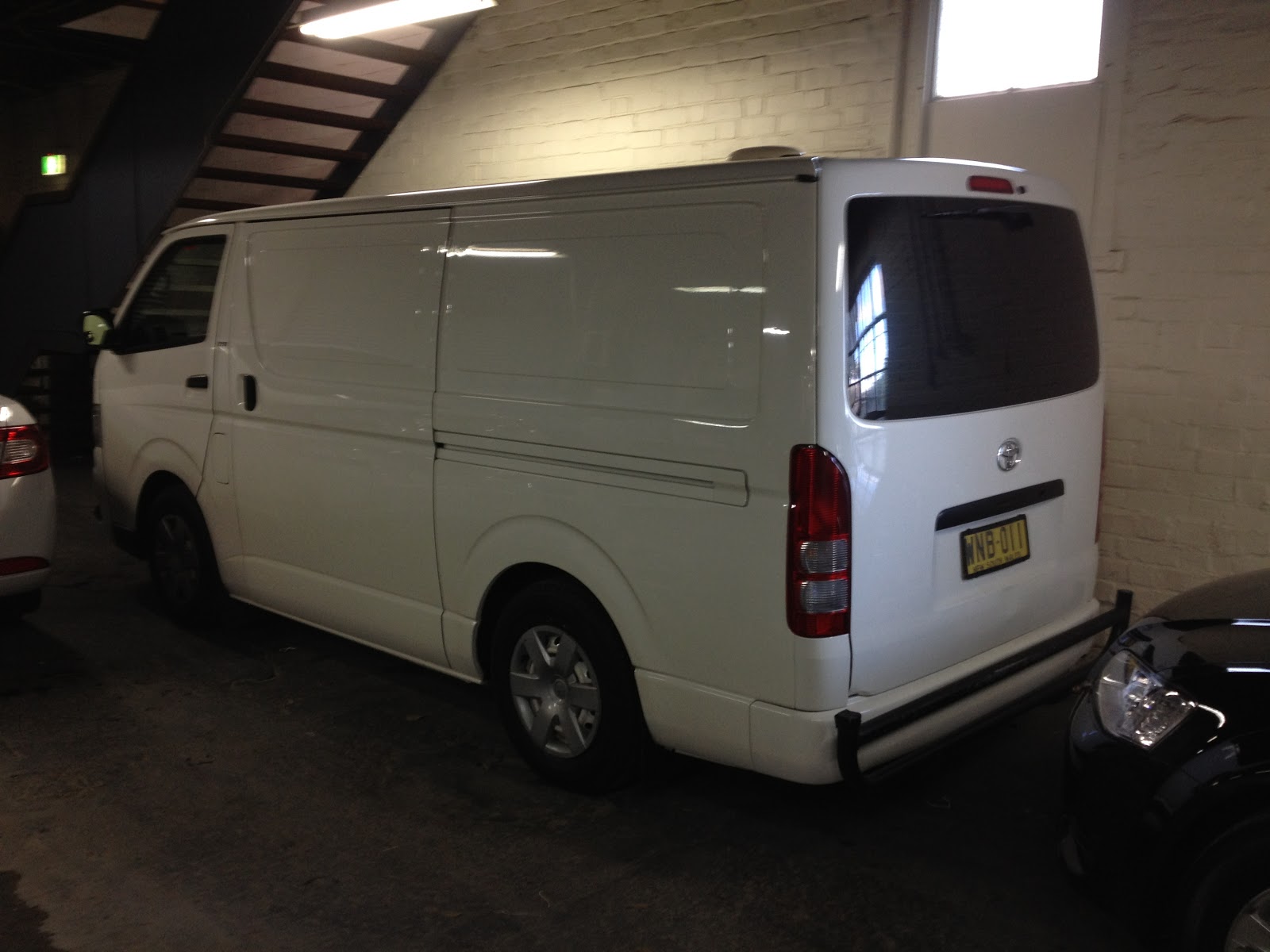
    Now for the transfer vehicle itself.  The most common is the Toyota Hiace (pictured right and below) as it is cheap, practical and so reliable.  The Hiace is used by 'Statewide' and 'Mortuary Services Support' (dedicated transfer companies) and many funeral homes.  It is just such a reliable van, I remember how we would run our Hiace up and down freeways for days on end and it never missed a beat.  Plus it is actually quite cheap (to run and buy) which makes it quite a good option from a financial point of view for the company.  All of this is exactly what one wants in the transfer car, last thing anyone wants is to be broken down with a body on board.  The next most common would be a basic Mercedes Van, this is used primarily be InvoCare transfer crews.  It is more expensive to buy than the Hiace, but InvoCare is not just rich, they are also happy and willing to spend money if it is justified.  The Mercedes is a much nicer van inside and outside with better airconditioning and more legroom for the drivers.  However there are other much less common transfer vehicles, I remember an interstate transfer company arrived with a really odd custom built car.  It was like a ute which's tray was a large single and sealed box.  This thing was apparently from the 1980s and on its second engine, which had done over 5 million kilometres.

    Because the Toyota Hiace is the most common transfer vehicle I will primarily look at this as the example of the transfer van.  In the back of the Hiace is an automatic 'lift' (pictured below) which can be raised or lowered.  This makes it possible for the van to hold four bodies at once and because the lift can be lowered it makes 'loading up' the body much easier.  One can simply lower the lift to waist hight rather than have to lift the body to head hight.  Inside the Hiace there is the divider, this divider is not only the airtight seal but also practical because it has so many shelves.  Here is where we keep the body bags, slide sheets, gloves, hand sanitisers, street map and so on.

    One massive drawback to the Hiace is that it is rather top heavy once the lift is installed.  A transfer van, exactly the same as the one featured in this post, actually flipped on its side in Melbourne only a couple of years ago.  When driving it you could really feel this top heaviness.  It was obviously impossible to take any corner too fast or the van would fall over.


Inside the cabin of the Hiace.

Inside the back of the Hiace with the lift raised.

Inside the back of the Hiace with the lift lowered.

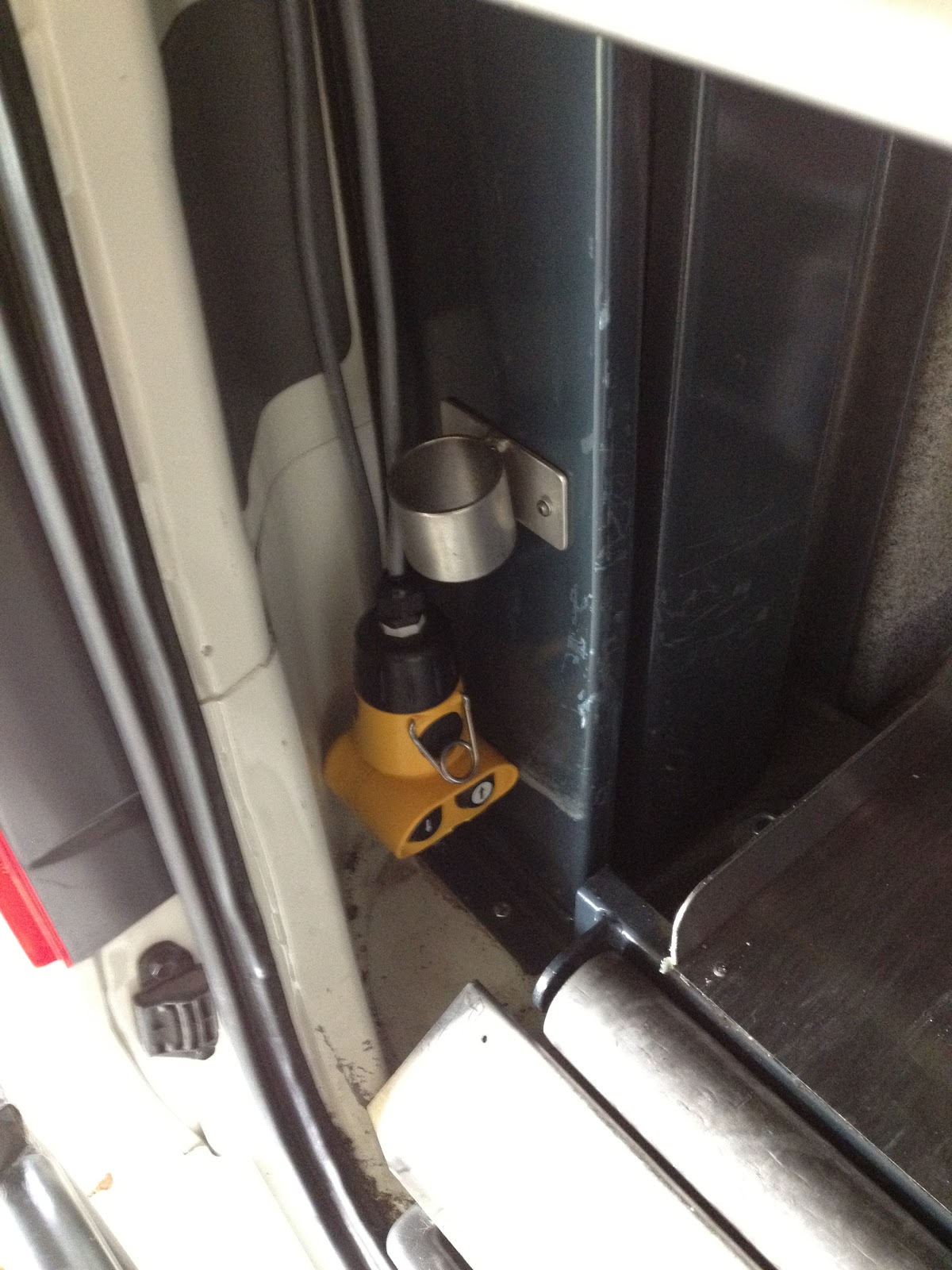
The switch to raise and lower the lift.

Stretchers sitting inside the van.

The clamp used to keep the stretchers in place.
Our transfer van, back in the garage after a long day.
The transfer stretchers.
The leg-less one is lying upside down and on top of the one with legs

Inside the transfer van with no stretchers.


    This is what we will all ride in one day, a white van.  It is literally the second last thing most people will be driven in after they die (the last being the hearse).

~~

2012-02-13

My First Transfer

   In about my second week at the funeral home they sent me on my first transfer.  It was over at St Vincents Public Hospital.  I still remember it; the anticipation, the nervousness, the excitement.  I had no idea what to expect.  While they had explained ‘transfers’ to me a couple of times I had never actually seen one let alone been on one.  And here I was, going to collect my first body from a hospital.  Transfers are a two person operation, in this case the guy who went with me was a veteran of the industry.  ‘Garry’ has been doing transfers and working funerals for longer than I have been alive.  And it shows as he is quite good at it.  In fact he is very good at just about everything he does and he would later become my favourite hearse driver.

   At this time we still had the Ford Falcon station-wagon.  This held only two stretchers at a time but was a little more palatable than the van.  So we would use it for quick or nursing home transfers.  Garry and I hoped in the wagon, he drove while i held the paperwork.  They explained that I would have to check everything, but I knew he would be looking over my shoulder to make sure I got it right.  Which actually made me feel better that there would be less chance of a mistake, but also worse as I had someone watching my every move.


   He made sure to explain the process to me as we drove out.  How he would be looking over what I did, for my sake as much as anything else.  That discretion and appropriate behaviour was always crucial.   He told me the sort of things to look for on a DC or CC and how imporant they are.  Then he told me about a couple of stories from his transfer days.  The usual things about how hospitals work, nothing special.


   We arrived at the hospital and headed in to reception together.  He introduced me to the receptionist, a nice older lady behind the large desk.  She handed me the appropriate papers and then we headed off to the mortuary.  He drove up what looked like a park, ignoring and passing several ‘No Entry’ signs as he did so.  I assumed this was alright, but was still surprised.


   Upon arriving at the mortuary he started to reverse up into the garage.  This is when I first noticed that due to the capsule to contain and hide the stretchers the back window was completely blacked out.  The only way to see behind was through the wing mirrors.  And yet the middle rear-view mirror remained attached to the windscreen.  Noticing me see the mirror he commented that it was being kept there as they intended to sell the car later and removing it would count as an after market modification.  Which could reduce its value.  It was funny how we could be talking about the resale value of a car while picking up a body from the hospital.


   Even though the rear vision was limited to two wing-mirrors he reversed it in without issue.  Obviously he had done this many times before.  Now we were inside he showed me the stretcher.  Something I had never seen in action before.  It was relatively simple once you got the idea.  He demonstrated how to grab the stretcher and squeeze a little handle on the right as you pulled it out.  This made the legs fold down.  Then he put it back in, squeezing the same handle just as the first legs of the stretcher kissed the back of the car.  He gave me a go at it, although I had trouble at first by the second or third time it was easy.


   This was all done while the mortician got the body out.  This mortician is a very nice guy, easy to get along with and very professional.  So he had no issue with us having a little practice in the garage.  Actually he was taking great amusement and interest in the whole spectacle.  Garry and the mortician obviously knew each other exchanging pleasantries and asking how each others kids were; after all they had been working together for decades.  As we entered the mortuary Garry grabbed some gloves out of a box on the wall, as he did so he informed me that all hospitals would have gloves.  But not nursing homes or the coroners.


   The mortuary was connected directly to the small garage by a roller door.  It had a white roof with creme walls and a floor to match.  The fluro lights gave it a cold and very bright atmosphere.  An old computer sat quietly on one side by a large square cut into the floor.  I would later learn that this square was actually a weighing machine and was in just about every hospital.  On the other side of the room proudly stood a row of stainless steel draws.  They glistened under the fluro lighting.  In the middle of the room was a trolley with a long blue lumpy bad on it.  Inside the bag was the body.


   The mortician and Garry then showed me how to check the body for valuables and put on the wrist tag.  Garry then signed the mortuary book, showing me how to do so as he did it.  Next we all stood opposite the our stretcher and grabbed the body bag together.  Then we pulled him across onto our stretcher.  Our stretcher come with two seat-belts, one set at the foot end and one set at the head end.  We buckled then tightened these to prevent the body moving about on the stretcher.


   Finally we were ready to load the stretcher into our wagon.  Loading the stretcher was more difficult with weight on it.  Although it was not perfect I got it in.  We said our goodbyes to the mortician and moved off.


   Back at the base we revered up to the mortuary and unloaded the stretcher.  Then we transferred the body to one of our trays.  Garry and I then filled out our whiteboard and mortuary book together before I took the paperwork into the office as he put the wagon away.

~~