I recently got a question about how bodies are processed in Sydney. As in what happens to the dead between death and the funeral. It is a rather interesting question many of us never think of.
So far I have found nobody has an issue with knowing the details (so long as they are not too graphic) about what happens. In fact most people are rather interested in it. However many think of this as a 'taboo' subject. Well, actually that is not quite true, people think others think death is taboo. They themselves do not see it as taboo or something to avoid but think most other people do. As such they avoid this topic to avoid offending or upsetting people.
We do not avoid this topic because it is taboo. We avoid it to avoid upsetting others. And we also know so little about it. How does your water make it into your tap? Something most cannot answer, not because it is taboo or upsetting but because they simply do not know.


2012-06-08
Death & Sex Difference
I always find the sex difference with death to be quite interesting. That women live longer and men are more likely to die young. Thus I thought it was time for a little bit of social sciences and statistics. In this post I look briefly at differences in deaths related to sex. I do not look at race or location, although there are some interesting numbers there.
2012-06-05
American & Australian Style Lowering
I found this American product video demonstrating two automatic lowering devices for the graveside. It made me think of the difference between American funeral and Australian funerals. Many conductors here in Australia do not like the American lowering system. Continue on for the video!
2012-06-04
Funeral Fun - Broken down in the cemetery
A breakdown is never a fun thing. Especially in the funeral industry. Even more so in a cemetery during a funeral! But this is exactly what happened one hot summer day.
This is the story of how our hearse broke down in a cemetery, during a funeral, and how a gravedigger came to our rescue.
This is the story of how our hearse broke down in a cemetery, during a funeral, and how a gravedigger came to our rescue.
2012-06-03
Survey Reminder
If you haven't already done so I would like to as people to answer my short survey. It shouldn't take too long and I would greatly appreciate the answers. Either way thank you for participating and thank you for reading this blog :)
>> Click here to do the survey << (if you have trouble clicking here the link is also at the end).
As always the responses will be anonymous and confidential!! But if there are any issues or questions about the survey feel free to contact me.
So far the answers are proving to be very interesting and somewhat surprising. When I get more responses I can put the data together and make a detailed post about it. For example almost everyone has attended over 5 funerals. This trend remains stable across all age groups, the young and old have generally been to more than 5 funerals. This is surprising to me as I expected most people would have been to 2-4 funerals. Also that almost nobody remembers the funeral home who took care of the most recent funeral they attended.
These are just a few of many interesting and surprising results. So if I can get more data perhaps I can discover even more!
~~
https://docs.google.com/spreadsheet/viewform?formkey=dFV5TlFvaF80ZGxUU3Z6ejFvcndzRHc6MQ
>> Click here to do the survey << (if you have trouble clicking here the link is also at the end).
As always the responses will be anonymous and confidential!! But if there are any issues or questions about the survey feel free to contact me.
So far the answers are proving to be very interesting and somewhat surprising. When I get more responses I can put the data together and make a detailed post about it. For example almost everyone has attended over 5 funerals. This trend remains stable across all age groups, the young and old have generally been to more than 5 funerals. This is surprising to me as I expected most people would have been to 2-4 funerals. Also that almost nobody remembers the funeral home who took care of the most recent funeral they attended.
These are just a few of many interesting and surprising results. So if I can get more data perhaps I can discover even more!
~~
https://docs.google.com/spreadsheet/viewform?formkey=dFV5TlFvaF80ZGxUU3Z6ejFvcndzRHc6MQ
Attending a Funeral - Driving in cortege
I that i tend to get questions following my posts on how to attend funerals. People appear nervous, unsure and generally hesitant. Who can blame them, funerals are a tense thing to the inexperienced and many of us are inexperienced with them. Thus I thought a few posts detailing the mist important or tricky parts of the funeral could help. Starting with one of the most difficult and stressful parts for many mourners, driving in cortege.
Driving in cortege is the act of following a hearse (or any other lead car). You will be driving quickly and closely behind a hearse or other cars. This makes it tricky and worrying. Yet this was my favourite part of working funerals. It can be quite easy and simple as long as you think ahead and apply some common sense.
This post is for mourners, however I will write another post about hot to drive in cortege as a funeral director. This is because driving as a mourner and as an undertaker are very different. Comparing both posts might be interesting or helpful. I do go over driving a funeral car in this post here. But I want another new posts focusing on driving in cortege.
Anyway, here is how to drive in a cortege from a mourners perspective:
Driving in cortege is the act of following a hearse (or any other lead car). You will be driving quickly and closely behind a hearse or other cars. This makes it tricky and worrying. Yet this was my favourite part of working funerals. It can be quite easy and simple as long as you think ahead and apply some common sense.
This post is for mourners, however I will write another post about hot to drive in cortege as a funeral director. This is because driving as a mourner and as an undertaker are very different. Comparing both posts might be interesting or helpful. I do go over driving a funeral car in this post here. But I want another new posts focusing on driving in cortege.
Anyway, here is how to drive in a cortege from a mourners perspective:
2012-05-30
Funeral Fun - Leaky coffin

After placing the coffin down I turned around and saw one or two pinky splash marks on the floor. I instantly knew they were most likely from the coffin. They looked fresh and where right where we had carried the coffin. I immediately told the conductor, who then very subtly went up and felt the coffin. It was dry around all sides, so if it had leaked it was not still leaking. Next we went to inspect the hearse.
Sure enough there was a small puddle in the back where the coffin had been. The pink and sticky fluid sat there proudly. Better still it had also slipped through the rollers into the underneath of the hearse (where we kept many handy things such as tables, umbrellas, chairs, and so on). In other words this fluid was all through his hearse.
Due to the schedule this hearse then spent the rest of the day sitting in the summer sun. Nobody had time to clean the fluids out, so they baked on. When we brought the hearse back to the garage and informed the driver he was not happy. He always tried to take care of his hearse, always looked after it and felt for it. So to find it with sticky and not hard pinkish fluids all through made him upset.
Naturally we all suddenly had lots of work to do and were unable to help him clean the fluids. But we did pop by every now and then to tell him if he had missed a spot.
Overall it was a rather funny and unusual event. Well, funny for everyone except the hearse driver, although even he saw the humour.
~~
Funeral Fun - Emptying the crypt
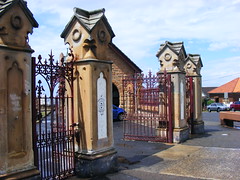 |
| Gates into Waverley Cemetery. |
Basically the job was to move five coffins in a crypt so it could be renovated. I had never been in a crypt before but had heard stories. People described them as dark, damp, dirty, small, boring and slippery. So I was actually rather excited and looking forward to it.
The day before we took the stretchers out of the transfer van and filled it with things we might need. Such as boards, ropes, torches and so on. Just a variety of things that might be handy if needed. I was put in the van and sent on a funeral first. This meant I had to bring a more 'practical' set of cloths as my three piece funeral suit would not be suitable for pulling coffins out of a crypt.
After the funeral I made my way over to Waverley Cemetery where the crypt was. As usual I was the first to arrive and so I had plenty of time to sit and eat my lunch. After all I would soon need my energy. I sat near the gate so that it was in sight but I was hidden. It was starting to turn into a miserable day, it was cold, overcast and looked like rain. Hardly the sort of weather we wanted.
Not too much later everyone else started to arrive and we made our way to the crypt. As they set up I changed into the more suitable work clothes. It had started to spit rain very lightly and then stopped, I remember one of the other undertakers commenting that he hopped the rain would keep away, even for a little bit.
When they had opened the door and set up we went inside to assess the situation. The job involved taking four adult coffins and one baby coffin off shelves and then taking them down one level into a room underneath the crypt. Unfortunately the door to the basement room under the crypt was directly infront of the door to the crypt itself and actually very small. It was not so much a 'door' as a small and steep hole with some stairs. Even better this hole was right in front of the door to the upper level. So we had to cover it up with boards to be able to get in and out of the upper level. Then we would have to uncover it to get to the bottom level.
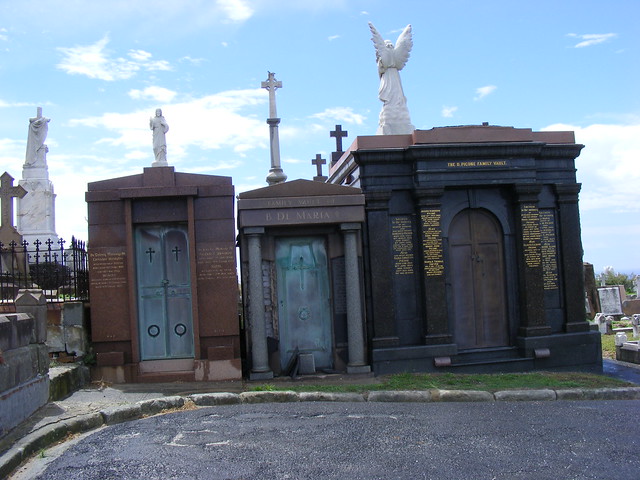 |
| Three crypts at Waverley, the one of the right is very similar to the one we worked out of. |
And there were only four of us. The grave diggers were not allowed to help due to OH&S issues. They obviously felt sorry for us and helped how they could, in fact a couple got quite actively involved. But they were council employees and council diggers cannot by law do certain things. Such as move coffins (like lowering or carrying them) and so on. All due to OH&S and insurance issues.
But what could we do? There were only four of us and the poor family had waited months for the job to be done. But our boss had been putting it off. And a family member was present through the job, he was obviously very upset at seeing his family being moved about but he was also extremely grateful.
We set to work and moved the two easiest coffins out first. I remember thinking how difficult it was, that these two coffins were so heavy and how little room there was. Little did I know that this would be the easiest part of the job. After taking the two coffins out we loaded them into the back of the van. Then we uncovered the hole to the bottom level and started to take the coffins down.
Here was the trouble, the hole was just big enough to fit the coffins and very step. We had to tie the coffin with rops, lower it foot first down the hole, then send the smaller person to squeeze between the coffin and the hole and direct it as the others continued to lower. Guess who was the 'smaller' person, me! I was to squeeze myself down the hole and direct the coffin until there was enough room for the others to come down and help me.
This is how we got the first coffin into the room. But then we had to get it on a shelf. Because of the lack of room and steepness of the hole we could barely raise the foot end of the coffin to get it onto the shelf. It kept getting caught on the walls, and with its heavy weight we had a lot of trouble. But we did it, the first two coffins were on the shelves and done.
Now it got hard. The next two coffins were bigger, heavier, had no handels and were higher. We lifted them up onto sticks while still on the shelves, then we tied ropes around them. Next I climbed up to the top shelf of the crypt (which had nothing on it except debris and dirt). I had to lie on this shelf as it was close to the roof and then take a rope to help swing the coffin out. So there I lay, in the dirt on a cold shelf in a crypt. All while swinging a heavy coffin down.
With a lot of trouble and effort we got the last two coffins out. But they were larger, so getting them down the hole was more difficult. I remember at one point another undertaker getting his pants caught on the coffin as he tried to squeeze past it to get down the hole. It was quite funny actually, seing him stuck there by his pants to a coffin! Even he thought it was funny. But then the supervisor reminded us that the family was watching and we had to stop giggling.
In the end we got the job done, but it was very dirty and a lot of work. When we finished the family member thanked us all personally, he was very grateful for the job and thought we had done well. And I had so much fun doing it, we all did. As difficult and dirty as it was it was also very rewarding and seing the job finished was so satisfying. I really enjoyed the day and the job with good people.
~~
2012-05-26
Attending a Funeral - Cemetery tips
One big thing to remember is that the cemetery is almost exactly like the beach. It is hot in summer and cold in winter, the ground is soft and slippery, there is limited parking, there is basically no shelter from the rain or sun. Overall think of going to the cemetery as going to the beach in formal clothing.
- Do not worry: Unfortunately a lot of people have issues with cemeteries. However cemeteries are not spiritual, not creepy, they're just a place. And they're everywhere. Sydney Town Hall Station is built on an old cemetery and when they were building Town Hall they never found all the bodies. Cemeteries are scattered and forgotten under many cities, especially older cities. So chances are you walk through them regularly. Cemeteries are just spaces, and often quite beautiful spaces. Waverley cemetery is one of the most beautiful places in Sydney with the right light. In the end a cemetery is what you make of it. So make it what you want it to be.
- Look up the time and location: As with almost all my funeral tips knowing where and when you should be is key. Look up the address and directions before the day. It is rather embarrising to get lost on the way to a funeral Most cemeteries cannot be put into a GPS, and even then people get lost within the cemetery grounds.
- Find the grave: Do not bet on following a cortege to find the grave. If you get lost, separated or there is no cortege contact the cemetery office. The office details can be found by simply 'googeling' the cemetery name. Many cemetery websites also have downloadable maps to help navigate the place. Cemeteries are like mazes, there is something that makes most of them difficult to navigate.
- Umbrella: Bring one or two even if there is no chance for rain. They are a great source of shade which will keep you cool and comfortable. The funeral directors should provide umbrellas if you ask (you can even keep it if they aren't looking as you leave). However do not rely on this and be prepared.
- Water: This one is obvious but so many people forget. Bring a small bottle of water and sip at it just before, during and after the service. Being in a cemetery is surprisingly dehydrating even in cool weather. And it is always better to risk needing to go to the bathroom over risking fainting due to dehydration/heatstroke (which I have seen happen). Australia is hot, be read for it.
- Sunscreen: Again, this should be obvious and if you do not bring and use sunscreen on sunny days it is your own loss. Skin cancer is a big issue in Australia and sunscreen is cheap and easy, so why not?
- Chairs: Funeral homes and cemeteries should provide some chairs. But does not always happen, and even then they will usually only provide 4 to 6 chairs. So if chairs are needed make sure the funeral home knows before the day and how many they will need. Or bring a few chairs yourself if you are able.
- Stay out of the way: Keep out of the way of funeral and other staff. If they look like they need help then offer, but otherwise let them do their job. This makes everything go quicker and smother for everyone.
- Keep up and keep together: Most cemeteries are big or confusing places with narrow and twisty roads. It is incredibly embarrassing to get lost only a corner away from the grave. So do not fall behind and stay behind the hearse.
- Do NOT get out until the right time: At almost every cemetery the cortege will stop by an office to get paperwork before going to the grave. These offices usually have a car park and toilets, so quite often people will park thinking that this is where they should stop. Next thing they know the hearse and other cars have gone leaving them lost and alone. It happens too often, even if the funeral staff warn people. So STAY IN YOUR CAR until you either see the grave itself (make sure it is the right one though) and/or it is obvious that the cortege has arrived. You know this has happened when all the undertakers get out of their cars/hearse and not just one person.
- Walk: You do not have to park right next to the grave. Sometimes you it is dangerous or inappropriate to park close by and you will just take a space of an older or less able person who cannot walk far or over rough terrain. Other times your car will get in the way of staff or other funeral processions, so do not park on corners, do not park too close together and be ready for a short 2 minute walk. I will say I find it is generally but not always SUVs (o four wheel drives) that park inappropriately in their attempt to get as close as possible.
- Wear appropriate shoes: The ground at cemeteries is spongy, slippery and soft, so wear shoes for this. The most common inappropriate shoe is a stiletto. I have seen women seriously damage their ankles because of their shoes. And I have no sympathy for them. To wear high stilettos to a cemetery is stupid and dangerous. It will inconvenience everyone and just make the person with the shoes look silly. It is better to wear sneakers or boots and look a little strange than bend an ankle in front of everyone.
- Mud, live with it: Cemeteries are dirty places, there is a lot of digging going on and as such there is a lot of lose dirt. So when it rains there is a lot of mud. Live with it and deal with it later. There is no point holding people up while you scrape the mud off your shoes before you get in the car. Simply get the bigger lumps off, get in the car and more out of the way of others. Once the mud dries it will scrape off very easily and usually as people try to clean it off their shoes they spread it over their clothes. If desperte use the corner of gutters or grates of drains to scrape away mud. Tissues are also handy.
- Know how to drive: Most cemeteries, especially old ones, tend to have narrow streets. With tight corners, slopes, and dead ends. Driving through a cemetery may mean squeezing down a narrow street between graves and cars. Or perhaps you will have to go around an incredibly tight corner. Either way, knowing how to drive will help.
Just remember, think of the cemetery as the beach. Prepare for it in the same way except you will be wearing formal clothing.
If there's any specific questions or concerns not addressed here feel free to contact me and I if I can I will help however possible.
~~
An Unregulated Industry
One thing that shocked me about the industry was the sheer lack of rules or regulations. There is pretty much no governing body to watch over what goes on and no real repercussions in many cases. Talking with several undertakers they all spoke of a desire for more regulation and how others have tried over the years and failed miserably. They said the industry has never been regulated and have depressingly resigned themselves to the thought that it never will be.
You need no qualifications to join the industry, a drivers license is useful but not essential in certain situations. There is also no age restriction, one undertaker now a veteran in his own ways told me how he joined the industry at 15 as part of school work experience. His first transfer was a gruesome affair where the deceased had been cut in half in an industrial accident. The job involved buckets and scooping, and this was one of his first days at only 15. Now, some may think that this was quite a while ago yet it was only in the late 1980s that this happened. I have no doubts that there is potential for this to still happen at certain companies. Anyone can join the industry at any age if the company is willing to employ them.
The pay for an undertaker (also known as "assistant funeral director") is little more than minimal wage. The wage is about $20 per hour for full time staff, at the entry level. I have heard that conductors with some companies earn an extra $17 per week on top of this. These are the people who run the funeral on the day. When paying so little one cannot expect high quality staff as anyone who wants more than this and is able to earn it will go elsewhere.
Some of the larger funeral companies such as InvoCare are pushing more and more casual staff to save money. The situation with embalmers is not much better. These casual staff have less experience and training, being casual they only work when needed where needed. The situation is not much better for embalmers. While there is a shortage of embalmers across Sydney they are not paid enough and companies are going for contract or casual embalmers.
The lack of experience of staff is an issue for some companies. As no experience or qualifications are needed some join the industry with nothing to help them. They need to be trained from scratch in everything. Many might think of this as a normal thing for most companies, many join jobs without experience or knowledge and leran as they go. In itself this is not too much of an issue for the funeral industry, however there are certain things and hazards people need to know before starting. this makes starting the job safer and easier for new staff as well as easier for further training the new staff. I remember in retail there is an briefe induction course before starting work, with Target it was over two days and with BigW it was a more intense one day course. These courses covered basic OH&S, security, policy, practices and so on. Basically all the little and important things that should be gotten out of the way. Yet in the funeral industry where there is exposure to infectious fluids, lots of manual lifting, driving, etc there is no induction course or training. I will say InvoCare is outstanding in providing these courses to staff, but it is done after they join. Instead it should be before they join the industry. What good are these courses to someone who has almost a years experience? By then they would have learnt most of what is taught and been exposed to the hazards the courses aim to warn about.
Another issue with the delegalisation is that ordinary undertakers are the ones who transfer bodies on crime scenes. With murders, suicides, accidents or so on it is an undertaker who will arrive with their van and move the body to the coroners for examination. Letting just anybody move the body means that the government has no real control over how the body is moved. Evidence could be compromised or outright destroyed with mismanaging the body as the undertakers are not trained in forensic techniques. Many undertakers formal education stops at finishing high school and there is no training provided or needed for police transfers.
There is also little to no protective equipment provided to the transfer crews. On a police job they have shower-caps on their feet, but otherwise it's like any other transfer. They have basic gloves and nothing else, and these gloves are not even sharps/puncture proof like the police gloves. An undertaker told me of how he had to transfer a body from a murder. There was blood and needles everywhere and the deceased had HIV and hep C. The police refused to lend him their sharps proof gloves for the job. Another undertaker told me of how the deceased had died on train tracks in a tunnel the city. As they were getting the body one of the police yelled "train" and they had to squeeze against the walls as a train went past. CityRail has extremely strickt rules and requirements about who can step on the tracks, especially active ones yet these were not applied to the transfer crew. Nor was the track shut down. And this was not an old story, it happened in the 80s-90s. An undertaker also told me of another police transfer where a family member had "lost it" and killed the family violently, they had also brutally killed the family cat. He said how everything went as usual, they removed the bodies of the people, yet the cat was different. The police put it in a garbage bag and left it on the street for the garbage truck. While not directly related to the lack of regulation in the industry it does speak of how things are sometimes seen or done because of this deregulation.
There are no official governing bodies to watch over the industry and few laws or regulations directed at it. Nor are there any real consequences for violating what rules there are. There the Australian Funeral Directors Association (AFDA), yet membership is voluntary and from what I see they do not oversee or enforce much. So long as certain basics are met and fees are paid membership is guaranteed. The infamous story of 'bricky' is a good example. I explain in detail in this post here, but basically he is an undertaker who buried a coffin of bricks because he cremated the wrong body. So now the industry refers to him as 'bricky'. When they exhumed the coffin the person in charge opened the lid further than allowed and this meant the health department no longer had jurisdiction. Instead it had to fall under a commercial framework and was taken to court that the family did not get what they paid for. Bricky was found guilty, fined a few thousand and let go. The case was very public making national news at the time. Yet his business actually increased, not only was he able to continue in the industry with nothing more than a light punishment but he was better for it. He later went on to stalk a woman with a hearse at night, but that's a whole other story. I also heard of another much older story where the owner of a funeral home opened all the windows in a nursing home in the middle of winter. He was at the nursing home on a transfer to remove a body and while there he thought that he might try to increase his business.
Not all funeral directors are decent people, although most are. Some are not even real funeral directors having never worked on a funeral in their lives. They do not even have a physical business and yet they sell funerals. They're called "briefcase funeral directors" as all they have is a briefcase and a phone. Everything else they rent out, they rent a temporary transfer crew (as one would rent a courier), they rent a hearse and a space in a mortuary and have no ownership over anything. As a result they have no quality control or even the ability to check the process and I have heard of serious mistakes being made. The reason they own nothing is it is cheap, they do not have to pay for staff or facilities and save a lot of money compared to funeral homes. However these savings are not really passed onto families, they may pay less than with other funeral places but the briefcase funeral director will still make a large profit. Lack of quality control, room for mistakes and over charging mourners are the outcomes of this type of business. But what of the AFDA as many would assume their job was to oversee the industry? As I outlined membership is optional and even then not difficult to acquire. Furthermore if a company is not a member most mourners would never know or care. Thus there is plenty of room for just anyone to become a funeral director, even if they have nothing.
There is a union for those in the industry, however despite my best efforts I cannot find a website for it, perhaps one does not exist. Also few people in the industry I met were part of this union. Thus I find it hard to look into the union. From what I found it does help people, one undertaker told me of how it really had his back in a pay dispute with a company and if it wasn't for the union he would have lost a lot of money. However I do not think the union has as much influence as it should. I will briefly say that I am a capitalist through and through. But capitalism needs unions to give companies perspective and help keeps things safe and decent for staff. I was surprised how the union was almost hidden from staff, the boss at WNBull would deliberately not put up and remove any notices from or about the union. I was reminded of my time in retail where all staff were told of the retail union in their initial training, in fact we were actively encouraged to join the union by the companies. Target and BigW both advertised and encouraged membership officially and unofficially despite butting heads with the unions on several occasions. Instead with the funeral industry the AFDA is completely optional and the union has low membership. Thus there is little influence or power from these groups. I saw that InvoCare monitored and protected its own staff more than these groups.
There is a story of an ex-InvoCare employee who would make a small cut on the bodies they dressed or prepared. Quite a 'strange' and completely immoral practice. InvoCare fired this person on the spot as soon as they found out, walking them off the premises and making sure they never worked in another InvoCare funeral home ever again. Unfortunately they did not take it further, I personally think that they did not want it to become public as it would give InvoCare a bad name. Yet I think they handled it well, firing the person the very moment they became aware and making sure it would not happen again. This shows how InvoCare regulates itself with nobody to watch over them. While they do a decent job certain people can walk away without punishment or inquiry that is deserved in order to protect the company.
If anyone is going to change the industry for the better it would be InvoCare. Due to their dominance they have the power and potential to implement and effect changes. And after my briefe time with them I honestly believe that many of the higher ups do care. For example the head of HR was a lovely woman who gave me the impression that she did not just implement OH&S because she had to but because she thought of the welfare of her co-workers. InvoCare has more potential than any other group to make the changes that are needed. While I hope they do start to change things I know they wont. Not because they do not want to but because there is no profit in it. It is not a cruel company, it is efficient and the heart of InvoCare is 'profit' (like any other business). There is no profit to be made (or lost) in regulating the industry and so they will not do it. Simple and regretful as at the end it is everyone who suffers. Staff risk their safety, the companies risk efficiency the deceased risk their dignity, mourners risk quality and the legal system risks evidence...
I honestly believe that a license is needed to be an undertaker, that it could reduce the risks and issues. Or in the least weed out the people not appropriate for the industry.
~~
You need no qualifications to join the industry, a drivers license is useful but not essential in certain situations. There is also no age restriction, one undertaker now a veteran in his own ways told me how he joined the industry at 15 as part of school work experience. His first transfer was a gruesome affair where the deceased had been cut in half in an industrial accident. The job involved buckets and scooping, and this was one of his first days at only 15. Now, some may think that this was quite a while ago yet it was only in the late 1980s that this happened. I have no doubts that there is potential for this to still happen at certain companies. Anyone can join the industry at any age if the company is willing to employ them.
The pay for an undertaker (also known as "assistant funeral director") is little more than minimal wage. The wage is about $20 per hour for full time staff, at the entry level. I have heard that conductors with some companies earn an extra $17 per week on top of this. These are the people who run the funeral on the day. When paying so little one cannot expect high quality staff as anyone who wants more than this and is able to earn it will go elsewhere.
Some of the larger funeral companies such as InvoCare are pushing more and more casual staff to save money. The situation with embalmers is not much better. These casual staff have less experience and training, being casual they only work when needed where needed. The situation is not much better for embalmers. While there is a shortage of embalmers across Sydney they are not paid enough and companies are going for contract or casual embalmers.
The lack of experience of staff is an issue for some companies. As no experience or qualifications are needed some join the industry with nothing to help them. They need to be trained from scratch in everything. Many might think of this as a normal thing for most companies, many join jobs without experience or knowledge and leran as they go. In itself this is not too much of an issue for the funeral industry, however there are certain things and hazards people need to know before starting. this makes starting the job safer and easier for new staff as well as easier for further training the new staff. I remember in retail there is an briefe induction course before starting work, with Target it was over two days and with BigW it was a more intense one day course. These courses covered basic OH&S, security, policy, practices and so on. Basically all the little and important things that should be gotten out of the way. Yet in the funeral industry where there is exposure to infectious fluids, lots of manual lifting, driving, etc there is no induction course or training. I will say InvoCare is outstanding in providing these courses to staff, but it is done after they join. Instead it should be before they join the industry. What good are these courses to someone who has almost a years experience? By then they would have learnt most of what is taught and been exposed to the hazards the courses aim to warn about.
Another issue with the delegalisation is that ordinary undertakers are the ones who transfer bodies on crime scenes. With murders, suicides, accidents or so on it is an undertaker who will arrive with their van and move the body to the coroners for examination. Letting just anybody move the body means that the government has no real control over how the body is moved. Evidence could be compromised or outright destroyed with mismanaging the body as the undertakers are not trained in forensic techniques. Many undertakers formal education stops at finishing high school and there is no training provided or needed for police transfers.
There is also little to no protective equipment provided to the transfer crews. On a police job they have shower-caps on their feet, but otherwise it's like any other transfer. They have basic gloves and nothing else, and these gloves are not even sharps/puncture proof like the police gloves. An undertaker told me of how he had to transfer a body from a murder. There was blood and needles everywhere and the deceased had HIV and hep C. The police refused to lend him their sharps proof gloves for the job. Another undertaker told me of how the deceased had died on train tracks in a tunnel the city. As they were getting the body one of the police yelled "train" and they had to squeeze against the walls as a train went past. CityRail has extremely strickt rules and requirements about who can step on the tracks, especially active ones yet these were not applied to the transfer crew. Nor was the track shut down. And this was not an old story, it happened in the 80s-90s. An undertaker also told me of another police transfer where a family member had "lost it" and killed the family violently, they had also brutally killed the family cat. He said how everything went as usual, they removed the bodies of the people, yet the cat was different. The police put it in a garbage bag and left it on the street for the garbage truck. While not directly related to the lack of regulation in the industry it does speak of how things are sometimes seen or done because of this deregulation.
There are no official governing bodies to watch over the industry and few laws or regulations directed at it. Nor are there any real consequences for violating what rules there are. There the Australian Funeral Directors Association (AFDA), yet membership is voluntary and from what I see they do not oversee or enforce much. So long as certain basics are met and fees are paid membership is guaranteed. The infamous story of 'bricky' is a good example. I explain in detail in this post here, but basically he is an undertaker who buried a coffin of bricks because he cremated the wrong body. So now the industry refers to him as 'bricky'. When they exhumed the coffin the person in charge opened the lid further than allowed and this meant the health department no longer had jurisdiction. Instead it had to fall under a commercial framework and was taken to court that the family did not get what they paid for. Bricky was found guilty, fined a few thousand and let go. The case was very public making national news at the time. Yet his business actually increased, not only was he able to continue in the industry with nothing more than a light punishment but he was better for it. He later went on to stalk a woman with a hearse at night, but that's a whole other story. I also heard of another much older story where the owner of a funeral home opened all the windows in a nursing home in the middle of winter. He was at the nursing home on a transfer to remove a body and while there he thought that he might try to increase his business.
Not all funeral directors are decent people, although most are. Some are not even real funeral directors having never worked on a funeral in their lives. They do not even have a physical business and yet they sell funerals. They're called "briefcase funeral directors" as all they have is a briefcase and a phone. Everything else they rent out, they rent a temporary transfer crew (as one would rent a courier), they rent a hearse and a space in a mortuary and have no ownership over anything. As a result they have no quality control or even the ability to check the process and I have heard of serious mistakes being made. The reason they own nothing is it is cheap, they do not have to pay for staff or facilities and save a lot of money compared to funeral homes. However these savings are not really passed onto families, they may pay less than with other funeral places but the briefcase funeral director will still make a large profit. Lack of quality control, room for mistakes and over charging mourners are the outcomes of this type of business. But what of the AFDA as many would assume their job was to oversee the industry? As I outlined membership is optional and even then not difficult to acquire. Furthermore if a company is not a member most mourners would never know or care. Thus there is plenty of room for just anyone to become a funeral director, even if they have nothing.
There is a union for those in the industry, however despite my best efforts I cannot find a website for it, perhaps one does not exist. Also few people in the industry I met were part of this union. Thus I find it hard to look into the union. From what I found it does help people, one undertaker told me of how it really had his back in a pay dispute with a company and if it wasn't for the union he would have lost a lot of money. However I do not think the union has as much influence as it should. I will briefly say that I am a capitalist through and through. But capitalism needs unions to give companies perspective and help keeps things safe and decent for staff. I was surprised how the union was almost hidden from staff, the boss at WNBull would deliberately not put up and remove any notices from or about the union. I was reminded of my time in retail where all staff were told of the retail union in their initial training, in fact we were actively encouraged to join the union by the companies. Target and BigW both advertised and encouraged membership officially and unofficially despite butting heads with the unions on several occasions. Instead with the funeral industry the AFDA is completely optional and the union has low membership. Thus there is little influence or power from these groups. I saw that InvoCare monitored and protected its own staff more than these groups.
There is a story of an ex-InvoCare employee who would make a small cut on the bodies they dressed or prepared. Quite a 'strange' and completely immoral practice. InvoCare fired this person on the spot as soon as they found out, walking them off the premises and making sure they never worked in another InvoCare funeral home ever again. Unfortunately they did not take it further, I personally think that they did not want it to become public as it would give InvoCare a bad name. Yet I think they handled it well, firing the person the very moment they became aware and making sure it would not happen again. This shows how InvoCare regulates itself with nobody to watch over them. While they do a decent job certain people can walk away without punishment or inquiry that is deserved in order to protect the company.
If anyone is going to change the industry for the better it would be InvoCare. Due to their dominance they have the power and potential to implement and effect changes. And after my briefe time with them I honestly believe that many of the higher ups do care. For example the head of HR was a lovely woman who gave me the impression that she did not just implement OH&S because she had to but because she thought of the welfare of her co-workers. InvoCare has more potential than any other group to make the changes that are needed. While I hope they do start to change things I know they wont. Not because they do not want to but because there is no profit in it. It is not a cruel company, it is efficient and the heart of InvoCare is 'profit' (like any other business). There is no profit to be made (or lost) in regulating the industry and so they will not do it. Simple and regretful as at the end it is everyone who suffers. Staff risk their safety, the companies risk efficiency the deceased risk their dignity, mourners risk quality and the legal system risks evidence...
I honestly believe that a license is needed to be an undertaker, that it could reduce the risks and issues. Or in the least weed out the people not appropriate for the industry.
~~
Subscribe to:
Posts (Atom)